

Getting bail after arrest in India means asking a court to release someone from custody, and the fastest route is usually interim bail first, regular bail second. Interim bail buys time within hours or days; regular bail, filed under Section 480 BNSS, covers the rest of the trial. Which one you file, and in which court, depends on the offence and how much time you have.
Key Takeaways
- Interim bail is temporary: it covers a short, fixed window while a regular or anticipatory bail plea is being heard, per Advocate Gandhi's explainer on interim bail.
- Regular bail lasts the whole case: filed under Section 480 BNSS (formerly Section 437 CrPC), it releases the accused for the duration of investigation and trial, subject to conditions.
- Bailable offences move fast: under Section 478 BNSS, the accused has an absolute right to bail the moment surety is furnished, a right the Supreme Court called "indefeasible" in Rasiklal v. Kishore.
- The court changes with the offence: Magistrate courts handle most first-time regular bail pleas; Sessions Court and High Court step in for serious or rejected cases.
- One lawyer, start to finish, saves time: switching lawyers between arrest and the bail hearing means re-explaining facts under pressure, exactly when speed matters most.
Bail Options at a Glance
| Bail Type | When You Apply | Which Court | Typical Duration |
|---|---|---|---|
| Anticipatory Bail | Before arrest, when fearing one | Sessions Court or High Court | Until confirmed or cancelled |
| Interim Bail | Right after arrest, urgently | Same court hearing the main plea | A few days to a few weeks |
| Regular Bail (bailable offence) | Immediately after arrest | Magistrate / SHO on furnishing surety | Duration of the case |
| Regular Bail (non-bailable offence) | After arrest, on a hearing | Magistrate, then Sessions Court if refused | Duration of the case |
| Regular Bail (serious/NDPS/economic offences) | After arrest, stricter scrutiny | Sessions Court or High Court | Duration of the case, with conditions |
What Happens the Moment Someone Is Arrested
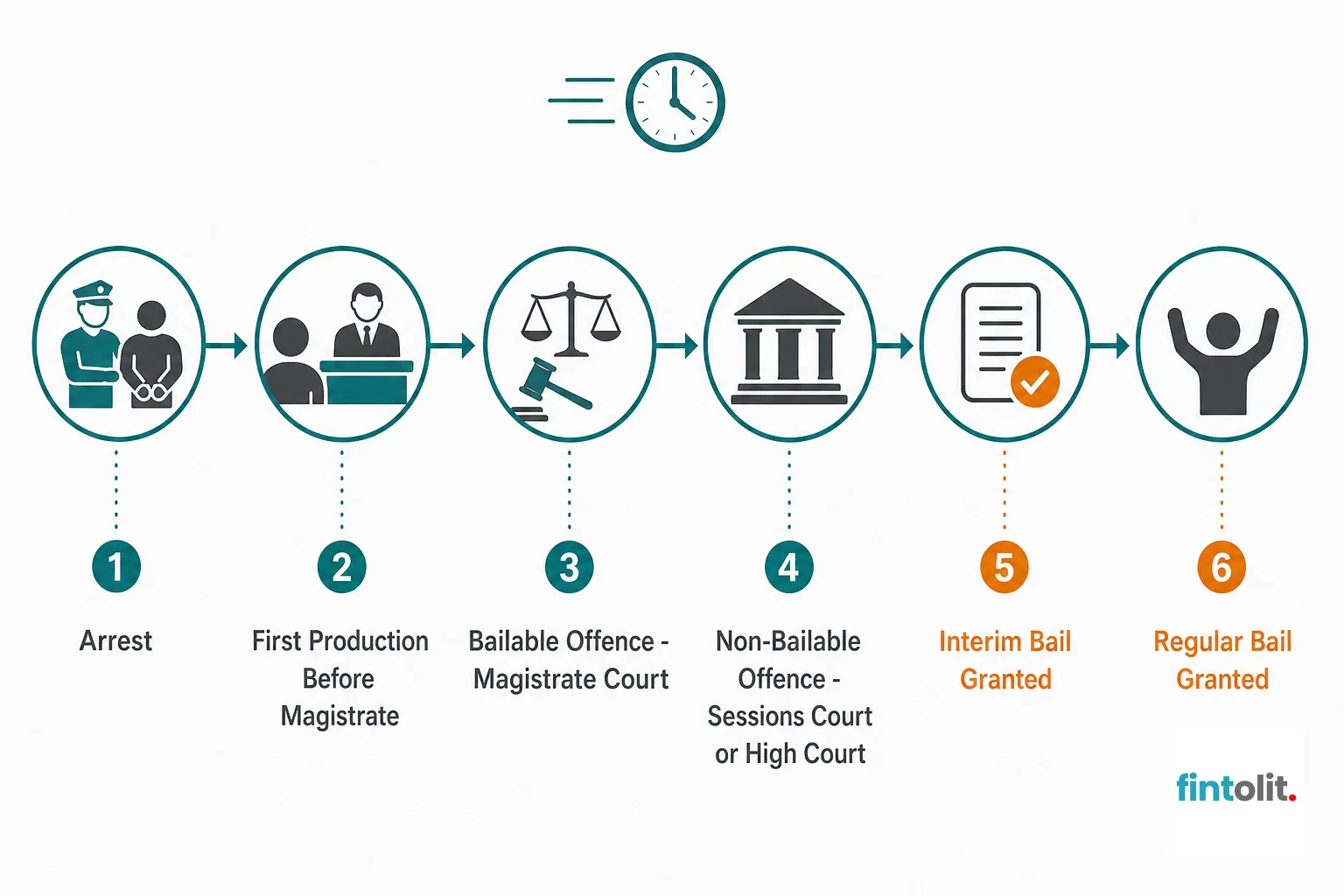
The clock starts the second handcuffs go on. Police must produce the arrested person before a Magistrate within 24 hours, and that first hearing shapes everything that follows.
Families often lose the first few hours to panic, calling relatives, hunting for a lawyer's number, arguing about who should go to the police station. That delay is expensive. A lawyer who arrives at the police station, or joins the first production before the Magistrate, can push for interim bail on the spot instead of waiting for a full hearing days later.
If you're anywhere in Delhi, Gurugram, or Noida, response time matters just as much as legal strategy. A lawyer who can reach a local police station or court within the hour is often the difference between a night in lockup and a same-day release.
What Is Interim Bail and When Should You Ask for It
Interim bail is a short-term release order, not the final word on the case. Courts grant it while they take time to decide the main regular or anticipatory bail application.
Think of it as a bridge. If the Sessions Court needs a week to hear a full regular bail plea, it can grant interim bail for those seven days so the accused isn't sitting in custody while paperwork moves. It comes from the same court that will eventually decide the bigger question, and it usually carries the same kind of conditions: surrender the passport, report to the local station, don't leave the city. Ask for it whenever the wait for a full hearing is longer than a day or two, especially around holidays or when a Sessions Court is dealing with a backlog.
What Is Regular Bail and How Is It Different
Regular bail is what gets someone out of custody for good, not just for a few days. Filed under Section 480 of the Bharatiya Nagarik Suraksha Sanhita, 2023 (BNSS), it applies once a person is already arrested in a non-bailable offence and wants release for as long as the case runs.
Need a Lawyer for clarity on your case?
For a bailable offence, this isn't even a fight. Section 478 BNSS gives the accused a right to walk out the moment surety is arranged, and the police officer in charge can process it without a judge getting involved, as explained by Legal Republic's step-by-step breakdown.
For non-bailable offences, a judge decides. They weigh the nature of the accusation, the accused's criminal history, flight risk, and whether evidence could be tampered with. That judgment call is where a lawyer's argument, and the facts they've had time to prepare, actually decide the outcome.
Which Court Handles Which Bail Application
The court depends on the offence, not on where the arrest happened. Bailable offences usually get sorted at the police station or before the Magistrate the same day. Non-bailable offences start at the Magistrate court, move to Sessions Court if refused, and can go all the way to the High Court in serious matters.
Anticipatory bail works differently again, because it's filed before an arrest happens, not after. If that's your situation rather than a post-arrest one, our detailed breakdown of the anticipatory bail application process walks through what happens court by court. Readers in Gurugram specifically can also check our guide on regular and anticipatory bail lawyers in Gurgaon, since local court timelines vary.
Special statutes change the picture too. Cases under the NDPS Act, for instance, come with tighter bail conditions that don't follow the usual rules, something we cover in depth in our piece on NDPS Act bail conditions in India.
How Fast Can Bail Actually Come Through?
For a bailable offence, release can happen the same day, sometimes within hours of arrest, once surety is furnished. For non-bailable offences, expect anywhere from a few days to a few weeks, depending on how quickly a hearing gets scheduled and whether the first attempt is refused.
Interim bail, when the situation is urgent, can come through faster than any of these, sometimes within a day, precisely because it doesn't require the full weight of evidence to be argued out. Courts grant it to prevent unnecessary custody while they take the time regular bail deserves.
What slows things down almost every time isn't the law. It's paperwork that isn't ready, a surety who hasn't been briefed, or a lawyer meeting the client for the first time an hour before the hearing.
Why the Same Lawyer From Arrest to Bail Hearing Matters
Picture a family that hires one lawyer to sit with the accused at the police station, then a different one, weeks later, to argue the bail plea in Sessions Court. The second lawyer starts from zero. They're reading the FIR for the first time, guessing at what was said in the first 24 hours, and building an argument on secondhand facts.

A lawyer who was there from the first phone call already knows the arrest details, the exact wording of the FIR, and what the client told police. That's not a small edge. In a bail hearing, where a judge is weighing flight risk and the strength of the case in a single sitting, a lawyer who knows the file cold argues faster and more convincingly than one still catching up.
This is the whole idea behind having the same lawyer from consultation to case closure. Fintolit assigns one verified criminal lawyer with 10+ years of experience to a case, backed by a dedicated case manager who keeps the family updated at every stage, so nobody is left guessing what happened at today's hearing.
Documents and Information You Need Ready
Bail hearings move on facts and paperwork, not sympathy. Having these ready before the hearing saves real time:
Need a Lawyer for clarity on your case?
- Copy of the FIR: the exact sections charged decide whether bail is a right or a judge's call.
- Identity and address proof: for both the accused and the person standing surety.
- Surety details: a person willing to guarantee the accused will show up for hearings, with proof of income or property.
- Employer or business letter: useful to show ties to the city and low flight risk.
- Prior case history, if any: courts ask about this directly, and hiding it backfires.
Frequently Asked Questions
How do I find a good lawyer in India for a bail matter?
Look for a criminal lawyer with real courtroom experience in bail matters, not just a general practice. Ask for their track record with similar offences, confirm they'll personally handle your hearings, and check that their profile and background are shared before you commit to anything.
Our guide on how to find a verified lawyer online in India walks through the exact questions to ask before you pay for a consultation.
What do lawyer fees look like for a bail application?
Fees for bail work vary by city, the offence involved, and whether the matter needs a Magistrate hearing or goes up to Sessions Court or High Court. Rather than guess, ask for a fixed, upfront quote before the first hearing so there are no surprises halfway through the case. Our lawyer consultation cost guide breaks down what typically drives these numbers up or down.
Can bail be denied, and what happens next?
Yes. Judges can refuse regular bail if they believe the accused is a flight risk, could tamper with evidence, or the offence is serious enough to warrant custody during trial. A refusal at the Magistrate level isn't the end. The next step is a fresh application before the Sessions Court, and from there, the High Court if needed.
Getting the Timing Right Matters More Than Anything Else
The single biggest mistake families make after an arrest is waiting, hoping the situation resolves itself, or spending the first critical hours searching for a lawyer instead of calling one who already knows the case. Whether it's interim bail to buy time or a regular bail application to close the matter, having someone who understands both the law and the local courts in Delhi, Gurugram, and Noida changes how fast things move.
If someone you know has just been arrested, don't wait for the next hearing date to find representation. Book a consultation with a verified criminal lawyer who can start working the case today, from the first call at the police station through to the bail order itself. For anything urgent outside consultation hours, you can also chat with us on WhatsApp and a case manager will get back to you directly.
Recommended Resources
You're just getting to the good part.