

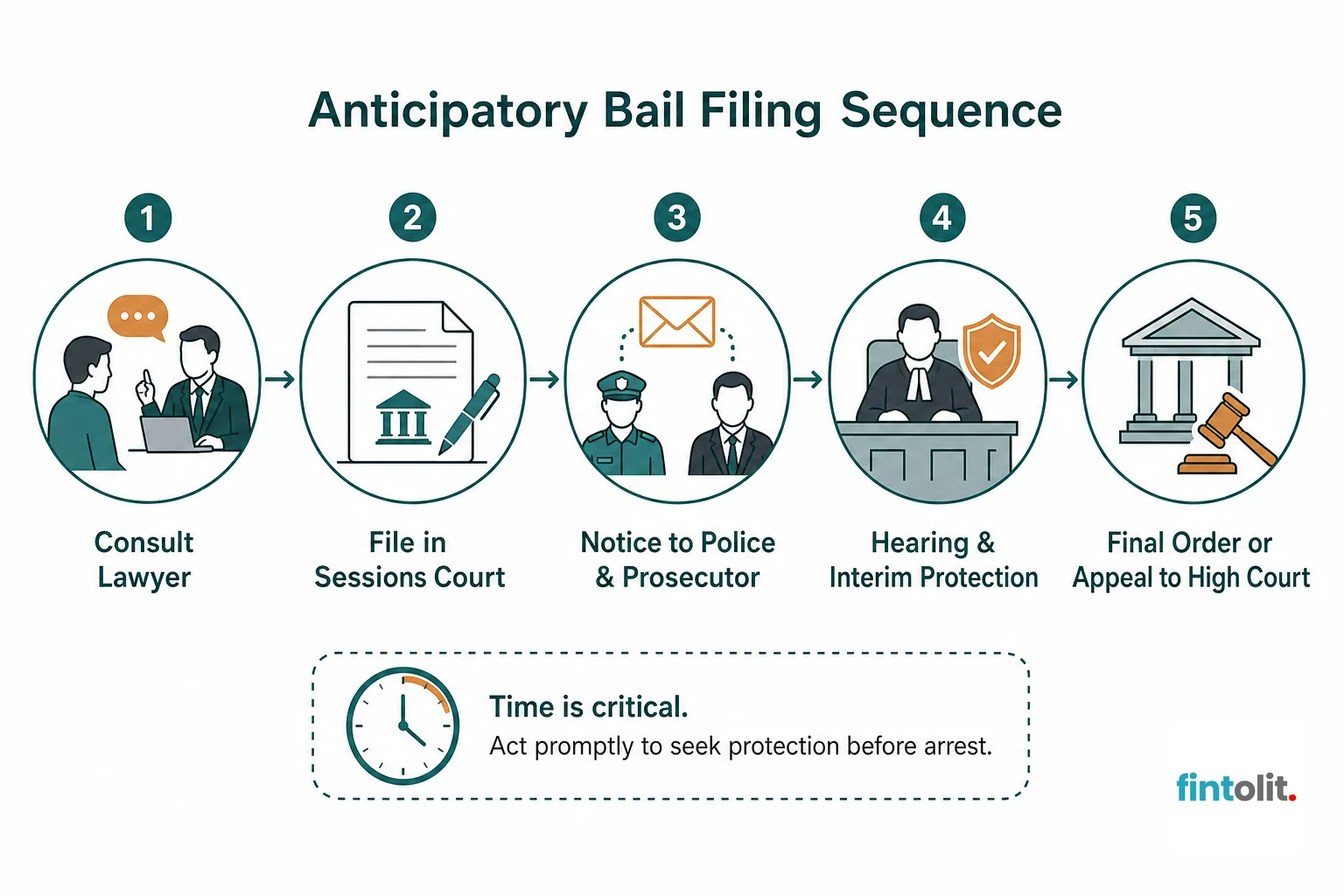
The anticipatory bail application process in India starts with a plea before the Sessions Court, moves to notice for the police and public prosecutor, and ends with a court either granting protection with conditions or refusing it, usually within one to three hearings. Courts look at the seriousness of the allegation, your role in it, and whether custody is really needed to investigate. Get this filed early and correctly, and an arrest never has to happen at all.
The Process in Five Steps
- Confirm you actually need anticipatory bail (existing FIR or a credible fear of one).
- File before the Sessions Court first; only go to the High Court if that fails.
- Prepare the application with the FIR copy, ID proof, antecedents, and a vakalatnama.
- Attend the first hearing, where interim protection is often granted the same day, and notice goes out to the police and public prosecutor.
- Get the final order, which usually attaches conditions like joining investigation and not contacting witnesses.
Key Takeaways
- File where you live first: the Sessions Court is the usual starting point; the High Court comes in only if that fails or the matter demands it.
- The law changed its number, not its spirit: Section 438 CrPC is now Section 482 BNSS, and the courts still weigh the same core factors, as set out in the Gurbaksh Singh Sibbia line of reasoning that Indian courts continue to follow for anticipatory bail pleas.
- Interim protection can come fast: many Sessions Courts grant temporary protection on the first date while they call for a police report.
- Conditions are standard, not punishment: expect terms like joining investigation, not tampering with witnesses, and sometimes a local address requirement.
- A refusal isn't the end: you can move the High Court next, and timing that appeal well matters more than most people realise.
Anticipatory Bail at a Glance
| Aspect | What to expect |
|---|---|
| Governing law | Section 482 BNSS (replaces Section 438 CrPC) |
| Where to file first | Sessions Court, district level |
| Where to file if refused | High Court of the relevant state |
| Jurisdiction type | Concurrent, both courts can hear it |
| Typical first hearing timeline | Same day to a few days for interim protection |
| Common conditions attached | Join investigation, don't leave the country without permission, don't contact witnesses |
| Key documents needed | FIR copy (if any), ID proof, antecedent details, vakalatnama |
| Who represents you | A criminal lawyer, ideally one who knows the local Sessions Court bench |
1. Figure Out If You Even Need Anticipatory Bail
You need this if you're worried about being picked up over an FIR that's already been filed, or one you suspect is coming. Maybe a business partner threatened a police complaint. Maybe a relative filed something out of spite. Either way, this application asks the court for a promise. If arrest does happen, you'll be let out on bail right away instead of sitting in a lock-up first.
That's really the whole difference from regular bail. Regular bail is something you ask for after you're already in custody. Anticipatory bail flips the order, so the arrest doesn't get to happen the way it normally would.
Family disputes, cheque bounce complaints, workplace accusations, and property fights all commonly lead people here. If you're unsure whether your situation qualifies, a quick read on how workplace complaints move through the legal system can help you understand where an FIR risk actually starts.
2. Where Do You File the Application?
Most lawyers will tell you to go to the Sessions Court first. It's closer, faster, and less expensive to approach than the High Court. Only if that court refuses, or the case is unusually serious, does the High Court become the next stop.
Both courts can technically hear the plea directly, since jurisdiction here is concurrent. But going straight to the High Court without trying the Sessions Court first often invites a question from the bench. Why skip the first forum? Save that route for when you actually need it.
Need a Lawyer for clarity on your case?
What changed with BNSS
The old Section 438 of the CrPC is gone. It's now Section 482 of the Bharatiya Nagarik Suraksha Sanhita, and the underlying test courts apply hasn't shifted much, according to recent breakdowns of the new provision from legal practitioners tracking the transition. What's changed is procedural language and some timelines, not the basic idea of protection before arrest. Section 482 BNSS, like the old Section 438, also carries the sub-clauses empowering courts to attach specific conditions to the grant, including requiring the applicant to be available for police interrogation, to not directly or indirectly make inducements or threats to any person acquainted with the facts, and to not leave the country without prior permission of the court. These aren't optional add-ons; they're conditions the section itself contemplates, and orders routinely track them.
3. Building the Application: What Actually Goes In It
Your lawyer needs the FIR copy if one exists, or full details of the complaint if it hasn't been registered yet. Alongside that goes your version of events, written calmly and factually, without emotional padding a judge has no use for.
Antecedents matter a lot here. If you've never been arrested before, if you have a fixed address and a steady job, and if you've cooperated with any police summons already, all of that goes in. It tells the court you're not a flight risk and you're not going anywhere.
Strong applications also explain, point by point, why custodial interrogation isn't necessary. If the evidence is mostly documentary, or already in the possession of the police, say so directly. That argument often does more work than anything else in the file.
- Certified copy of the FIR, or complaint details if no FIR yet
- ID proof and address proof
- A short affidavit stating your version of facts
- Details of any prior criminal record, or a clean-record statement
- Vakalatnama authorising your lawyer to appear
4. What Happens at the First Hearing
The first hearing usually happens fast. If the court is convinced arrest risk is real and immediate, many Sessions Courts grant interim protection on that same date. This can happen before the police side is even heard in detail.
Notice then goes out from the court to the investigating officer and the public prosecutor, asking for a report on your antecedents and the state of the investigation. That report often shapes the next hearing more than anything your lawyer argues.
5. What Judges Actually Weigh Before Granting Bail
Four things come up in nearly every order: how serious the accusation is, whether you're likely to run, whether you might tamper with evidence or pressure witnesses, and what your actual role in the alleged offence looks like once you strip away the FIR's language. The Supreme Court's ruling in Gurbaksh Singh Sibbia v. State of Punjab is still the reference point courts cite when weighing these factors, favouring a liberal reading of the anticipatory bail power rather than a restrictive one.
Nature and seriousness of the accusation
Judges read past the label on the FIR. A cheating charge dressed up in dramatic words still gets examined for what actually happened financially. A family dispute wrapped in criminal sections still gets read as what it is: a personal fight that escalated. Your lawyer's job is to show the court the real shape of the dispute, not just answer the FIR's framing.
Flight risk and cooperation history
Whether you've tried to evade the police already, or showed up when called, also gets weighed. Showing a pattern of cooperation, even informally, strengthens your position more than any single argument in court.
Risk of tampering with evidence or witnesses
If the complainant or witnesses are people you have regular access to, colleagues, neighbours, family, the court looks harder at whether that access could be misused. Distance from the complainant, on paper or in practice, helps your case here.
Need a Lawyer for clarity on your case?
Your actual role in the alleged offence
Being named in an FIR isn't the same as being the person who did the act described. Courts weigh whether you're the principal accused or someone swept in by association, and that distinction often decides the outcome.
6. Conditions Courts Usually Attach
Bail rarely comes with zero strings. Expect the court to ask you to join the investigation whenever the police call you, and to avoid contacting the complainant or any witnesses named in the case.
In cases involving travel risk, courts sometimes ask for your passport to be deposited, or restrict international travel without prior permission. A local address requirement is also common, so the investigating officer always knows where to reach you.
None of this is punishment. It's the court's way of balancing your freedom against the investigation's needs. Break a condition, though, and that protection can be cancelled fast.
What This Actually Costs
Budgeting for anticipatory bail means accounting for two separate costs: the court fee for filing the application, and your lawyer's engagement fee. Court fees for such applications are typically a nominal, fixed amount set by the relevant state's court fee rules, so check the exact figure with the filing counter or your lawyer at the Sessions Court you're approaching, since it varies by state. Lawyer fees vary far more widely, since they depend on the complexity of the FIR, the seniority of the counsel, and whether the matter is likely to go up to the High Court after a refusal. Ask any lawyer you're considering for a clear, itemised quote before you engage them, covering the Sessions Court stage separately from any High Court appeal, so there's no ambiguity if the matter needs a second round.
How long does anticipatory bail take to get approved?
Interim protection can come on the very first hearing date, often within a day or two of filing, while the final order usually takes a few weeks depending on the court's calendar and how quickly the police file their report. Complex or high-profile matters can stretch this timeline further.
Can anticipatory bail be denied and what next?
Yes, a Sessions Court can refuse the plea, especially in cases involving grave allegations or repeat offenders, and that refusal isn't final. Your next move is the High Court, where fresh grounds and a stronger factual record often change the outcome, according to guidance from practitioners covering both forums.
Delhi-NCR Courts: What to Expect Locally
Delhi's district courts, along with the Sessions Courts in Gurugram and Noida, handle a steady volume of anticipatory bail matters every week. Listing dates move quickly here compared to smaller towns, but that speed cuts both ways. You need your paperwork ready before you walk in, not after.
Local counsel who regularly appears before a specific Sessions Court bench in Saket, Gurugram, or Noida usually has a read on how that particular judge weighs antecedents and flight risk. That familiarity often shaves days off the process.
Handling the underlying dispute alongside this matters too, whether it's a cheque bounce notice or a property fight that escalated into a police complaint. Sorting the anticipatory bail matter first buys you room to handle the rest without the added pressure of an arrest hanging over you. Many clients dealing with allegations tied to a disputed power of attorney or family property matter find the bail plea is only the first of several legal steps.
Getting the Right Legal Help, Fast
Anticipatory bail moves quickly, and the difference between protection granted and an actual arrest often comes down to how fast you get a competent criminal lawyer on the file. Fintolit connects you with verified criminal lawyers who have 10+ years of courtroom experience across Delhi, Gurugram, and Noida, with a dedicated case manager tracking every hearing so you're never left guessing what happens next.
Need a Lawyer for clarity on your case?

You see the lawyer's profile and background before you pay anything, and the same lawyer stays with your case from the first consultation through to its close. If you think an arrest might be coming, don't wait for the knock on the door. Book a consultation with a verified criminal lawyer today, or chat with us on WhatsApp for urgent guidance on your specific situation.
Recommended Resources
You're just getting to the good part.