

Life after divorce is shaped less by the judge's final order and more by what you do in the weeks right after. The decisions that matter most are updating account beneficiaries, transferring property titles, setting a workable custody schedule, and rewriting your will — miss any one and it can quietly undo the protection your decree was supposed to give you.
Key Takeaways
- The decree is not the end of the paperwork: banks, the sub-registrar and insurers all need their own separate updates before your divorce actually protects you.
- Beneficiary forms don't fix themselves: life insurance, EPF and mutual fund nominations often still name your ex-spouse until you personally change them.
- Custody terms can be revisited later: Indian family courts allow modification when circumstances genuinely change, so an imperfect first order isn't permanent.
- A mutual consent waiver is possible, not automatic: courts can relax the standard cooling-off gap, but only when specific conditions are met.
- The first 90 days set the tone: people who fix documentation early avoid most of the disputes that resurface a year later.
- Legal paperwork and emotional rebuilding run in parallel: the same 90-day window that resolves your accounts and titles is also when co-parenting routines, mental health support, and your social circle need deliberate attention.
At a Glance: Decisions That Shape Life After Divorce
| Decision Area | What to Check | Best Handled By | Typical Timing |
|---|---|---|---|
| Decree review | Property clauses, support terms, custody schedule | Family lawyer | Before signing, not after |
| Financial accounts | Beneficiary forms, joint loans, credit cards | You + bank/insurer directly | First 30 days |
| Property division | Title transfer, registration, mutation | Property lawyer | 30-90 days |
| Custody & support | Schedule clarity, escalation clause | Family lawyer | At decree, revisit as needed |
| Estate plan | Will, POA, nominee updates | Family lawyer | Immediately after decree |
| Name/address change | PAN, Aadhaar, passport, bank KYC | You | First 60-90 days |
| Emotional & social rebuilding | Co-parenting communication routine, support network, mental health check-in | You, ex-spouse, counsellor | Ongoing from day one |
1. Get the Judgment and Decree Right Before You Sign
Once a judge signs your divorce decree, it becomes the single document that proves your marital status, your property rights, and your parental responsibilities going forward. Any bank, court, or government office you deal with later will ask for this paper, so vague wording around asset division or custody now creates real friction in a year.
A good family lawyer reads the draft decree line by line before you agree to it, not after. Terms around who pays which loan, who keeps which asset, and how support amounts get calculated should be specific enough that neither side can argue about interpretation later.
If you're in Delhi NCR and still finalising your terms, a step-by-step guide to family court procedures in Delhi can help you understand what the judge will actually expect from your paperwork before the hearing.
2. Update Every Financial Account, Not Just the Big Ones
Here's a detail most people miss: a divorce decree does not automatically remove your ex-spouse as a beneficiary on your life insurance policy, EPF account, or mutual fund holdings. You have to contact each institution separately and file the change yourself, and the pattern holds across most jurisdictions, as DivorceClear's account-by-account breakdown lays out.
Skip this step and, years later, your ex-spouse could still legally inherit funds you assumed went to your children or parents. Go through every joint account, every insurance policy, and every retirement fund on your list. Close what you can. Reassign what you can't.
Credit cards and loans taken jointly during the marriage need attention too. If your name is still on a loan your ex-spouse is supposed to service, a missed payment on their end still hits your credit score.
3. Sort Out Property Division Documentation
Deciding who keeps the flat is only half the job. The other half is registering that decision so it holds up legally, whether that means a sale deed, a release deed, or a mutation entry with the local municipal authority.
Need a Lawyer for clarity on your case?

In Delhi, Noida and Gurugram, registration offices each have their own quirks around stamp duty calculations and document formats, which is exactly why choosing the right jurisdiction and lawyer for a property matter changes how fast things move. Skipping formal transfer because "we already agreed verbally" is one of the most common reasons ex-spouses end up back in court within a few years.
If either party owns property that needs a will rewritten around it, or a power of attorney revoked, handle that at the same time you transfer title. Doing it in one sitting with your property lawyer saves a second round of paperwork.
Because mutation fees and stamp duty vary by locality and property value, ask your property lawyer for a written estimate specific to your registration office before you schedule the appointment, rather than assuming a flat rate applies across Delhi, Noida and Gurugram.
4. Decide Custody and Support With the Long Game in Mind
A custody order isn't set in stone. Indian family courts allow modification requests when circumstances genuinely shift, a parent relocating for work, a child's changing school needs, or a support amount that no longer matches either parent's income. Knowing this takes pressure off getting every clause perfect on day one.
What actually matters at the drafting stage is clarity: exact pickup and drop times, holiday splits, and how school fees or medical costs get shared. Vague terms like "reasonable visitation" cause more fights than almost anything else in post-divorce life.
Can a Mutual Divorce Really Be Finalised in 15 Days?
No, not as a routine outcome. The standard law requires a six-month cooling-off gap between the first and second motion under Section 13B(2) of the Hindu Marriage Act, and courts waive it only in specific situations, not automatically.
The Supreme Court's ruling in Amardeep Singh v. Harveen Kaur confirmed that this cooling-off period is directory, not mandatory, meaning a family court has discretion to relax it when the parties have genuinely settled everything and further delay would serve no purpose, as explained in AM Legal's analysis of the waiver rule. That waiver is the exception people mean when they search for a "15-day" mutual divorce, not the default timeline.
5. Revisit Your Estate Plan Immediately
Divorce is one of the most common reasons people finally update, or create for the first time, a will and power of attorney. Yet many people put this off for months, assuming the decree already covers it.
It doesn't. Your will, if you have one, might still name your ex-spouse as executor or beneficiary. Any power of attorney you signed during the marriage needs formal revocation, not just a mental note that "it doesn't count anymore."
Handle this early, before life gets busy again and the old documents quietly stay valid. Ask your family lawyer for a written quote covering will drafting and POA revocation together, since bundling the two in one sitting is usually cheaper and faster than doing them as separate matters weeks apart.
6. Rebuild the Emotional, Social and Co-Parenting Side of Life After Divorce
Paperwork protects your finances and your parental rights, but it doesn't rebuild your daily life on its own. The practical changes, going to work, managing the household, picking up the kids, now rest on one set of shoulders instead of two, and that shift is where a lot of the real strain shows up.
Co-parenting communication works best when it mirrors the clarity you built into the custody order itself: agree on one channel (a shared app, a single WhatsApp thread, or scheduled calls) and stick to logistics — pickup times, school updates, medical decisions — rather than reopening old arguments through it.
Need a Lawyer for clarity on your case?
If the custody schedule from Section 4 is vague, that same vagueness spills into daily co-parenting conflict, so tightening the written schedule is also an emotional-wellbeing decision, not just a legal one.
On the mental health side, treat the adjustment period the way you'd treat any major life transition: a counsellor or therapist familiar with divorce-related stress can help you separate decisions you're making from a place of clarity versus decisions made out of anger or exhaustion.
This matters directly for the legal steps above — signing off on a property transfer or a custody clause while still in acute distress is how people end up with terms they regret months later.
Socially, expect your circle to shift. Some friendships were built around your marriage as a unit and may fade; new routines, whether a support group, a hobby, or simply reconnecting with people you'd lost touch with, tend to fill that space over time rather than all at once. None of this needs to be rushed to fit the 90-day legal window below; it runs on its own timeline, alongside the paperwork, not instead of it.
7. Use the First 90 Days to Build Structure, Not Just Finish Paperwork
The first 90 days after your decree is where most of the real work happens: locking in updated legal and financial records while the details are still fresh. Waiting longer makes each task harder to track down.
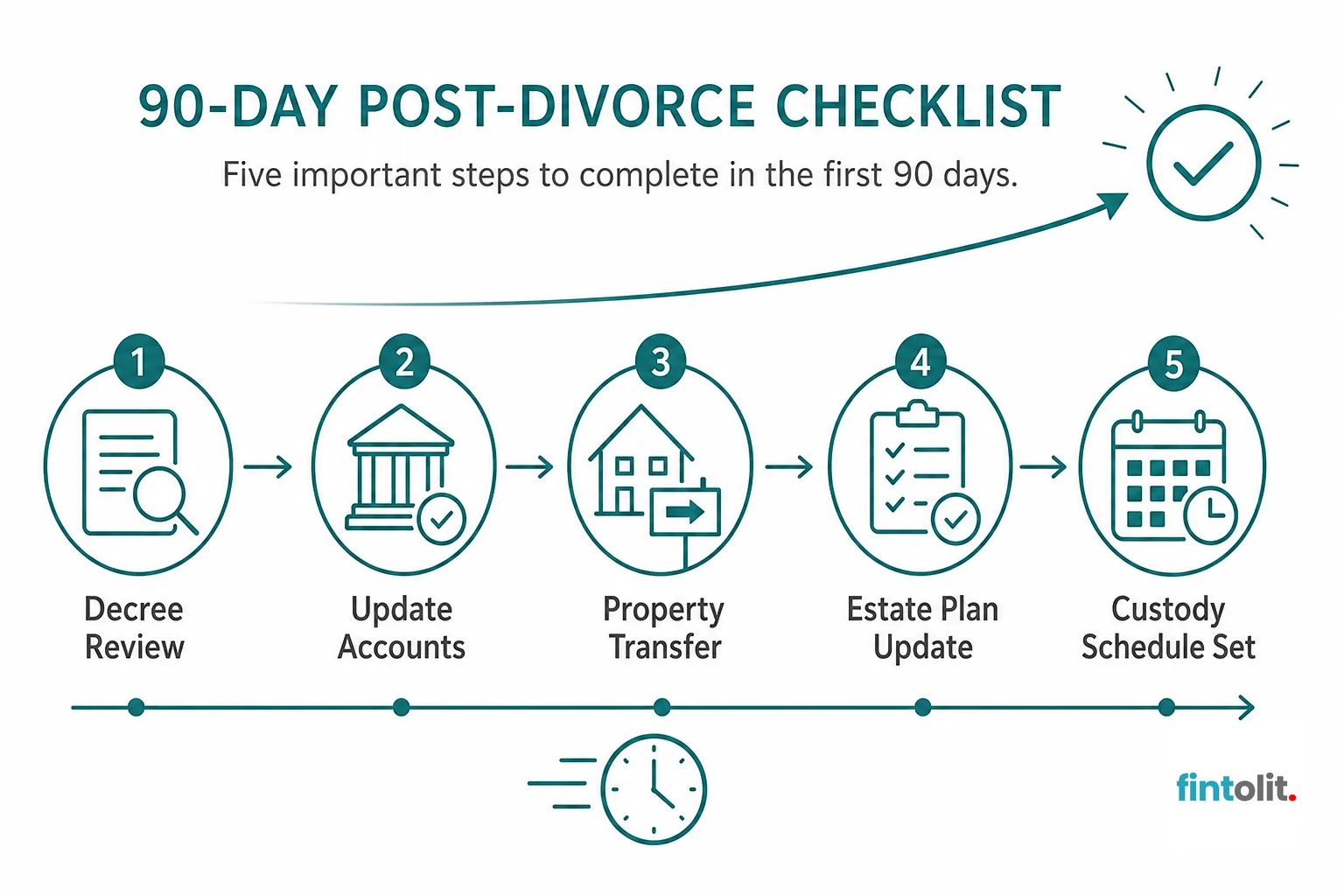
- Week 1-2: File your certified decree copy with your bank, employer HR, and any pending court matters.
- Week 2-4: Update PAN, Aadhaar, passport and bank KYC records with your new marital status or name.
- Month 1-2: Complete property transfer or registration, and revise your will and POA.
- Month 2-3: Confirm custody and support arrangements are actually running smoothly, not just written down, and check in on how the co-parenting communication routine is holding up in practice.
Who Should You Talk to First: A Family Lawyer or a Financial Planner?
Talk to a family lawyer first. They tell you what the decree legally requires and by when, and only after that is settled does a financial planner have real numbers to work with for your new budget or investments.
Doing it the other way round means restructuring a financial plan around terms that might still shift before final signing: the lawyer's read of the decree comes first, the financial plan second, and the order isn't interchangeable.
How Fintolit Supports You Through and After Divorce
Fintolit connects you with a verified family lawyer with 10+ years of experience, available for a focused online consultation in Delhi or an in-person "Lawyer at Home" session across Delhi, Noida, Gurugram and the wider NCR. You see the lawyer's profile and background before you pay, so there's no guessing who you're trusting with your case.
A dedicated case manager stays with your file from the first consultation through property transfer, custody finalisation, or will updates, so you're not repeating your story to a new person every time. If you're weighing an online consultation against a home visit, that comparison can help you decide what suits your situation right now.
Frequently Asked Questions
What does a divorce lawyer actually help with after the decree?
A divorce lawyer helps enforce and modify decree terms, from unpaid support to custody disputes, and guides beneficiary, property and estate-plan updates so the paperwork matches the court order.
Is mutual divorce in 15 days possible for everyone?
No. It requires the six-month cooling-off period to be waived by the court, which only happens when both parties have fully settled all issues and can show further delay serves no purpose.
Can custody arrangements be changed after the divorce is final?
Yes. Courts allow modification requests when circumstances genuinely change, such as relocation, a child's changing needs, or a shift in either parent's income or availability.
Need a Lawyer for clarity on your case?
How much does post-divorce legal documentation typically cost?
Costs vary by document type and complexity: will drafting, POA revocation, and property mutation are billed separately by most lawyers, and mutation fees in particular depend on your specific registration office and property value. Ask for a written, itemised quote for each document before proceeding, rather than assuming a single flat fee covers all of them, and use Fintolit's legal documentation cost guide as a starting checklist of what to ask about.
How do I handle co-parenting communication without reopening old conflicts?
Keep one dedicated channel for logistics only, whether that's a shared app or a single messaging thread, and route anything emotionally charged through a counsellor or mediator instead of that channel. A tightly written custody schedule (see Section 4) reduces how often you need to communicate about disputed details in the first place.
Getting life after divorce right isn't about one big decision, it's about a dozen small ones handled in order: the decree wording, the beneficiary forms, the property title, the custody schedule, the will, and the co-parenting and emotional-support routines that run alongside all of it. Missing any one leaves a loose thread that resurfaces later, often at the worst time.
If you're navigating any part of this, book a consultation with a verified family lawyer to get a clear, upfront plan for your specific situation, or chat with us on WhatsApp if you'd rather talk through your questions first.
Recommended Resources
You're just getting to the good part.