

Haryana property registration means recording your sale deed with the Sub-Registrar Office, paying stamp duty of 7% for men and 5% for women in urban areas (5% and 3% in rural areas), plus a 1% registration fee capped at ₹50,000. Since November 1, 2025, the entire process runs on a paperless e-registration portal.
Key Takeaways
- Stamp duty is gender-based: Urban buyers pay 7% (men), 5% (women) or 6% (joint), while rural rates run lower at 5%, 3% and 4% respectively.
- Registration fee caps out: The 1% registration charge stops climbing once your declared property value crosses roughly ₹50 lakh, per the ₹50,000 ceiling.
- Paperless since November 2025: Haryana ended its old manual process and moved to a fully digital e-registration system across all tehsils.
- Tatkal slots now exist: Passport-style priority appointments let buyers and sellers skip long waiting queues at busy sub-registrar offices.
- Collector rate sets your floor: Stamp duty is charged on whichever is higher, the actual sale price or the government's circle rate for that area.
Haryana Property Registration At a Glance
| Item | Detail |
|---|---|
| Stamp duty (urban) | 7% men, 5% women, 6% joint |
| Stamp duty (rural) | 5% men, 3% women, 4% joint |
| Registration fee | 1% of value, capped at ₹50,000 |
| Registration mode | Fully paperless e-registration since Nov 1, 2025 |
| Appointment booking | Online slot booking, plus new tatkal priority slots |
| Core documents | Sale deed, ID proof, PAN, photographs, prior title chain, NOC where applicable |
| Verification at SRO | Biometric verification of buyer, seller and witnesses |
| Valuation basis | Higher of transaction value or collector (circle) rate |
How Does Property Registration Work in Haryana?
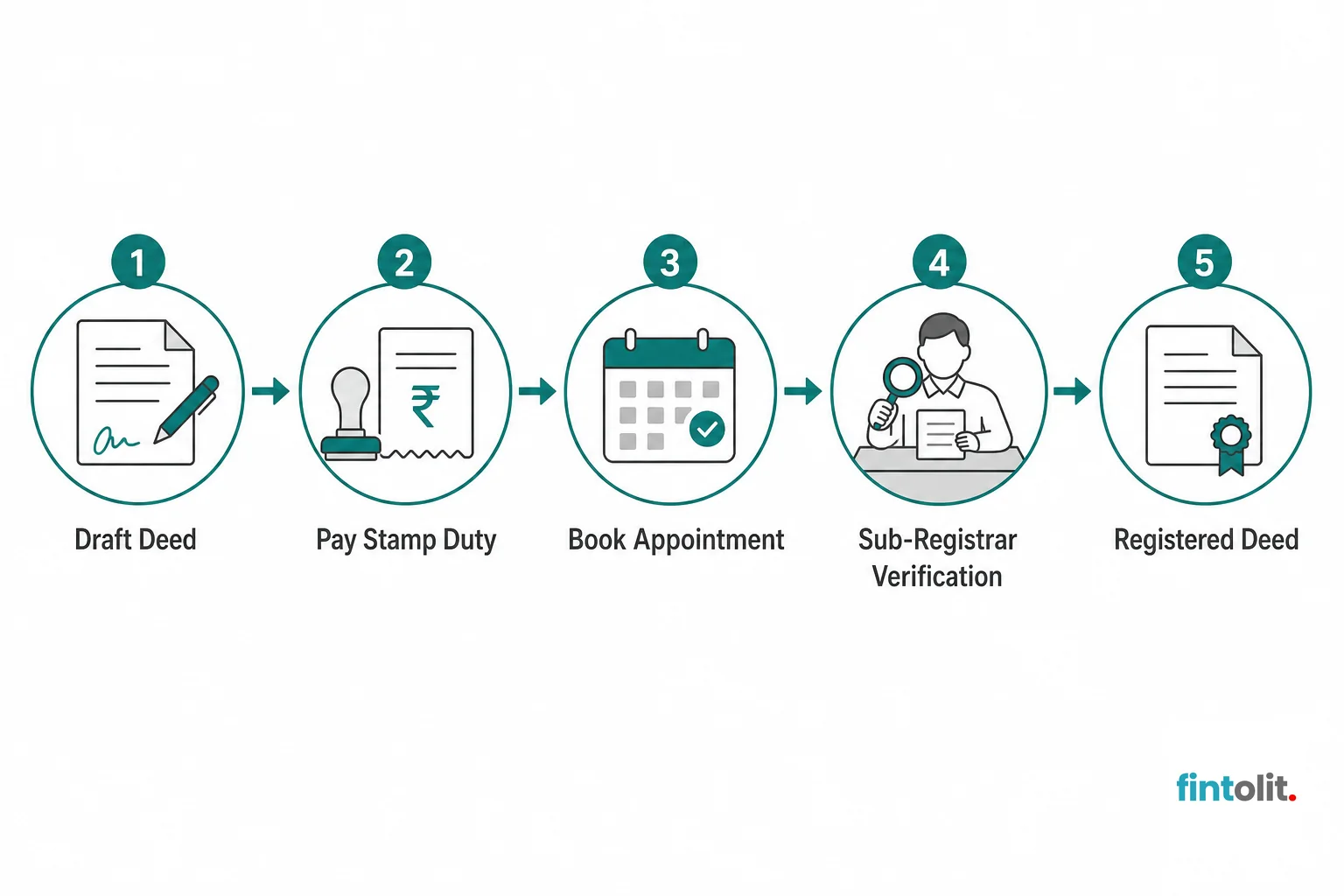
Registration in Haryana now runs through a unified e-registration portal, replacing a manual process that stood for decades. You draft the deed, pay stamp duty, book a slot, and appear at the Sub-Registrar Office for verification.
[[]]
The paperless system went live on November 1, 2025, ending what officials called a 58-year-old manual routine. Every tehsil in the state now handles registrations digitally, from deed upload to final record-keeping.
In practice, the steps look like this. First, draft your sale deed, either through a deed writer or the templates available on the state's deed registration portal. Second, calculate stamp duty and generate an e-stamp online. Third, book your appointment slot. Fourth, both parties and witnesses show up at the Sub-Registrar Office for identity and biometric verification.
Haryana has also rolled out newer reforms on top of this base system, including an auto mutation feature that updates land records automatically once your deed registers, so you no longer file a separate mutation application at the tehsil.
What Documents Do You Need for Registration?
Getting your paperwork right the first time saves you a second trip to the Sub-Registrar Office. Here's what you'll typically need on registration day.
- Original sale deed (drafted and stamped)
- Identity proof for buyer, seller, and witnesses (Aadhaar, PAN, passport)
- PAN card, mandatory for transactions above the prescribed threshold
- Passport-size photographs of all parties
- Proof of ownership chain: previous sale deed, mutation extract, or Jamabandi record
- No Objection Certificate, where the property falls under a housing society, cooperative, or requires clearance
- PID (Property ID) number for agriculture properties, mentioned directly on the Jamabandi portal
NRIs adding a property to their name from abroad face an extra layer here, since ID verification and power of attorney documents need careful checking before the deed goes anywhere near a registrar. Our guide on verifying property documents from abroad walks through exactly what to gather before you sign anything.
Stamp Duty and Registration Charges in Haryana
Stamp duty is the single biggest cost in any Haryana property transaction, and it changes depending on where the property sits and whose name goes on the deed.
[[ ]]
]]
In municipal or urban areas across cities like Gurugram, Faridabad, Panchkula, and Ambala, stamp duty runs at 7% for male buyers, 5% for female buyers, and 6% for joint ownership. Outside municipal limits, in rural or panchayat areas, the same categories drop to 5%, 3%, and 4%.
Need a Lawyer for clarity on your case?
| Ownership Type | Urban Rate | Rural Rate |
|---|---|---|
| Male buyer | 7% | 5% |
| Female buyer | 5% | 3% |
| Joint (male + female) | 6% | 4% |
On top of stamp duty, you'll pay a registration fee of 1% of the property value, but this fee stops rising once it hits a ₹50,000 ceiling, which effectively kicks in around the ₹50 lakh mark in declared value. Buying jointly with a spouse is one of the simplest ways to reduce your stamp duty bill without any legal complication, and many families in Gurugram and Panchkula now register this way for exactly that reason.
What Are Collector Rates and Why Do They Matter?
A collector rate is the government's minimum assessed value for land in a given area, and Haryana charges stamp duty on whichever number is higher: your actual sale price or this rate. It exists so buyers and sellers can't understate the deal on paper to dodge tax.
If your negotiated price sits below the collector rate for that sector or village, you still pay stamp duty calculated on the collector rate, not your lower price. Sellers sometimes try to show a lower value on the deed to save on duty, but the sub-registrar's system flags this automatically and rejects the deed until it matches or exceeds the government rate.
Collector rates get revised periodically and vary block by block, even within the same city. A plot in one Gurugram sector can carry a very different rate from a plot two sectors over, which is exactly the kind of local detail a property lawyer checks before you sign anything.
Tatkal Appointments and Other Digital Reforms
Getting a same-week appointment used to be the hardest part of registering property in Haryana, especially in high-demand districts like Gurugram. That's changing fast.
[[ ]]
]]
Haryana has introduced passport-style tatkal appointments for property registration, letting buyers and sellers skip the usual waiting period for urgent deals. Alongside this, the state now allows citizens to upload additional documents digitally rather than carrying physical copies to the office.
These reforms sit on top of the broader paperless system, so most of what used to require an in-person visit, from initial document submission to appointment scheduling, now happens online through the unified e-registration portal. The one part that still needs your physical presence is biometric verification on the day of registration itself.
Common Legal Issues Property Buyers Face in Haryana
A clean-looking deed doesn't guarantee a clean title. These are the problems that show up most often once a property changes hands in Haryana.
- Disputed ownership: Multiple family members claim rights over the same ancestral plot, often surfacing only after registration is already done.
- Forged or altered documents: A previous sale deed or Jamabandi record shows tampering that only a detailed title check catches.
- Encroachment: Boundaries on paper don't match what's physically fenced or built on the ground.
- Power of attorney misuse: A POA used to sell property without the actual owner's knowledge or a valid mandate.
- Undervaluation disputes: Deals structured below collector rate, which invites scrutiny and can delay or void registration.
If you're already dealing with a property that's contested, our detailed guide on when to consult a lawyer for property disputes covers the warning signs worth acting on early.
Is a Property Lawyer Necessary for Registration in Haryana?
You can technically register a property in Haryana without a lawyer, but skipping legal review means you're the one absorbing any risk hiding in the title chain. A lawyer checks the ownership history, confirms there's no pending litigation, and reviews the deed language before you sign.
[[ ]]
]]
This matters most for resale flats, ancestral land, and any property that's changed hands more than twice. A ten-minute clause review can catch a mismatched survey number or an unresolved mortgage that a buyer would otherwise only discover months later, when it's far harder and costlier to fix.
Need a Lawyer for clarity on your case?
Fintolit connects you with a verified property lawyer with 10+ years of experience for a fixed-fee, 60-minute consultation, either online or through a Lawyer at Home session if you'd rather sit down face to face. You see the lawyer's name and background before you pay anything, and the same lawyer stays with your case from that first call through to registration.
How Fintolit Helps With Property Registration in Haryana
Buying or selling property in Haryana involves real money and irreversible paperwork, which is exactly why guessing your way through stamp duty slabs or deed clauses is a bad idea. Fintolit removes that guesswork with upfront, fixed pricing and a dedicated case manager who tracks your file so you're never left wondering what happened after your last call.
Whether you need a deed reviewed before you sign, a title verified before you pay, or help resolving a dispute that's already surfaced, a specialist property lawyer can walk you through what your specific transaction actually needs. If you're an NRI managing this from outside India, our checklist on verifying documents before buying is worth reading before you send a single rupee.
Don't let a stamp duty miscalculation or a missed encumbrance turn into a costly legal fight later. Book a consultation with a verified Fintolit property lawyer today, or chat with us on WhatsApp to get quick answers on your Haryana property registration before your next appointment slot.
Recommended Resources
You're just getting to the good part.