

An NRI can sell property in India legally without ever boarding a flight. A registered Power of Attorney can authorise someone in India to sign and execute the sale on the owner's behalf.
The buyer still withholds tax under Section 195. The seller still needs clean title documents. However, neither requirement demands the owner's physical presence at the sub-registrar's office.
Key Takeaways
- Power of Attorney does the heavy lifting: A Special Power of Attorney, drafted for this one transaction, lets your agent sign the sale deed and appear at registration while you stay abroad.
- TDS is deducted differently for NRIs: Under Section 195, the buyer withholds tax on the full sale value, not just the profit, unlike the 1% rule that applies to resident sellers under Section 194-IA.
- Form 13 can reduce that upfront hit: Filing for a lower or nil deduction certificate before the sale closes can bring the TDS down closer to your actual tax liability.
- Repatriation has a yearly ceiling: Sale proceeds must first land in your NRO account. From there, you can move up to USD 1 million per financial year abroad, combined across all purposes.
- Most delays are self-inflicted: Expired POAs, missing apostilles, and mismatched name spellings between your passport and the title deed cause more hold-ups than any actual legal restriction.
At a Glance: Selling Property as an NRI
| Step | What Happens | Who Handles It | Typical Time |
|---|---|---|---|
| Draft & execute POA | Notarised abroad, then apostilled or consular-attested | You + your lawyer in India | 1-2 weeks |
| Document check | Title deed, encumbrance certificate, tax receipts verified | Property lawyer | 3-7 days |
| Buyer sourcing & agreement | Sale agreement signed by your agent | Agent under POA | Varies |
| Form 13 application | Apply for lower/nil TDS deduction certificate | Chartered accountant | 2-4 weeks |
| Registration | Sale deed signed and registered at sub-registrar | Agent under POA | 1 day, once scheduled |
| TDS deduction | Buyer withholds tax under Section 195 | Buyer | At time of payment |
| Repatriation | Funds moved from NRO account abroad, up to the annual cap | You + your bank | 1-3 weeks with Form 15CA/15CB |
1. Confirm You Can Sell Without RBI Approval
Most NRIs don't need prior approval from the Reserve Bank of India to sell residential or commercial property. You do need to stay inside the Foreign Exchange Management Act framework.
This mostly means the buyer has to be an Indian resident, an NRI, or a person of Indian origin, depending on the type of asset.
Agricultural land, plantation property, and farmhouses sit in a different bucket. An NRI who inherited such land can usually sell it, but selling it to buy a new one gets restrictive fast.
If your asset falls in this category, get that checked before you list it. Do not wait until after a buyer has already put down earnest money.
2. Set Up a Power of Attorney That Actually Works
Do you actually need a Power of Attorney to sell property in India as an NRI? Not always. However, for anyone who can't travel for signing and registration, it is the only practical route.
A well-drafted Special Power of Attorney lets your chosen agent do everything from signing the sale agreement to collecting payment on your behalf. That agent is often a family member or your lawyer's representative.
The distinction between a Special Power of Attorney and a General Power of Attorney matters more than people expect. A Special POA limits your agent to one defined transaction.
That is exactly what you want when selling a single flat or plot. A General POA hands over broad, open-ended authority, and that is where family disputes and fraud attempts tend to start.

Execution from abroad has its own sequence. First, draft the POA for the specific property and transaction. Then sign it before a notary in your country of residence.
Need a Lawyer for clarity on your case?
Get it apostilled if your country is a Hague Convention member. Otherwise, have it attested by the Indian consulate.
Skip the apostille step, and the sub-registrar in India can reject the document outright. That sends you back to square one.
Our detailed breakdown of how to give power of attorney from the USA to India without notary errors walks through the exact wording and stamping sequence.
If you're unsure which type suits your situation, the piece on situations where the wrong power of attorney type can backfire is worth reading before you sign anything.
How Is Selling Property Different for NRIs vs Resident Indians?
NRI sellers face steeper upfront tax withholding, mandatory Power of Attorney arrangements for remote signing, and stricter repatriation rules. None of these apply to a resident seller.
A resident simply signs in person and faces a flat 1% TDS on the sale value. Under Section 194-IA, a buyer purchasing from a resident deducts just 1%.
That rule stops applying the moment the seller is an NRI. Section 195 takes over instead, and it is a heavier deduction on a bigger base.
3. Get Your Property Documents in Order From Abroad
Before you think about pricing the sale, gather the title deed, the latest encumbrance certificate, property tax receipts, and a copy of the approved building plan if it's an apartment.
Buyers and their lawyers will ask for these early. An NRI seller who scrambles to source them from overseas loses negotiating leverage.
Name mismatches are the single most common paperwork trap. If your passport reads "Rajesh Kumar Sharma" but your title deed says "R.K. Sharma," expect the registrar to flag it.
Fix this with a notarised affidavit before registration day, not during it.
If you haven't verified your documents recently, our guide on OCI cardholder property rights in India clears up several ownership myths that also trip up NRI sellers who hold dual documentation.
4. Understand TDS Under Section 195 Before You Price the Deal
What TDS rate applies when an NRI sells property in India? The buyer withholds tax on the entire sale consideration under Section 195, not just on your capital gain.
Current guidance puts long-term capital gains TDS around 12.5% plus applicable surcharge and cess. Short-term gains attract slab rates instead.
That upfront bite can lock up a large chunk of your sale proceeds for months. You may need to wait for a tax refund after filing your return.
Most sellers who plan ahead avoid this by applying for a Form 13 lower or nil deduction certificate from the Income Tax Department before the sale closes.
It reduces the TDS to something closer to your actual tax liability instead of the default flat rate. It typically takes a few weeks to process, so file it as soon as you have a buyer lined up.
A chartered accountant handles the Form 13 filing. A property lawyer handles the sale documentation.
Coordinating both from a different time zone is where most NRI sellers lose weeks. A single case manager can track both threads and update you on either side, without you chasing two separate professionals.
5. Sign, Register, and Close the Sale Remotely
Can the entire registration happen without the NRI seller present? Yes, provided the Power of Attorney is valid and properly stamped.
Your agent can appear at the sub-registrar's office, present the POA alongside the sale deed, and complete registration on your behalf.
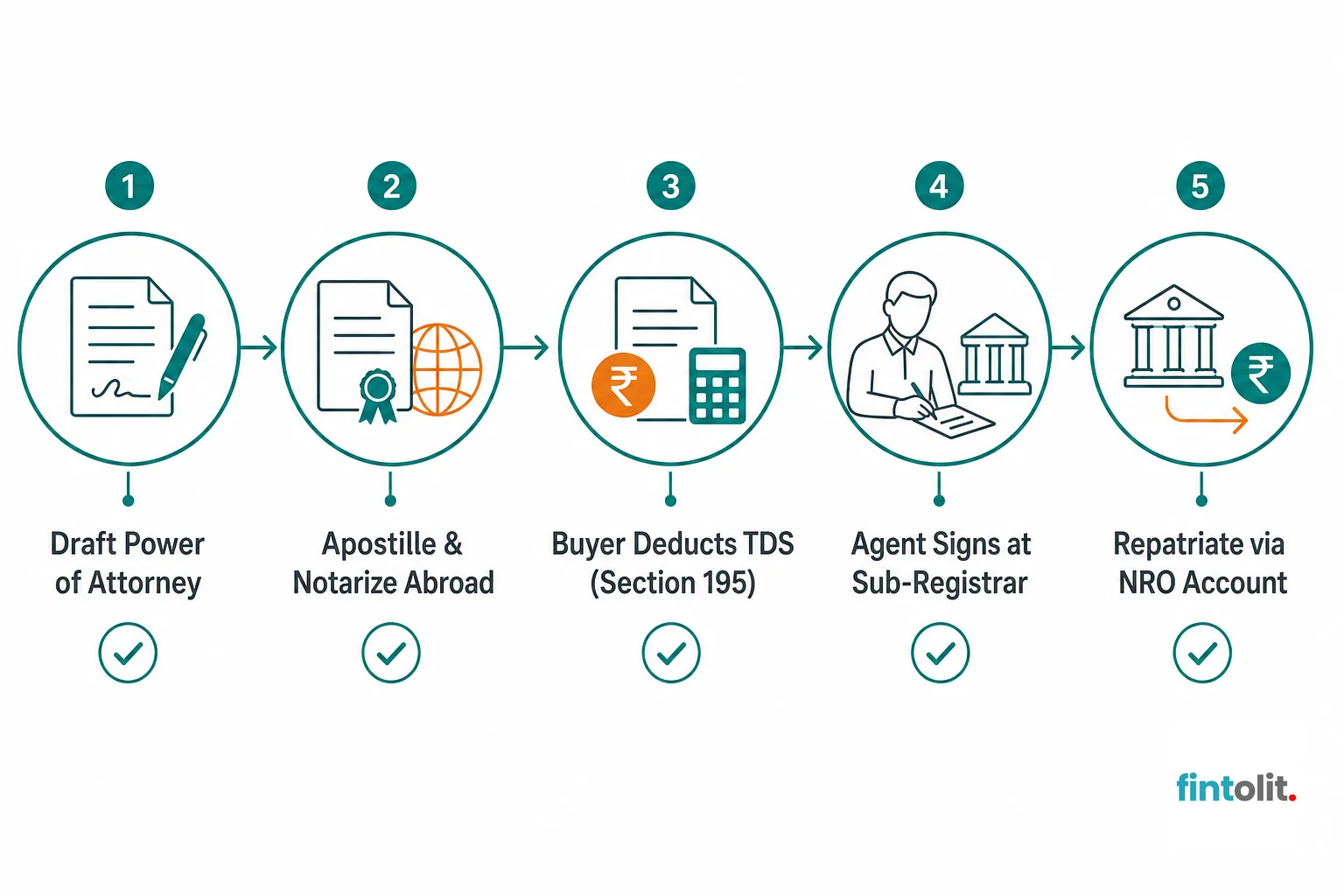
The practical rhythm looks like this: your agent negotiates and signs the agreement to sell. You review and approve documents over email or a shared drive.
The CA files Form 13 in parallel. Once TDS clearance and buyer financing line up, your agent attends the registrar's office for the final signing.
Need a Lawyer for clarity on your case?
A dedicated case manager keeps you posted after each step instead of leaving you to call and ask. That can be the difference between a two-month close and a six-month one.
If you'd rather have someone from Fintolit walk through your specific timeline, you can book a consultation. You can get a verified property lawyer assigned before you commit to anything.
6. Repatriate the Sale Proceeds Correctly
How does an NRI move sale proceeds out of India after closing? Proceeds must first go into your NRO account.
From there, you can repatriate up to a set annual ceiling once your bank verifies Form 15CA and, where needed, Form 15CB from a chartered accountant.
That ceiling currently sits at USD 1 million per financial year. It is aggregated across every purpose you're repatriating for that year, not just this one sale.
If you're selling a high-value property and also moving other funds out the same year, plan the sequencing with your bank early. Hitting the cap mid-transaction can strand the remainder until the next financial year opens.
For a deeper walkthrough of TDS timing and the lower deduction certificate process, our case manager guide for NRI property matters explains how ongoing updates are structured once your file is active.
Common Documentation Mistakes That Delay an NRI Property Sale

- An expired or improperly attested POA: Sub-registrars reject POAs without a valid apostille or consular stamp, and re-doing this from abroad can cost weeks.
- Name or spelling mismatches: Differences between your passport, PAN card, and the title deed stall registration until corrected by affidavit.
- Skipping Form 13 until the last minute: Waiting until after the sale agreement is signed to apply means you absorb the full TDS hit and wait for a refund.
- Using a General POA for a one-time sale: It works, but it also hands your agent authority far beyond what the transaction needs, which is how disputes with relatives start.
- No local point of contact for the sub-registrar visit: Registration dates get rescheduled often; someone needs to be reachable in India that week.
If you're worried about a relative misusing a POA you've already signed, read our guide on NRI property power of attorney mistakes that void the document before you send funds or finalise the sale.
FAQs
Do I need to visit India to sell my property?
No. A properly executed Special Power of Attorney lets your agent sign the sale deed and complete registration in India while you remain abroad.
This works as long as the POA is apostilled or consular-attested correctly.
How long does the whole process take?
A straightforward sale with clean title documents and an early Form 13 filing usually closes in six to ten weeks.
Disputed title, missing documents, or a rejected POA can stretch this to several months.
Can I use a General Power of Attorney instead of Special?
You can, but it is not advisable for a single sale. A General POA grants broad ongoing authority over your affairs.
A Special POA limits your agent to this one transaction. That is safer and easier for registrars to accept.
What happens if TDS is deducted at the higher default rate?
You can claim a refund when you file your Indian income tax return for that year. However, the money stays locked up until the return is processed.
Filing Form 13 before the sale avoids this wait entirely.
Selling property in India from abroad involves more moving pieces than a resident sale ever does. These include POA execution, TDS certificates, and repatriation limits.
Getting any one of them wrong adds months to your timeline.
Fintolit's property lawyers in Delhi NCR handle NRI sales end to end. One case manager tracks your file, and one verified lawyer supports you from the first consultation to the final registration.
Need a Lawyer for clarity on your case?
Book a consultation to get your document checklist reviewed before you list your property.
You can also chat with us on WhatsApp if you have a specific question about your POA or TDS situation right now.
Recommended Resources
You're just getting to the good part.