

An OCI cardholder can legally buy residential and commercial property in India, but not agricultural land, farmhouses, or plantations. That single line trips up more overseas families than any other, because relatives, brokers, and even some registrars pass along versions of it that are half right. Getting oci card holder property rights in india wrong on paper can mean a stuck registration, a frozen sale, or worse, a benami investigation years later. Below, we break down the problems these myths cause and the solution to each one, so you know exactly where you stand.
Key Takeaways
- Residential and commercial ownership: OCIs can buy as many residential or commercial properties as they want, with no RBI approval needed, per the Ministry of External Affairs FAQ.
- Agricultural land is off-limits: Farmland, plantation property, and farmhouses cannot be purchased directly under FEMA rules, confirmed by the Indian Embassy in Qatar.
- Inheritance is a separate track: An OCI can inherit agricultural land even though buying it outright isn't allowed.
- No blanket RBI permission needed: Standard purchases don't require Reserve Bank clearance, but sales to certain buyers do come with conditions.
- A pre-purchase legal check saves years of trouble: Title verification and a FEMA compliance review before you sign catch the mistakes that surface later as court cases.
At a Glance: OCI Property Rights in India
| Property Type | Can an OCI Buy It? | Can an OCI Inherit It? | RBI Permission Needed? |
|---|---|---|---|
| Residential flat or house | Yes | Yes | No |
| Commercial office or shop | Yes | Yes | No |
| Agricultural land | No | Yes | N/A (purchase barred) |
| Farmhouse | No | Yes | N/A (purchase barred) |
| Plantation property | No | Yes | N/A (purchase barred) |
| Number of properties (residential/commercial) | No cap | No cap | No |
| Selling to a resident Indian | Allowed | - | No |
Myth 1 (The Problem): "OCI Cardholders Can't Own Property in India At All" — Here's the Solution
This is the myth that costs OCIs the most, because it stops people from investing entirely, or pushes them into shaky workarounds. It's false. The MEA's own FAQ confirms that NRIs and OCIs do not need RBI permission to acquire immovable property, as long as it's residential or commercial.
The confusion usually starts with a cousin's story about a "farmhouse deal that fell through" or a broker who conflates OCI rules with the stricter ones that apply to other categories of foreign nationals. An OCI card is not a tourist visa. It comes with property rights closer to a resident Indian's, minus the agricultural carve-out.
The fix is simple: know that residential and commercial purchases are fully open to you. Fintolit's property lawyers see this myth most often among first-generation emigrants who assumed their OCI status was purely a travel convenience. It isn't. If you're weighing a flat purchase in Gurugram or Noida, the legal checks a property lawyer runs before you buy matter more than the myth ever did.
Myth 2 (The Problem): Buying Agricultural Land Through a Relative's Name — Why That "Solution" Backfires
Some families try to get around the farmland restriction by putting the purchase in a sibling's or parent's name while the OCI holder funds it quietly. This creates a benami transaction, and it has real consequences under the Benami Transactions (Prohibition) Act, including possible confiscation of the property itself.
The rule itself is straightforward. Under the Foreign Exchange Management Act framework, agricultural land, plantation property, and farmhouses stay off-limits to OCIs for direct purchase, a position LegalClarity's regulatory breakdown lays out clearly. The restriction exists regardless of how the money moves or whose name goes on the sale deed.
There's no clever structuring that fixes this problem. The real solution is redirecting the investment toward residential or commercial land, where the same OCI holder can buy freely and register the deed in their own name without any borrowed identity.
Need a Lawyer for clarity on your case?

Myth 3 (The Problem): "Inheriting a Family Farm Works the Same as Buying One" — Clearing Up the Confusion
Buying and inheriting are treated completely differently under Indian property law, and this is where families genuinely get confused rather than misled. An OCI cardholder cannot purchase agricultural land, but they can inherit it, whether from a resident Indian relative or from another NRI.
This distinction matters most when a parent passes away leaving ancestral farmland. The OCI heir doesn't need special permission to inherit that land, as confirmed by the detailed walkthrough on Diaspora Dreams' guide to OCI property rights. What they can't then do is expand that holding by purchasing the neighboring plot.
The practical solution: selling inherited agricultural land later is usually the cleanest path if the OCI heir has no plans to farm it themselves. That sale, in turn, needs its own document trail, which is where a lot of families discover their property title verification checklist should have started decades earlier, at the point the land was first registered.
Myth 4 (The Problem): "OCIs Need RBI Permission for Every Property Deal" — The Actual Rule
Most residential and commercial purchases by OCIs need zero RBI sign-off, not the blanket approval process many assume applies. The MEA FAQ is explicit that acquiring property does not require Reserve Bank permission for this category of buyer.
Where things do get procedural is on the sale side, and on transfers between certain categories of foreign nationals of Indian origin. Those specific transactions can carry conditions that a standard resident-to-OCI sale doesn't. Treating every deal as equally simple, or equally complicated, is where paperwork gets delayed at the sub-registrar's office. The fix is knowing which side of the transaction, buying or selling, actually needs the extra step.
Problem: Managing Property Remotely — Is a Power of Attorney the Solution?
Not always, but most OCIs living abroad use one anyway, because attending every registration or inspection in person isn't realistic. A properly drafted, transaction-specific power of attorney lets a trusted representative in India sign documents, pay dues, and handle registration on your behalf.
The word "properly" is doing a lot of work in that sentence. A vague or overly broad POA is exactly what gets misused, sometimes by the very relative it was meant to help. If you're setting one up, it's worth reading through what a power of attorney actually costs to draft correctly in India before you sign anything at your local consulate.
The Challenge for Delhi-NCR OCIs, and How to Solve It
Delhi, Gurugram, and Noida see a steady stream of OCI buyers looking for apartments and office space, and that demand brings its own local headaches. Builder possession delays, unclear encumbrance histories, and boundary disputes with neighbors show up more often when the owner isn't around to notice problems early.

An absentee owner in Toronto or Dubai can't drive out to check if a neighbor has quietly shifted a boundary wall in Gurugram. That's exactly the kind of dispute covered in Fintolit's guide on what to do first in a property boundary dispute, and it's far easier to prevent with a periodic site visit than to fix after the fact.
Problem: Selling Property From Abroad — The Step-by-Step Solution
Yes, an OCI can sell residential or commercial property in India without traveling, using a registered power of attorney and a lawyer who manages the buyer verification, sale deed drafting, and registration locally. The sale still triggers TDS obligations under Indian tax rules, which a case manager can track so nothing gets missed at the bank end.
The most common slip-up here isn't the sale itself, it's the paperwork order. Sellers who skip the POA registration step, or who use an unregistered one, often find the sub-registrar simply refuses to proceed on the scheduled date. Registering the POA correctly, and in advance, is the fix.
Need a Lawyer for clarity on your case?
How a Property Lawyer Prevents Costly Compliance Mistakes: The Solution Framework
Most of the disputes OCI families bring to Fintolit trace back to a step that got skipped early, not a law that was impossible to follow. A title search that never happened. A deed type chosen without checking stamp duty implications. A power of attorney drafted from a template found online.
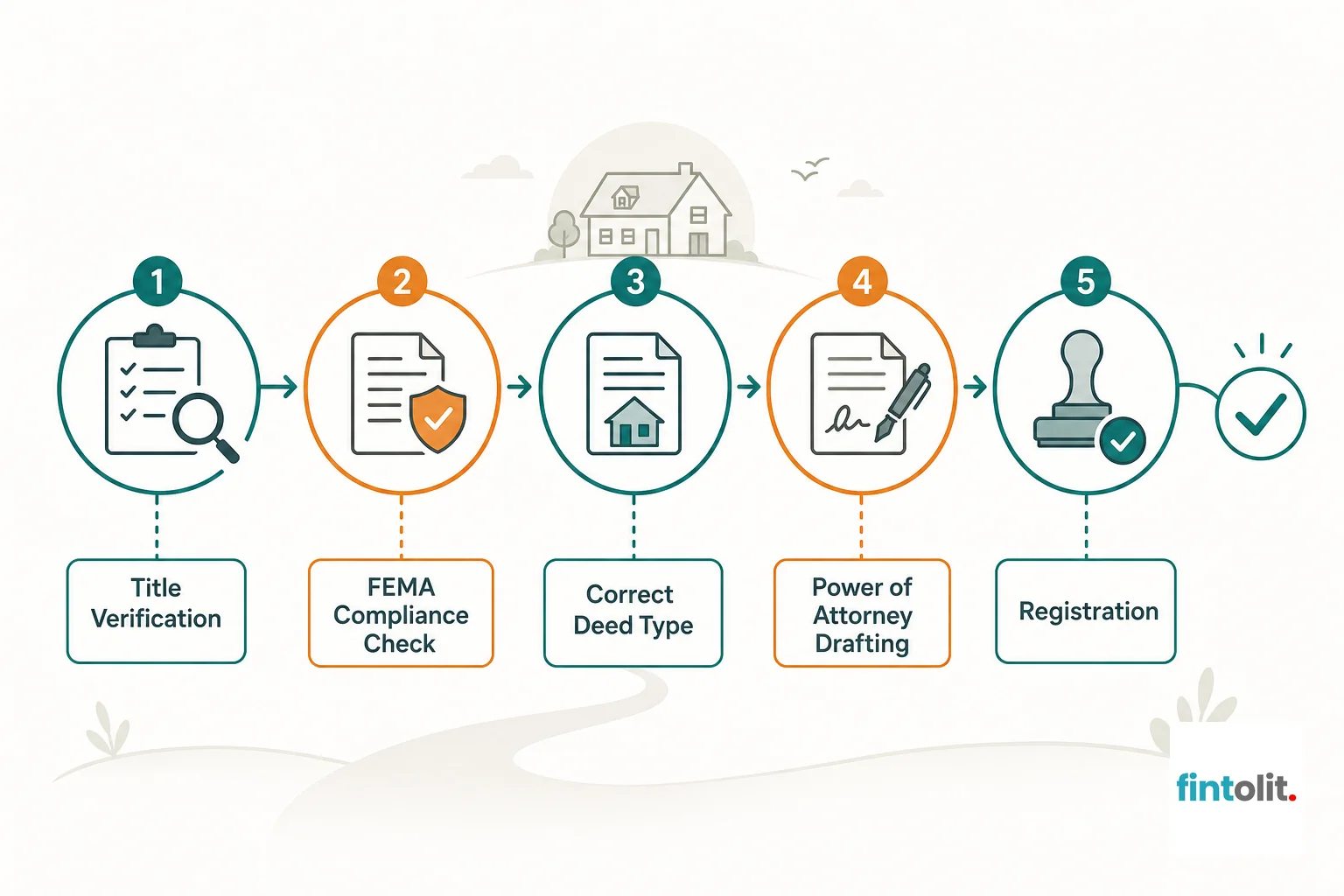
A verified property lawyer walks through each of these steps before money changes hands: confirming the seller's title chain, checking that the land isn't classified as agricultural, drafting the correct deed, and setting up a power of attorney that names exactly what the agent can and can't do. Fintolit assigns a dedicated case manager to keep that process moving, whether you're consulting online from Toronto or booking a Lawyer at Home visit for a family member still living in Delhi.
The same verified lawyer stays on your file from the first consultation through registration, so you're not re-explaining your situation to a new person every time there's an update.
Frequently Asked Questions
Can an OCI holder buy more than one property?
Yes, there's no cap on the number of residential or commercial properties an OCI can own in India. The restriction is on property type, agricultural land specifically, not on quantity.
What happens to agricultural land an OCI already owned before getting the card?
Land legally acquired before OCI registration, or inherited afterward, generally stays with the holder. The restriction targets new purchases going forward, not property already validly held.
Can OCI cardholders gift property to Indian relatives?
Yes, OCIs can gift residential or commercial property to relatives in India through a registered gift deed. Gifting agricultural land follows the same restrictions as buying it, so that specific transfer usually needs closer legal review.
One thing worth saying plainly: not every OCI property question has a clean, settled answer yet. Rules around plantation property definitions and state-specific tenancy laws still vary enough that what applies in Haryana may not apply the same way in Kerala.
If you're an OCI cardholder trying to buy, inherit, or sell property anywhere in Delhi NCR, Gurugram, or Noida, don't let a half-remembered rule from a relative decide your next step. Book a consultation with a verified property lawyer and get a clear compliance plan before you sign anything. Prefer to talk it through first? Chat with us on WhatsApp and a case manager will walk you through what your specific transaction actually needs.
Recommended Resources
You're just getting to the good part.