

You do not need to fly to India to give someone power to sell your flat or manage your bank account there. The correct way to give power of attorney from USA to India is to draft it for the specific transaction, sign it before a US notary, get a state apostille, courier the original, and finish stamping and registration once it lands in India.
Key Takeaways
- No travel required: Sign in the US before a licensed notary; you never need to board a flight to execute a valid POA for India.
- Apostille, not just notarization: Since India is a Hague Convention member, a state apostille authenticating the notary's seal generally replaces the older consular attestation route for most US-executed POAs.
- Original only: Indian sub-registrars will not accept scans or photocopies; the physical apostilled original has to be couriered to your attorney-in-fact.
- Stamp duty deadline applies: Once the POA reaches India, it must be stamped within a set window, and registration is mandatory if it involves immovable property.
- Vague drafting is the top rejection reason: Delhi, Gurugram, and Noida sub-registrar offices reject POAs that don't match the exact property or bank account details on file.
At a Glance: USA-to-India POA Steps
| Step | Where It Happens | What's Required | Typical Turnaround |
|---|---|---|---|
| Draft the POA | USA (with Indian legal input) | Wording matched to the exact Indian transaction | 2-4 days |
| Sign before notary | USA | Notary Public acknowledgment, 2 witnesses recommended | Same day |
| State apostille | US Secretary of State's office | Apostille certificate attached to the notarized document | Varies by state, days to weeks |
| Courier original | USA to India | Physical original, not a scan | 3-7 business days |
| Stamp duty payment | India | Paid within the deadline after the POA reaches India | Same week |
| Registration (if property involved) | Local sub-registrar office | Mandatory for immovable property transactions | Same day appointment |
1. Decide What Powers You're Actually Giving
Start by naming the exact job. A general power of attorney hands over broad authority across finances and property. A specific power of attorney limits your attorney-in-fact to one task, say, selling a particular flat in Rohini or operating one bank account in Gurugram.
Most NRIs only need a specific POA. It's safer, and it's what most sub-registrar offices actually expect to see when the document names one property, one bank, or one transaction. Broad, undefined language is the single biggest reason a wrong type of POA ends up unusable at the registrar's desk.
2. Draft the Document to Match Indian Registrar Requirements
Do not reuse a generic US power of attorney template. Indian sub-registrars want language tied to the exact transaction: the property's khasra or plot number, the bank account number, or the specific court case. Draft it for the Indian side of the deal, not the American one.

Two small details trip people up constantly. Your photo needs to be pasted on the last page of the document, and your signature on the POA has to match the signature in your current, valid Indian passport. A mismatch here is grounds for outright rejection, no exceptions.
This is exactly where document drafting support pays for itself. A lawyer who has actually filed POAs at Delhi-NCR sub-registrar offices knows which clauses get flagged and which ones sail through.
3. Sign Before a US Notary Public
Once the draft is right, sign it in front of a licensed US Notary Public. Under the Uniform Power of Attorney Act, a signature acknowledged before a notary carries a legal presumption of genuineness, which is exactly the credibility an Indian registrar wants to see on a foreign-executed document.
Bring two witnesses if your state or the Indian registrar's local practice expects it. You do not need to visit an Indian consulate to complete this step; the notary route is enough when followed by the correct authentication.
Need a Lawyer for clarity on your case?
Do I need to visit the Indian consulate to notarize my POA?
No. For most US states, a Notary Public plus a state apostille is sufficient; the consulate route is one option, not the required one. Some NRIs still choose consular attestation for extra certainty, but it adds time without adding legal weight once you have a valid apostille.
4. Get the State Apostille (Not Just Notarization)
Notarization alone does not satisfy an Indian registrar. You still need your state's Secretary of State office to attach an apostille, a certificate that confirms the notary's seal and signature are real. India recognizes apostilles under the Hague Convention, which is why this step has largely replaced the older, slower consular attestation process for most US-executed documents.
Turnaround differs by state. Some process apostilles same-day over the counter; others take two to three weeks by mail. Build that into your timeline if there's a deadline waiting on the India side, like a property sale closing.
5. Courier the Original to India
Once apostilled, the document has to physically travel. Email a scan to your attorney-in-fact for their records, but only the original apostilled paper works at an Indian registrar's counter. Use a tracked courier service and confirm delivery before your family member or lawyer in India tries to act on it.
Tell the receiving party exactly what to do next. A POA sitting in a drawer for months before stamping creates its own problems, which brings us to the last stretch.
6. Stamp and Register in India
Stamp duty on your POA has to be paid within a fixed window after the document reaches India. Miss that window and you may face penalties, or worse, a registrar who simply won't process an under-stamped document. Rates and the exact deadline vary by state, so confirm the current figure with a lawyer or the local stamp office before your attorney-in-fact walks in.
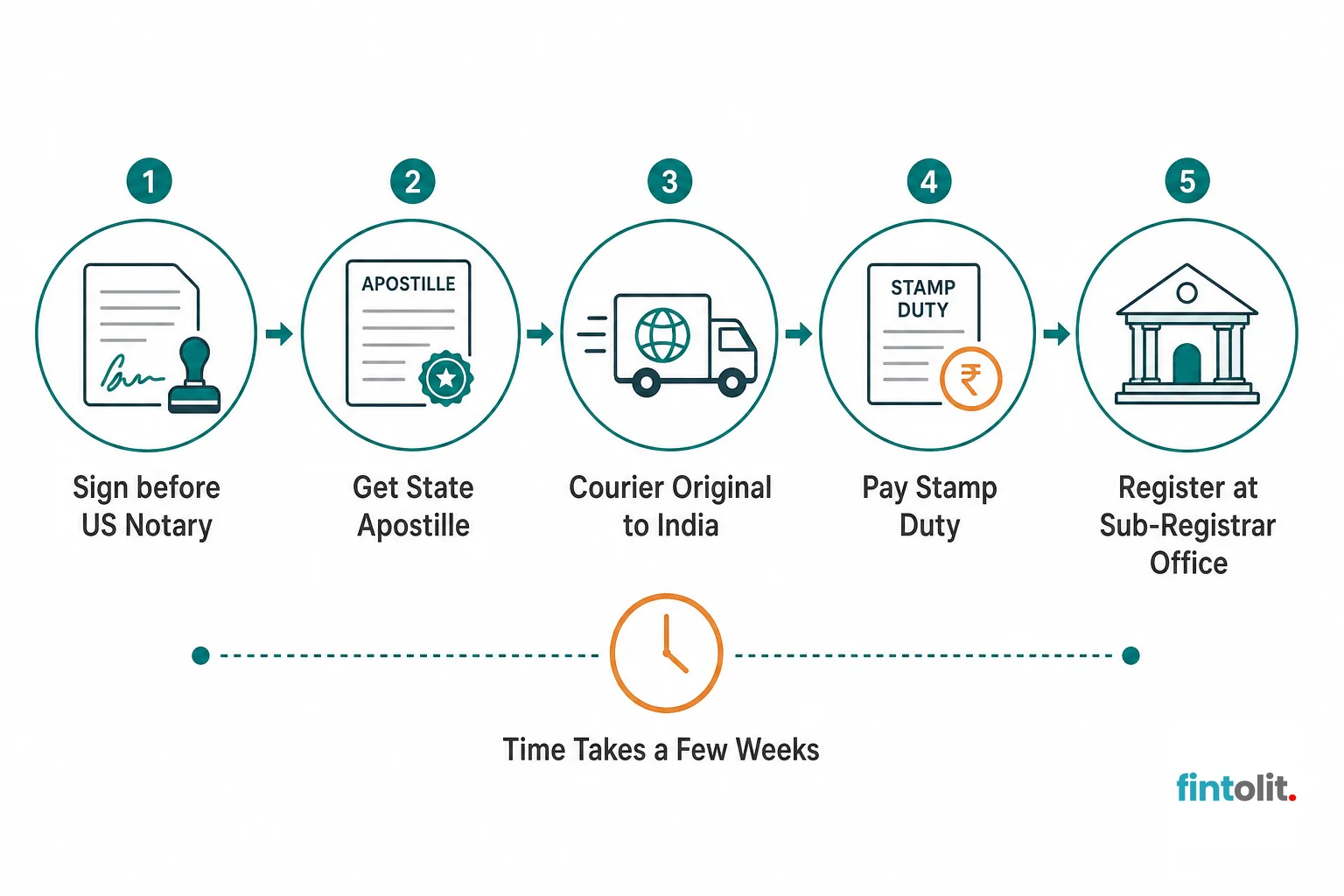
If the POA covers a property sale, purchase, or mortgage, registration at the local sub-registrar office is not optional. An unregistered POA for immovable property is effectively unusable when it matters most, at the point of executing a sale deed.
How is power of attorney different when you're in the US versus already in India?
The execution route changes; the destination doesn't. From the US, you sign before a notary and add a state apostille. In India, you sign before two witnesses and a notary directly. Everything after the document reaches the Indian registrar's desk, stamping and registration, is identical either way.
Common Notary and Attestation Errors That Get POAs Rejected
- Photo missing on the last page: A near-automatic rejection at the counter.
- Signature mismatch: Your POA signature must match your current passport exactly.
- Skipping apostille: Notarization alone, without the state apostille, doesn't satisfy most registrars.
- No registration for property: A stamped but unregistered property POA still won't let your attorney-in-fact complete a sale.
- Generic wording: A POA that doesn't name the specific property, bank, or transaction gets sent back for revision, costing you another courier round trip.

Why Delhi-NCR Registrars Are Especially Strict
Sub-registrar offices across Delhi, Gurugram, and Noida process a high volume of NRI power of attorney filings every week, given how many overseas Indians own property in the region. That volume means clerks have seen every shortcut and every generic template, and they reject inconsistent wording faster than offices with lower NRI traffic.
Getting your drafting checked before you courier anything from the US saves an entire round trip. A property lawyer familiar with Delhi filings can flag a mismatched clause in minutes, something that would otherwise surface only after the registrar rejects your document weeks later.
Need a Lawyer for clarity on your case?
FAQs
How much does POA drafting cost in India?
Costs depend on the complexity of the transaction and whether stamp duty or registration fees apply on top of drafting. Ask a verified lawyer for a fixed quote before you commit, rather than guessing from generic online estimates.
How long does the whole USA to India POA process take?
Expect roughly two to four weeks end to end: a few days for drafting and notarization, one to three weeks for the apostille depending on your state, under a week for courier delivery, and a same-week appointment for stamping and registration in India.
Can one POA cover both a Delhi property and a Gurugram bank account?
It can, but only if both are named specifically in the document. Combining transactions in one POA without precise details is exactly the kind of vague drafting that gets flagged at the registrar's desk, so get each asset spelled out clearly.
Getting a power of attorney wrong doesn't just cost you a courier fee and a few weeks. It can stall a property sale, freeze a bank account, or leave a family member in India unable to act when you actually need them to. If you want the drafting checked by a lawyer who has filed these at Delhi-NCR registrars, book a consultation with Fintolit before you send anything for notarization. Have a quick question first? Chat with us on WhatsApp and get a straight answer, not legal jargon. For related documentation needs, see our guide on legal documentation costs in India.
Recommended Resources
You're just getting to the good part.