

Yes, usually. Under Section 44 of the Transfer of Property Act, 1882, a co-owner can sell their own undivided share without the other co-owners' consent, and the buyer becomes a co-owner in their place. What a co-owner cannot do before partition is sell a specific room, a floor or the whole property. Families in Delhi and Gurugram should understand this line before signing any deed.
Key takeaways
Own share only: A co-owner may sell their own undivided share without asking the others, but never the shares that belong to them.
No exclusive room: Before partition, nobody owns a particular room or floor outright, so a deed for one does not give the buyer exclusive ownership of it.
Buyer steps into the seller's shoes: The buyer gets joint possession and a right to seek partition, and no more than the seller had.
Family dwelling-house limit: An outsider buying into an undivided family's dwelling-house cannot claim joint possession against the family living there.
A quarrel does not void a sale: Other co-owners must prove a specific ground, seek partition or try mediation.
At a glance: what a co-owner can and cannot sell
Question | Short answer |
|---|---|
Sell own undivided share without consent? | Generally yes, under Section 44 |
Sell the entire property alone? | No, other co-owners' shares are not theirs to sell |
Sell a specific room or floor before partition? | No exclusive ownership can pass; the buyer gets at most a share |
Does the buyer get exclusive possession? | No, only joint possession and a right to seek partition |
Outsider buying into a family dwelling-house? | No joint possession against family members living there |
Can other co-owners cancel the sale for disagreeing? | No, they need a legal ground, a partition suit or mediation |
What does Section 44 of the Transfer of Property Act say?
Section 44 lets one of several co-owners transfer their own share or interest in immovable property. The buyer gets the seller's right to joint possession and to seek partition, subject to any conditions or liabilities already attached to that share. A second paragraph limits outsiders who buy into an undivided family's dwelling-house.
The Times of India explains that a co-owner may transfer their own share but cannot transfer the shares belonging to others. The buyer acquires the rights attached to the transferred share and becomes a co-owner.
So consent matters in one situation: when the whole property, or an identified part of it, is being sold. As Moneycontrol reports, a co-owner cannot transfer the entire property or a specific portion without partition. Selling a share is allowed; selling "the first floor" is not.
What is the difference between an undivided share and a specific room or floor?
An undivided share is a fraction of the whole property, such as one-third of a house, held jointly with others. A specific room or floor is an identified physical portion. Before partition, no co-owner owns any particular portion exclusively, so none can sell one as if it were solely theirs.
Think of a shared pizza that is still uncut. Each person owns a third of the whole pizza, not the left-hand slice. Partition is the moment the knife comes out.

A hypothetical example
Suppose three siblings, Anil, Beena and Charu, inherit a three-storey house in Gurugram, one-third each, with no partition. This is an invented example, not a real client.
Anil can sell his one-third share to a buyer without asking his sisters. He cannot sell "the first floor" and promise the buyer it is theirs alone. Even if that deed is registered, the sisters' shares are untouched, and the buyer at most steps into Anil's one-third.
A registered deed proves a transfer happened. It does not prove the seller owned what the deed describes. That distinction trips up many first-time buyers.
Need a Lawyer for clarity on your case?
What does the buyer of an undivided share actually get?
The buyer gets the seller's fractional share in the whole property, along with a right to joint possession and to seek partition. The buyer does not get exclusive possession of any room, and takes the share subject to existing mortgages, claims and family arrangements. In short, the buyer gets no more than the seller had.
In practice, that means a buyer joins a house where other owners may already live. Expect friction. Lenders and later buyers may also hesitate over an undivided share, so resale can be harder than with a clearly separated flat.
The buyer gets: the seller's fraction, joint possession rights, and the right to ask a court for partition.
The buyer does not get: a named room, a boundary, or the right to push other owners out.
Can an outsider buy a share in an undivided family dwelling-house?
Legally yes, but with a major limit. Under the second paragraph of Section 44, an outsider who buys an undivided share in a dwelling-house belonging to an undivided family cannot claim joint possession or common enjoyment of that house. Family members living there can stay where they are.
The limit applies where the buyer is not a member of the family. A general definition of undivided interest helps here: every holder has rights over the whole, but the family's occupation of its home is protected from an outsider.
How far this restriction reaches, including whether an outsider can use a partition suit to get around it, depends on the facts and on how courts read the words "undivided family". This is genuinely contested ground, so do not assume either way.
Our practical view: if you are an outsider offered a share in a family home where relatives live, do not pay unless those relatives agree in writing. Your money could be locked in a share you cannot enjoy for years.
What do Indian courts say about a co-owner's sale?
Courts treat a co-owner's sale of their own share as valid, but the buyer receives only what the seller had. The Supreme Court has said a person cannot transfer a greater right than they hold, and the Delhi High Court has held that Section 44 does not bar a co-owner from selling an undivided share in joint property.
Two decisions are worth knowing. Read the full text of each from the official source: the Supreme Court of India website and the Delhi High Court website. Our summaries are simplified.
Ramdas v. Sitabai
Court and year: Supreme Court of India, 2009.
Citation: (2009) 7 SCC 444.
Facts and issue: A dispute over a transfer made by one of several co-owners of property, raising how far that transfer could bind the others.
Ruling: Under Section 44, a person cannot transfer a right greater than the one they themselves have. Later courts, including the Delhi High Court, cite it for that point.
Practical implication: A co-owner's sale cannot take away another co-owner's share. Check exactly what fraction the seller holds.
Raju Sardana v. Pawan Arya & Ors
Court and year: Delhi High Court, 2025.
Citation: 2025 Supreme(Online)(Del) 3526 (an online reporter citation; check the official neutral citation).
Facts and issue: A dispute in which the question was whether Section 44 stops a co-owner from selling an undivided share in joint property.
Ruling: No such bar exists. A co-owner is not stopped from transferring their share merely because the property is joint, though they cannot give a right greater than they hold.
Practical implication: Delhi families cannot expect a court to block a share sale only because the property is undivided.
The statute itself is available on India Code, the government's repository of Central Acts.
Need a Lawyer for clarity on your case?
How do the rules change by property type?
The share-selling rule stays the same, but what a co-owner actually owns can differ. Inherited, jointly bought, family and agricultural property each carry extra checks, such as succession papers, family settlements, joint-family rules or state land laws. Check the title papers before assuming a share can be sold freely.
Property type | What can change the position |
|---|---|
Jointly purchased | The sale deed names each buyer; check any stated shares and loan documents |
Inherited | Shares flow from a will or succession; unclear heirs mean unclear shares |
Ancestral or joint family | Shares may only become fixed at partition |
Family dwelling-house | Outsider restriction in the second paragraph of Section 44 |
Agricultural land | State land, tenancy and pre-emption laws differ across Delhi, Haryana and Uttar Pradesh |
Family settlement or will | May already fix who owns what, limiting what a co-owner can sell |
For ancestral property in particular, our guide on partitioning ancestral property when siblings cannot agree explains the next step.
What can other co-owners do if they disagree with the sale?
A disagreement alone does not cancel a valid sale of a co-owner's own share. The other co-owners can challenge the sale on a specific ground, such as the seller transferring more than they own, ask a court for partition, or try mediation first.
Realistic grounds include a seller who sold the whole property or a named portion, forged or fraudulent papers, a seller who was not legally able to transfer, or a share already bound by a family settlement or earlier agreement.
Challenge the deed: This needs evidence of a specific defect, not just displeasure.
Seek partition: This turns shares into physical portions and ends the shared arrangement.
Try mediation: It is often quicker and keeps the family speaking. Our overview of property disputes in Delhi and their remedies covers the options.
How do you check a co-owner's share before buying or selling it?
Start with the title chain, then confirm who all the co-owners are, what each share is, and whether any loan or dispute is attached. Insist on a registered deed that names the exact fraction being sold, and have a lawyer read the papers before any money moves.
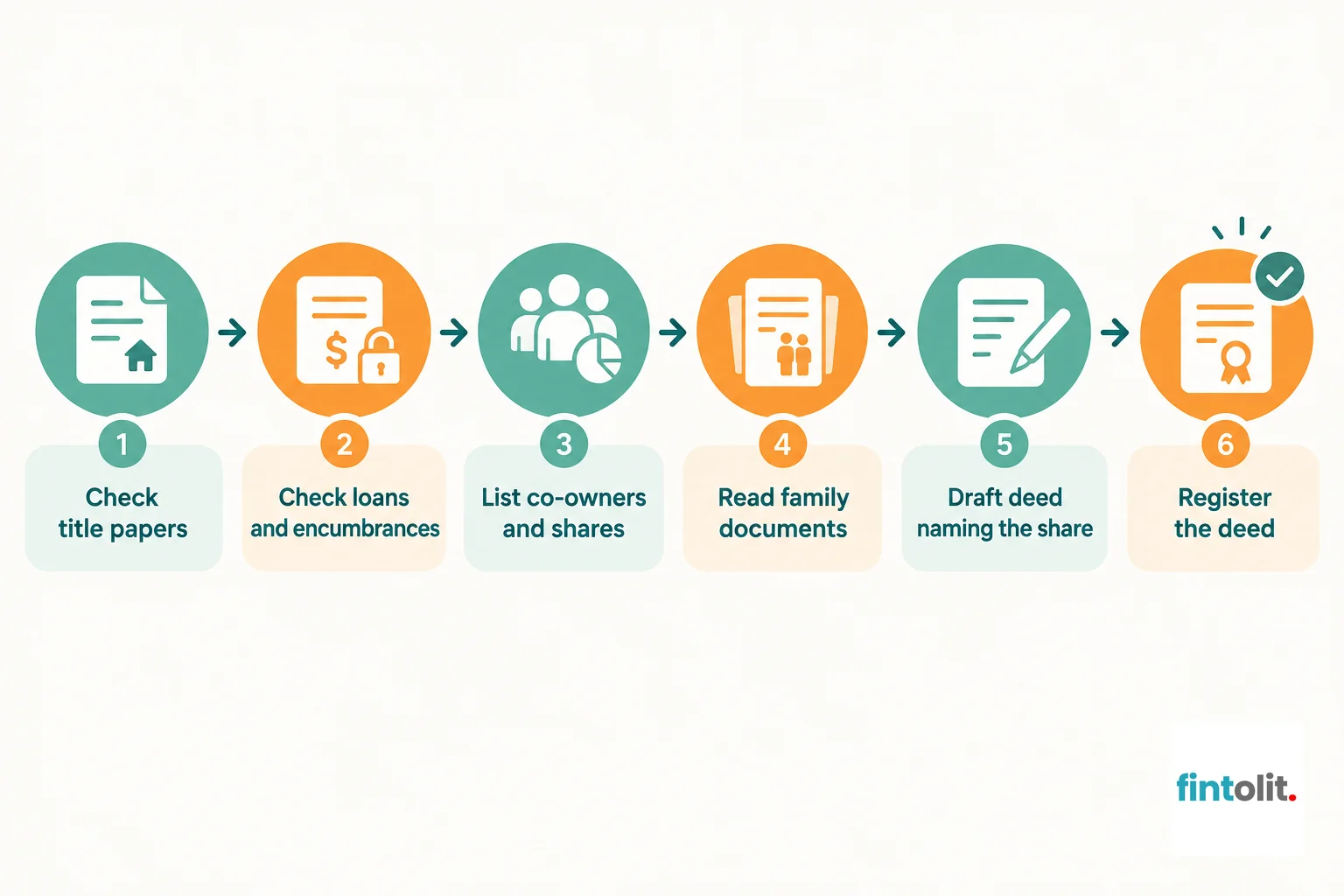
Check the title papers. Trace ownership back through earlier deeds, wills or succession documents.
Check loans and encumbrances. An encumbrance certificate and bank records show mortgages or charges on the share.
List every co-owner and share. Missing heirs are a common source of later claims.
Read family documents. Look for settlements, earlier agreements to sell, or court cases already pending.
Pick the right document. A sale, a gift and a release work differently; see our comparison of gift deed vs sale deed.
Name the share and register. The deed should state the fraction, not a room, and be registered at the Sub-Registrar's office. Rules and charges differ between Delhi and Haryana.
Common questions
Can a co-owner sell a specific room or floor?
Not as exclusive property. Before partition, every co-owner holds a share in the whole, so a deed for a particular room or floor cannot give the buyer exclusive ownership. The buyer can at most claim the seller's share and ask the court to consider the portion during partition.
Is a registered sale deed enough to get exclusive possession?
No. Registration records the transfer; it does not enlarge what the seller owned. A buyer of an undivided share gets joint possession and a right to seek partition, not exclusive possession of a named part of the property.
Does the same rule apply in Delhi and Gurugram?
Section 44 is a Central law, so it applies in both. Local differences arise in registration charges, agricultural land rules and other state laws. Always check the state rules where the property sits, as Delhi, Haryana and Uttar Pradesh each have their own.
Need a Lawyer for clarity on your case?
How much does a property consultation with Fintolit cost?
Our Online Consultation is Rs 1,599 including taxes, as a 60 minute video call. Lawyer at Home is Rs 3,500 including taxes, as an 80 minute consultation at your home. Both include a 15-day free follow-up.
Talk to a property lawyer before you sign
Co-ownership disputes usually begin with a paper nobody read closely. If you are thinking of selling your share, buying one, or reacting to a relative's sale, a short conversation first is cheaper than a long dispute later.
At Fintolit, you can book a consultation with a property lawyer online or at home across Delhi and Gurugram. The same advocate continues with your case till closure. If you would rather start with a quick question, you can chat with us on WhatsApp. We cannot promise any outcome, but we can tell you where you stand.
Source-verification note
This article gives general information, not legal advice. Before publication, a qualified Indian property lawyer should review the points below.
Statute text: Check both paragraphs of Section 44 against the current text on India Code.
Judgments: Confirm each citation, the facts and the holding against the official judgment text. The Delhi High Court citation is an online reporter reference.
Family dwelling-house limit: Review how courts currently read "undivided family" and whether an outsider can seek partition.
State laws: Confirm agricultural land, pre-emption and registration rules in Delhi, Haryana and Uttar Pradesh.
News sources: The Times of India and Moneycontrol items are news reports, not primary law.
Recommended Resources
You're just getting to the good part.