

Three brothers, one house in Rohini, and a father who died without a will. That is how most calls about partition ancestral property India disputes start. The fastest path out is usually not a courtroom; it's a documented settlement backed by legal advice, reached through mediation before anyone files a suit that can drag on for years.
Key Takeaways
- Ancestral property is different from inherited property: it must pass undivided through four generations of male lineage to count as ancestral under the Hindu Succession Act.
- Daughters have equal coparcenary rights: since the 2005 amendment, daughters get the same share as sons, regardless of when they married.
- Court partition suits in Delhi NCR often take 3-7 years: mediated settlements between siblings can close in 2-6 months with the right legal support.
- A registered partition or settlement deed is non-negotiable: verbal agreements between siblings collapse the moment property values rise or one party changes their mind.
- One sibling occupying the house doesn't erase others' shares: possession isn't ownership, and a buyout or sale is usually cleaner than forcing a physical split.
Partition Ancestral Property India: Quick Facts
| Route | Typical Timeline | Typical Cost Driver | Best For |
|---|---|---|---|
| Partition suit (civil court) | 3-7 years | Court fees + advocate fees across hearings | When one sibling refuses to cooperate at all |
| Mutual settlement deed | 2-8 weeks | Drafting + stamp duty + registration | When siblings broadly agree on shares |
| Mediation-led resolution | 2-6 months | Lawyer consultation + mediator fees | When siblings disagree but want to avoid court |
| Family arrangement (informal) | Immediate, but unstable | Minimal, but high risk later | Not recommended for property above nominal value |
| Buyout by one sibling | 1-3 months after valuation | Property valuation + registration charges | When one sibling wants to keep the house |
The Case: Three Brothers, One House in Rohini
Their father had built the Rohini house in 1988 and lived there until he passed away in 2023, without leaving a will. Under the Hindu Succession Act, his three sons and his widow became equal coparceners in the property overnight.
The eldest brother had lived there for two decades, paying the property tax and handling repairs. The younger two, both settled in Gurugram and Noida, wanted their share converted to cash. Nobody had touched the title documents in fifteen years.
What looked like a simple family matter turned tense fast. The eldest brother assumed possession meant priority. His brothers assumed equal shares meant an equal say in whether to sell. Neither was fully wrong, and neither had a lawyer yet.
What Counts as Ancestral Property Under the Hindu Succession Act?
Ancestral property is land or a house that has passed down undivided through four generations of male lineage, without any partition along the way. A house your father bought himself and left to you in a will is inherited, not ancestral, even though it feels the same at the dinner table.
That distinction matters because ancestral property creates automatic coparcenary rights from birth. Every son and, since the 2005 amendment to the Hindu Succession Act, every daughter becomes a co-owner the moment they're born into the family, not the moment a parent dies.
Self-acquired property works differently. The owner can will it to whoever they choose, and children have no automatic claim while the parent is alive. If you're unsure which category your family's property falls into, our guide on property law in Delhi breaks down how title history gets traced.
How Do You Partition Ancestral Property in India?
There are two formal routes, and choosing the wrong one wastes years. Start with a lawyer who reads the title deed, confirms who the legal heirs actually are, and checks whether the property has any existing mortgage, litigation, or unpaid dues.
If every heir agrees on their share, a mutual partition deed gets drafted, stamped, and registered at the sub-registrar's office. This converts undivided ownership into defined, separate shares, or into a buyout agreement if one heir wants to keep the whole property.
Need a Lawyer for clarity on your case?
If even one heir refuses to sign, or disputes the shares, someone has to file a partition suit in civil court. The court appoints a commissioner to assess the property, determines each party's legal share, and can order an actual physical division or a sale with proceeds split accordingly.
Mediation First: How the Rohini Case Actually Got Resolved
The brothers booked a family lawyer consultation in Delhi before anyone filed anything in court. That single decision saved them years.

A dedicated case manager coordinated between all three brothers and the mother, scheduling calls around everyone's work hours across two cities. The lawyer verified the property's title chain first, confirmed all four heirs' shares under the Hindu Succession Act, then proposed a structured mediation instead of a court filing.
The eldest brother agreed to buy out his siblings' shares at a jointly commissioned market valuation, paid over two installments backed by a registered settlement deed. The whole process, from first consultation to registration, closed in eleven weeks.
The lawyer's exact line to the brothers: "You can spend three years fighting for a house worth less than the legal fees, or you can spend three months settling it properly." That reframing is what actually moved the case forward.
What Does It Cost and How Long Does a Property Dispute Take in Delhi?
A partition suit in Delhi's civil courts routinely takes three to seven years, factoring in commissioner reports, multiple hearing adjournments, and appeals if either side contests the final order. Court fees scale with the declared property value, and advocate fees accumulate across every hearing.
A mediated settlement moves faster because there's no court calendar to wait on. Most sibling disputes we see resolve in two to six months once everyone commits to the process, with costs concentrated in the initial legal consultation and drafting fees rather than repeated court appearances.
Fintolit works across Delhi, Gurugram, and Noida with a fixed, upfront fee for the full consultation, so families know the cost before committing to anything. There's no hourly meter running while siblings argue over old grievances.
Partition Suit vs Mutual Settlement vs Mediation
Choosing between these three routes usually comes down to how willing your siblings are to talk at all. If they still take your calls, mediation almost always beats litigation on cost, time, and what's left of the relationship afterward.
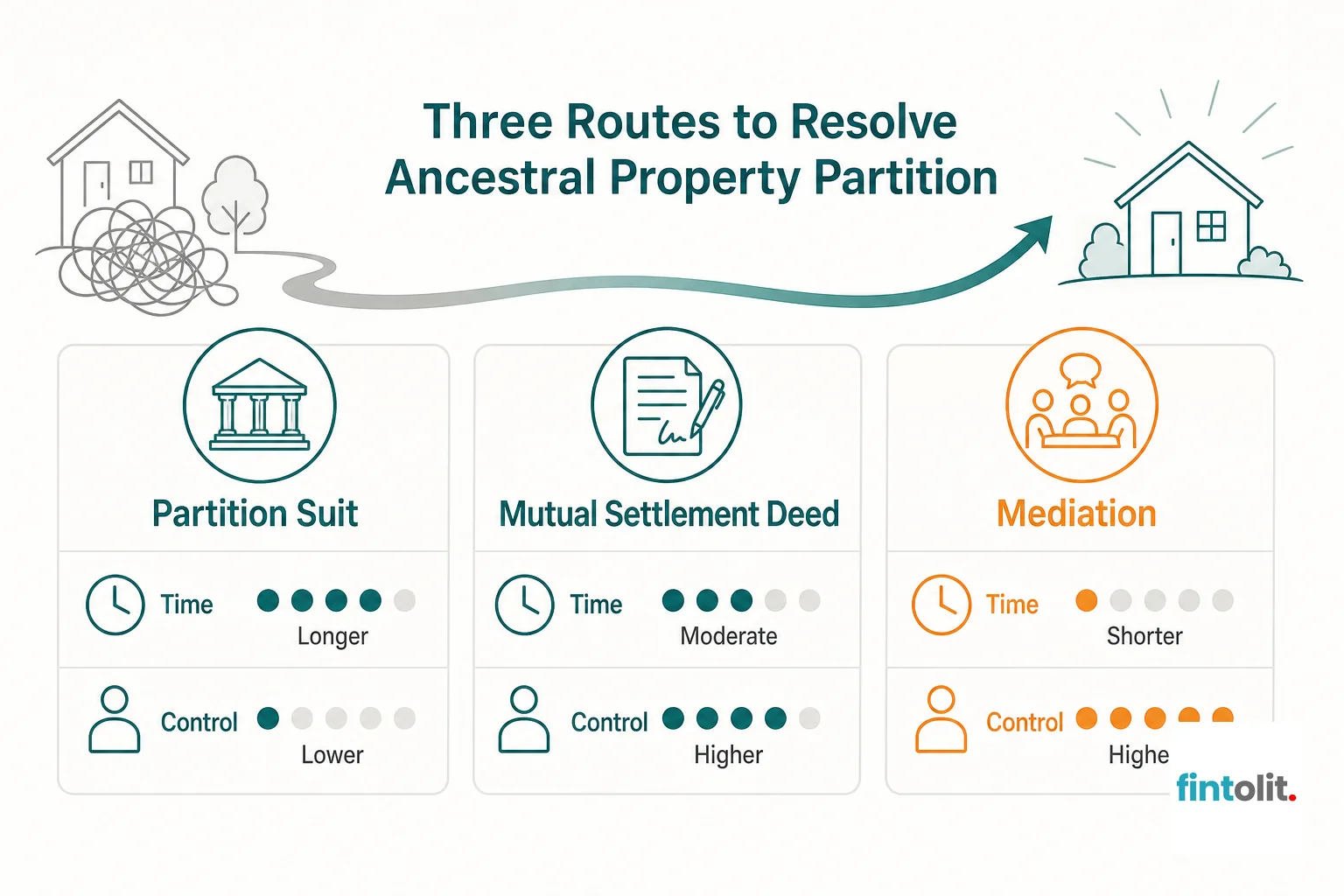
| Factor | Partition Suit | Mutual Settlement Deed | Mediation |
|---|---|---|---|
| Timeline | 3-7 years | 2-8 weeks | 2-6 months |
| Control over outcome | Court decides | Full control, if all agree | Guided negotiation, shared control |
| Best when | One heir refuses to engage | Everyone already agrees on shares | Disagreement exists but talks are possible |
| Relationship impact | Often severe | Minimal | Moderate, usually recoverable |
| Requires court appearance | Yes, repeatedly | No | No, unless mediation fails |
Common Mistakes Siblings Make During an Ancestral Property Dispute
Most disputes get worse not because the law is unclear, but because of small, avoidable errors early on.
- Skipping a title verification: nobody checks whether the property has an existing loan, litigation, or an unregistered prior sale before negotiating shares.
- Relying on a verbal split: a "we'll sort it out among ourselves" agreement has no legal weight once one sibling changes their mind or property prices rise.
- Ignoring daughters' or the mother's shares: post-2005, daughters are equal coparceners; excluding them from a settlement deed makes it challengeable later.
- Waiting years before consulting a lawyer: delays let occupation-based claims and informal arrangements harden into disputes that are harder to unwind.
- Assuming possession equals ownership: living in the house or paying its bills doesn't erase the other heirs' legal shares under the Hindu Succession Act.
For a full walkthrough of what documents to keep organized before any of this starts, see our guide on legal documents every Indian adult needs.
Need a Lawyer for clarity on your case?
Frequently Asked Questions
Can one sibling block partition of ancestral property?
No single heir can permanently block a legal partition. They can refuse a mutual settlement, but any coparcener can file a partition suit in civil court to force a legal division of shares, regardless of another heir's objection.
Do daughters get an equal share in ancestral property?
Yes. Since the 2005 amendment to the Hindu Succession Act, daughters are coparceners by birth with the same share as sons, whether they're married, unmarried, or living abroad. Courts have upheld this even for property inherited before 2005 in several rulings.
What documents do you need to file a partition suit or settlement deed?
You'll need the original or certified title deed, the legal heir or succession certificate, a family tree establishing all coparceners, property tax records, and any existing mortgage or encumbrance documents. Missing paperwork is the single biggest cause of delay in these cases.
Is mediation legally binding once siblings agree?
Only once the agreed terms are drafted into a registered settlement or partition deed. A verbal or WhatsApp-message agreement between siblings, even if everyone nods along, carries no enforceability if someone backs out later.
If your family is stuck on an ancestral property that nobody's agreed how to split, don't let it sit for another year while relationships and property records both get harder to untangle. Book a consultation with a verified property lawyer who can review your title documents and lay out a resolution plan before you spend a rupee on court fees. You can also chat with us on WhatsApp if you'd rather explain the situation in your own words first. The Rohini brothers settled their house in eleven weeks; your family's timeline starts with the first honest conversation, backed by the right legal advice.
You're just getting to the good part.