

A gift deed transfers property for free between people who often share blood or marriage ties, while a sale deed transfers it for a price, to anyone. The right pick between gift deed vs sale deed India comes down to whether money is changing hands, how much stamp duty you can absorb, and whether you might need to reverse the decision later.
Key Takeaways
- Consideration is the dividing line: a sale deed always involves payment; a gift deed involves none, and that single fact changes the tax and stamp duty math entirely.
- Stamp duty concessions exist for family gifts: several states, including Delhi and Haryana, charge lower stamp duty when property is gifted to a spouse, child, or parent.
- A gift deed is hard to undo: once registered and accepted, it can only be revoked on narrow legal grounds, unlike an unregistered will which you can rewrite anytime.
- Sale deeds carry the most fraud risk: a rising number of searches for "fake sale deed" reflects real cases where forged signatures or fabricated documents slip past buyers who skip title verification.
- Both need registration to be valid: neither instrument transfers ownership until it's stamped, signed, and registered at the sub-registrar's office.
At a Glance: Gift Deed vs Sale Deed
| Factor | Gift Deed | Sale Deed |
|---|---|---|
| Consideration involved | None | Agreed price paid by buyer |
| Who it's typically used for | Family members, close relatives | Any buyer, related or not |
| Stamp duty | Often concessional for blood relatives in states like Delhi and Haryana | Standard state rate on market value |
| Income tax on receiver | Exempt if from a "relative" under Section 56(2)(x) | Not applicable; seller pays capital gains tax |
| Can it be reversed? | Only on narrow grounds like fraud or coercion, and only if the deed itself allows revocation | Generally final once registered; challenge requires proving fraud or defect in title |
| Registration required | Yes, compulsory | Yes, compulsory |
| Best suited for | Parent-to-child transfers, family settlements | Arm's-length purchase or sale |
What Actually Separates a Gift Deed From a Sale Deed
Both documents move a title from one name to another. The difference sits in what, if anything, moves the other way. A sale deed records the price, the parties, and the possession date, and it's the standard route when a buyer and seller have no family connection.
A gift deed skips the price entirely. The giver, called the donor, transfers ownership out of affection or family planning, not in exchange for money. Courts and registrars still expect the deed to be signed, accepted by the receiver during the donor's lifetime, and registered, exactly like a sale.
Neither document works as a scribbled note. Skip registration and the transfer has no legal weight, no matter how many people signed it.
Stamp Duty: Where the Real Cost Difference Shows Up

Stamp duty is usually the first number families ask about, and it's where gift deeds pull ahead for close relatives. Delhi, Haryana, and several other states cut the rate meaningfully when the transfer is between a husband and wife, parent and child, or siblings.
A sale deed, by contrast, attracts the full state stamp duty on the property's market value or the agreed price, whichever is higher, regardless of who the buyer is. If you're in Delhi, Gurugram, or Noida, that gap between a family gift and an open-market sale can run into lakhs on a mid-sized flat.
That gap is exactly why some families try to disguise a sale as a gift, or vice versa, to save on duty. Don't. Registrars and tax officers cross-check consideration amounts against declared property values, and a mismatched deed invites scrutiny you don't want.
Choosing the wrong instrument may lead to unnecessary tax exposure or a deed that doesn't hold up when the property is resold years later.
Income Tax Angle Families Miss
A gift from a relative carries no income tax for the person receiving it, but a gift from a friend or distant acquaintance above a threshold gets taxed as income. This exemption under Section 56(2)(x) of the Income Tax Act is why most gift deeds happen strictly within defined family relationships.
Need a Lawyer for clarity on your case?
A sale works differently. The seller, not the buyer, faces capital gains tax on the difference between the sale price and the original cost of acquisition, adjusted for inflation if it's a long-term holding. The buyer's tax exposure is minimal beyond stamp duty and registration charges.
Families sometimes assume gifting sidesteps tax altogether. It doesn't always. If a parent gifts a rental property to a minor child, rental income still gets clubbed back into the parent's taxable income under clubbing provisions. Read the fine print before you assume a gift is tax-free in every direction.
Can a Gift Deed Be Cancelled? What About a Sale Deed?
A registered gift deed can be cancelled only on narrow grounds: fraud, coercion, undue influence, or a revocation clause the donor built into the original document. A sale deed can be challenged too, but usually only by proving the title was defective, forged, or the transaction itself was fraudulent.
This is where the "fake sale deed" searches this site sees every month make sense. A forged sale deed usually surfaces years later, when a buyer's lawyer runs a title search before a resale and finds a chain of ownership that doesn't add up.
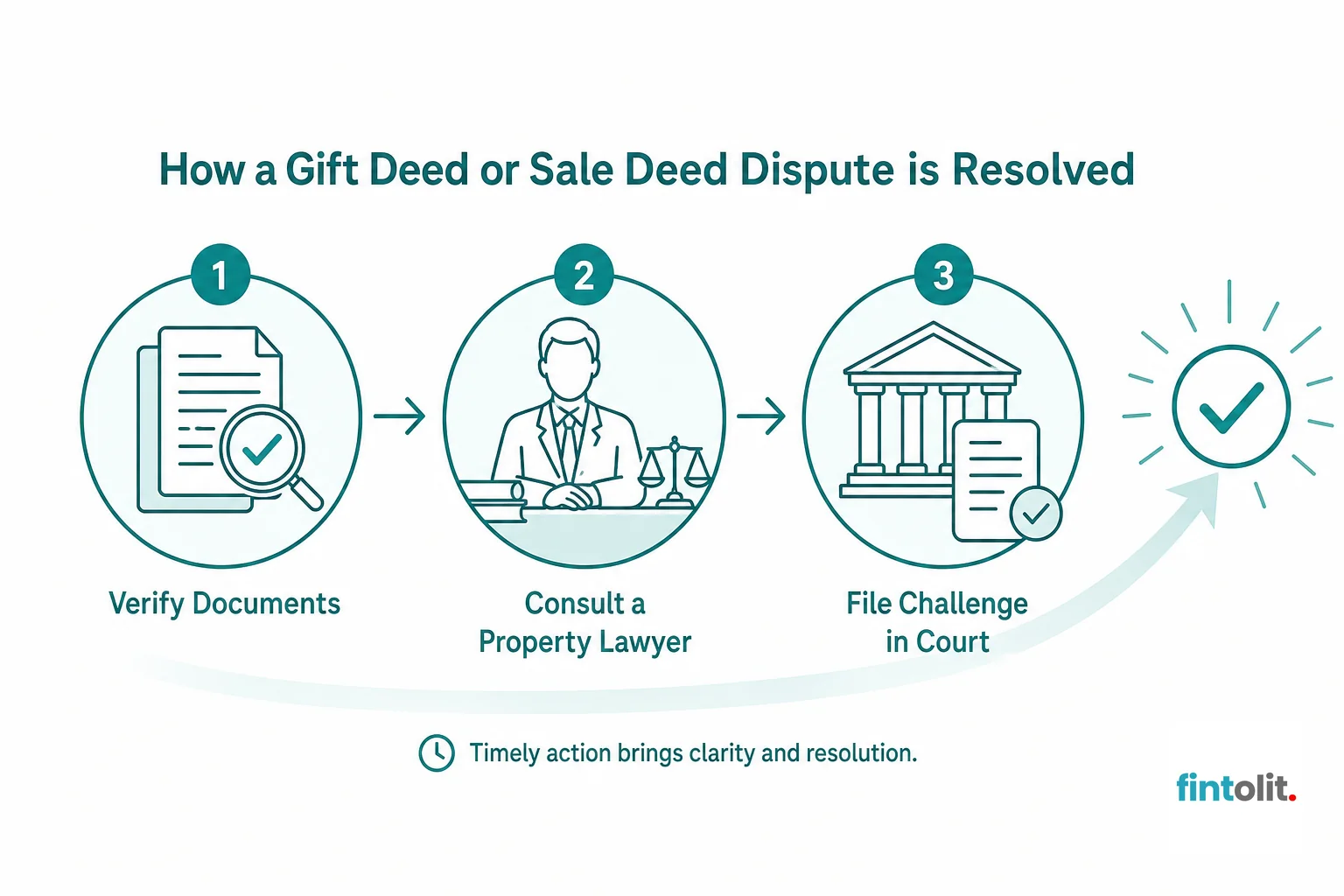
Once that happens, the fix isn't a phone call to the registrar. It means gathering the original documents, getting a lawyer to trace the title history, and filing a civil suit to declare the forged deed void. We've walked families through exactly this in cases involving property disputes in Delhi, and the earlier the forgery is caught, the cheaper and faster the fix.
Gift deeds carry a different risk. A child who receives property under a gift deed, then stops caring for an elderly parent, can sometimes see the gift reversed under the Maintenance and Welfare of Parents and Senior Citizens Act, 2007, if the deed included a condition of care.
Is a fake sale deed hard to detect before you buy?
A fake sale deed is detectable before purchase through a proper title search, encumbrance certificate check, and verification of the seller's chain of ownership at the sub-registrar's office. Skipping this step, not the forgery itself, is usually what lets fraud succeed.
Where a Will Fits Into This Choice
A will is the third option families keep confusing with the other two, and it behaves nothing like either. A gift deed and a sale deed transfer ownership immediately, once registered. A will only takes effect after the person who made it dies, and it can be changed as many times as they like before that.
If a parent wants a child to have the flat now, with certainty and no ambiguity, a gift deed does that. If the parent wants flexibility to change their mind, or worries about how multiple children will split assets, a will keeps options open until the very end.
The catch with wills is probate. Heirs sometimes need a court to validate the will before banks or registrars will act on it, which adds months to a process a gift deed avoids entirely.
How Much Will a Lawyer Cost For This?
Lawyer fees for drafting and registering a gift or sale deed usually depend on the property's value, the complexity of the title, and whether the transaction is contested. Fixed-fee models remove the guesswork that hourly billing creates on property matters.

Search data shows real hesitation here, people typing "lawyer fees for property disputes in India" and "how much does a lawyer cost in India" long before they type the name of any legal document. That hesitation is fair. Property lawyers who bill by the hour can turn a simple deed drafting into an open-ended expense.
Need a Lawyer for clarity on your case?
Fintolit assigns a verified property lawyer with a fixed, upfront fee and a dedicated case manager who tracks the drafting and registration end to end. You see the lawyer's name and background before you pay anything, and the same lawyer stays with you from the first consultation to the deed's final registration, no handoffs mid-case. If you want a clearer breakdown of what different legal services cost in this space, our guide on legal fees in India walks through typical ranges.
Which One Should Your Family Actually Use?
If you're a parent transferring a flat to your child and want certainty now, a gift deed usually wins. The stamp duty concession for blood relatives in Delhi NCR makes it cheaper than a sale, and it removes the property from your estate immediately.
If you're selling to someone outside the family, or even to a relative at fair value because you need the money, a sale deed is the only honest option. Trying to structure a real sale as a gift to save on duty is not a shortcut; it's the kind of decision that surfaces as a "fake sale deed" problem for someone down the line.
For blended families, second marriages, or situations where you might change your mind about who inherits what, neither a gift deed nor a sale deed fits. A will, paired with clear estate planning, protects you better because it stays flexible until your final decision matters.
One thing worth admitting: no single instrument is right for every family, and anyone telling you otherwise hasn't looked at your actual title documents yet.
Frequently Asked Questions
What's the biggest mistake families make when choosing between these documents?
The biggest mistake is picking based on stamp duty savings alone, without checking whether the transfer can be reversed later if family circumstances change, or whether it triggers an unexpected tax event for either side.
Does a gift deed avoid stamp duty completely?
No, a gift deed does not avoid stamp duty completely; it usually attracts a reduced rate for transfers between close relatives, but the duty itself is still payable and varies by state.
Can NRIs use a gift deed to transfer property in India?
Yes, NRIs can use a gift deed to transfer property in India to relatives, subject to FEMA rules and registration at the property's local sub-registrar office, which is easier to manage with a lawyer who can represent them locally.
Property transfers are one of those decisions that look simple until the paperwork is wrong, and by then the cost of fixing it is far higher than the cost of getting it right the first time. Whether you're leaning toward a gift deed, weighing a sale, or still deciding if a will suits your family better, book a consultation with a verified property lawyer who can look at your actual documents before you sign anything. If you'd rather talk it through first, message us on WhatsApp and we'll point you to the right specialist.
Recommended Resources
You're just getting to the good part.