

You need a corporate lawyer for founder agreement disputes the moment a disagreement over equity, roles or exit terms cannot be settled by talking, and before anyone stops attending board meetings, freezes bank access or sends an angry email. In Delhi NCR, early legal help usually keeps the matter out of the NCLT and out of court.
Key takeaways
- Act at the warning signs: Skipped board meetings, withheld financial data and "we'll fix the paperwork later" are the usual first signals. A lawyer can reset terms far more cheaply at this stage than after a lock-out.
- Your documents decide the route: The founders' agreement, shareholders' agreement and Articles of Association together set your rights. Where they conflict, the Articles generally bind the company.
- NCLT is for oppression, arbitration is for contract: Oppression and mismanagement petitions under Sections 241-242 of the Companies Act, 2013 go to the NCLT. NCLT benches in 2026 held such disputes are not arbitrable, even where an arbitration clause exists.
- Criminal law is a last resort: Since 1 July 2024, BNS, BNSS and BSA replace the IPC, CrPC and Evidence Act. Offences committed before that date are still tried under the IPC.
- Start with a fixed-fee consultation: A 60-minute online session with a verified senior lawyer costs Rs 1,599 including taxes, so you know your position before you escalate.
Founder agreement disputes at a glance
| Problem | Documents to pull first | Usual remedy | Forum |
|---|---|---|---|
| Equity or vesting disagreement | Founders' agreement, share certificates, cap table | Negotiated reset, legal notice, arbitration if a clause exists | Arbitral tribunal or civil court |
| Shut out of management or decisions | Articles, shareholders' agreement, board minutes | Board and shareholder remedies, then an oppression petition | NCLT |
| Money moved out of the company | Bank statements, ledgers, invoices | Mismanagement petition; criminal complaint if dishonest intent is clear | NCLT; police or Magistrate under BNSS |
| Exit price dispute | Exit, transfer and valuation clauses | Negotiated buyout; share purchase ordered under Section 242 | Negotiation, mediation, NCLT |
| Who may file an oppression petition | Share register, member list | Section 244: 100 members, or one-tenth of members (whichever is less), or holders of one-tenth of issued share capital | NCLT |
| Arbitration clause in the agreement | Dispute resolution clause | Contract claims may go to arbitration; oppression claims stay with the NCLT per 2026 benches | Split forums |
When do you need a corporate lawyer for a founder agreement dispute?
You need a corporate lawyer when a founder breaches or ignores the agreement and direct talks have failed, when you are being excluded from decisions or information, or when someone proposes new equity terms you have not seen. Earlier is better, because every week of silence weakens your position.
Most worried founders we hear from in Gurugram and Noida wait too long. They hope the relationship will recover. Meanwhile the other founder issues shares, changes bank signatories or approaches investors alone.
Three moments should send you to a lawyer straight away:
- You are asked to sign a new agreement, resignation or share transfer under time pressure.
- Your co-founder stops sharing accounts, or access to the bank, email or portal is cut.
- Someone says "the agreement doesn't really matter now" about a document you both signed.
A lawyer is not a declaration of war. A good one often lowers the temperature, because both founders see what a court or tribunal would likely do with the paperwork.
Warning signs of co-founder conflict over equity, roles and exit
Disputes rarely start with a fight. They start with small signals that look like busyness. Learning to spot them gives you months to act, not days.
Equity warning signs
- The cap table is "being updated" and you cannot see it.
- New shares or ESOPs are discussed without a board resolution.
- A founder who has left, or stopped working, still expects full equity.
- Nobody can find the signed vesting schedule.
Role and control warning signs
- Board meetings are skipped, or notice reaches you a few hours before.
- Decisions that need both founders' consent are made by one.
- Your title stays the same, but your authority at the bank, with clients or with investors shrinks.
- Your co-founder starts a similar venture on the side.
Exit warning signs
- You are pressed to "step back" with no price or timeline for your shares.
- A buyout figure arrives with no valuation method behind it.
- Non-compete or confidentiality terms are suddenly quoted at you.
One sign alone may mean nothing. Two or three together mean it is time to read your documents and get advice.
Need a Lawyer for clarity on your case?
What documents decide a founder dispute?
Three documents decide most founder disputes: the founders' agreement, the shareholders' agreement and the company's Articles of Association. A lawyer reads all three together, along with board minutes and filings, because the rights that matter sit in the clauses on vesting, reserved matters, transfers, exit and dispute resolution.
The hierarchy matters. A shareholders' agreement binds the signatories, but terms that are not also written into the Articles may not bind the company itself. Many early-stage founders signed a neat agreement and never amended the Articles. That gap is common, and it can change which remedy works.
Check these clauses first:
- Vesting and cliff: when does equity actually become yours?
- Reserved matters: which decisions need every founder's consent?
- Transfer restrictions: rights of first refusal, tag-along, drag-along.
- Good leaver and bad leaver terms: what price applies on exit?
- Non-compete and confidentiality: scope, duration, geography.
- Dispute resolution: arbitration seat, number of arbitrators, escalation steps.
A hypothetical vesting example
Suppose, as an illustration only, a founder holds 40% on a four-year vesting schedule with a one-year cliff and monthly vesting after that. She leaves at 18 months. She has vested 18 of 48 months, which is 37.5% of her 40%, or 15% of the company.
If the agreement says unvested shares go back to the company, her co-founder may claim the other 25%. If the clause is missing, or says nothing about leavers, the argument starts. That single clause is why we ask to see the signed agreement before anything else.
What can a corporate lawyer do before litigation?
Before litigation, a corporate lawyer audits your documents, sends a precise legal notice, negotiates a revised or exit arrangement and, where useful, brings in mediation. The aim is a signed settlement or buyout that holds, not a long case that damages the company both founders still own.
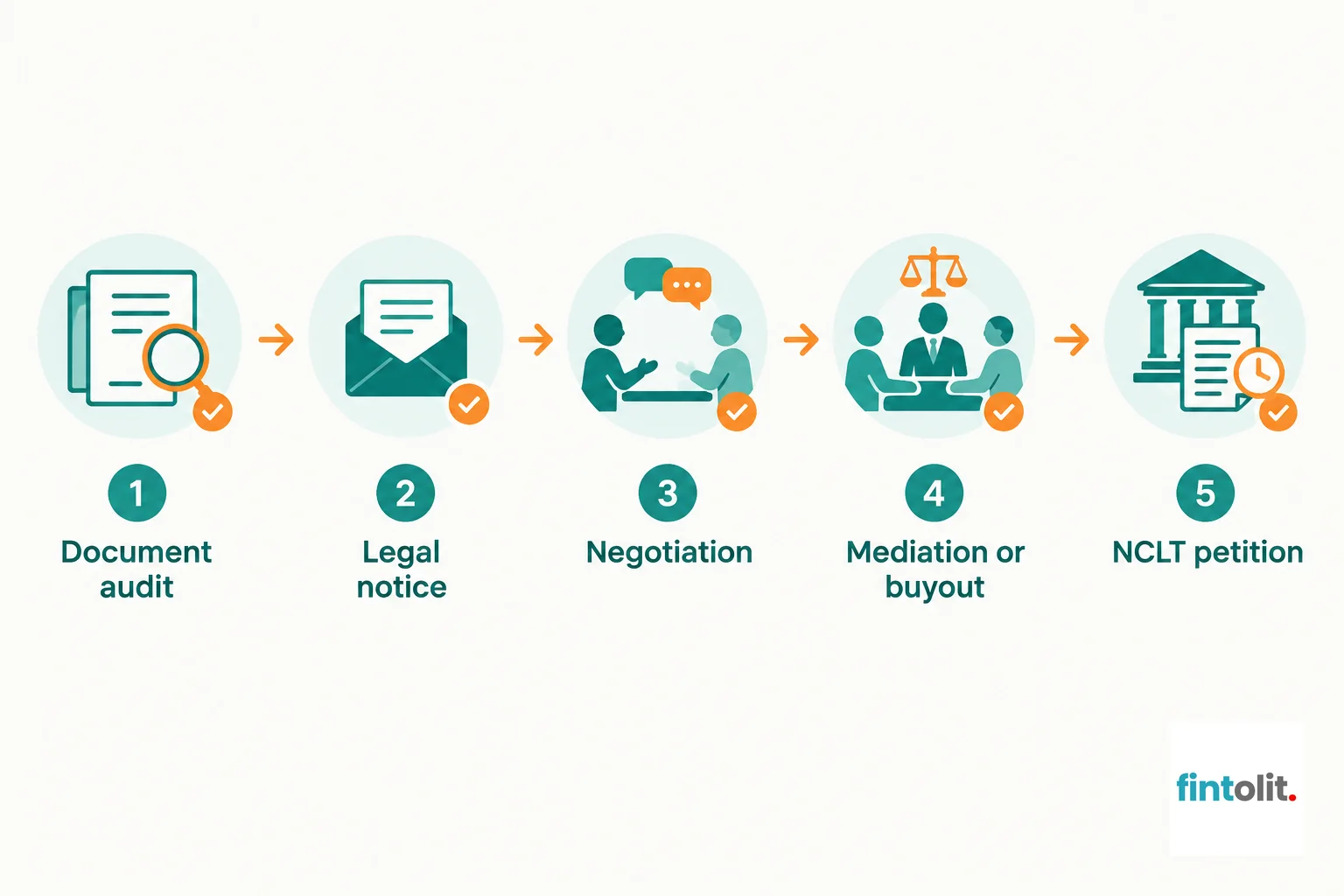
In practice the work runs in a sequence:
- Document audit: find what you signed, what is missing and what the Articles say.
- Evidence file: collect emails, chats, bank records and minutes. Keep originals unaltered.
- Legal notice: state the breach, the clause relied on and the fix you want, in measured language.
- Negotiation: reset roles, adjust vesting, or agree a buyout with a valuation method.
- Mediation or a neutral valuer: useful when both sides want to keep the business running.
- Formal proceedings: only when the steps above fail.
Indian commercial lawyers are increasingly speaking about mediation and online dispute resolution as faster, relationship-friendly options for business disputes. For founders still working under one roof, that direction suits them. For more on settling matters outside court, see our guide to resolving legal disputes without going to court.
A lawyer can also tell you honestly when you have a weak case. That is worth knowing before you spend months on it.
Board and shareholder remedies inside the company
The company's own machinery often solves the problem first, and it builds a record if you later go to the NCLT. These steps cost little and show you tried to resolve things properly.
- Demand proper board notice and minutes. Directors are entitled to notice of meetings and to see the records of what was decided.
- Use your inspection rights. Members and directors can ask for statutory registers and financial statements.
- Requisition an extraordinary general meeting. Under Section 100 of the Companies Act, members holding at least one-tenth of the paid-up voting capital can ask for one.
- Check removal rules. A director can generally be removed by an ordinary resolution of shareholders, so voting strength matters. Your agreement may protect a founder-director with a nomination right.
- Look for special resolution thresholds. Changes to the Articles need a special resolution, which a minority can often block.
Keep all of it in writing. Email beats a phone call, and a notice that was refused still proves you tried.
Need a Lawyer for clarity on your case?
Oppression and mismanagement petitions before the NCLT (Sections 241-242)
If a founder is being pushed out or the company is being run against its interests, Sections 241 and 242 of the Companies Act, 2013 let a member petition the NCLT. Section 241 covers oppressive conduct and mismanagement. Section 242 lists what the tribunal can order, including regulating the company's affairs and directing a purchase of shares.
Who can file is limited. Under Section 244, a company with share capital needs petitioners who are not less than 100 members, or one-tenth of the total members (whichever is less), or members holding at least one-tenth of the issued share capital. The tribunal can waive these limits in exceptional cases. Recent NCLAT rulings treat these conditions as alternatives, so meeting any one can be enough.
A founder with 10% or more of the shares is usually inside the threshold. A smaller holder may need a waiver application, which adds time.
What the NCLT can order
- Regulate how the company's affairs are conducted going forward.
- Order the company or other members to buy out the petitioner's shares.
- Restrain specific acts, or set aside certain transfers and agreements.
- Change or end management arrangements in a proper case.
In October 2026 the NCLAT upheld a supervised "Swiss Challenge" auction as an exit remedy in a family-company oppression dispute, relying on the tribunal's power under Section 242(2)(b) to direct a share purchase. The practical lesson for founders is that exit by court-managed buyout is a real, workable remedy. Whether other benches will use auctions in startup disputes is still open.
Which bench hears it
The NCLT has a Principal Bench in New Delhi and other benches, including Allahabad and Chandigarh. As a rule, the bench follows the company's registered office. A Delhi-registered company points to New Delhi, a Haryana-registered Gurugram company to the Chandigarh bench, and a Noida company registered in Uttar Pradesh to Allahabad. Confirm your registered office before planning travel and costs.
Are oppression disputes arbitrable? Arbitration clauses explained
NCLT benches in 2026 have held that oppression and mismanagement disputes are not arbitrable, so an arbitration clause in your founder agreement does not stop a Section 241 petition. Pure contract claims, such as breach of a vesting or non-compete term, can still be sent to arbitration.
This catches many founders by surprise. They assume the arbitration clause covers everything, or that it blocks the NCLT entirely. Neither is safe to assume.
In practice a dispute often has two layers. The contractual layer (did the founder breach the exit clause?) may go to an arbitrator under the Arbitration and Conciliation Act, 1996. The statutory layer (is the company being run oppressively?) belongs with the NCLT. Your lawyer's task is to separate them and pick the order that protects you.
One honest caveat: this is a developing area. Bench decisions on the point have not come to a single settled rule on every fact pattern, and appeals can change the picture. Ask your lawyer which way your specific bench has leaned, and do not rely on a general summary like this one for a filing decision.
For the closely related shareholder side of this problem, read our piece on shareholder agreement disputes and early red flags.
The criminal angle: BNS, BNSS and BSA
Some founder disputes involve conduct that looks criminal: money diverted, signatures forged, shares transferred by deception. Criminal law replaced its old codes from 1 July 2024. The Bharatiya Nyaya Sanhita (BNS) replaced the IPC, the Bharatiya Nagarik Suraksha Sanhita (BNSS) replaced the CrPC, and the Bharatiya Sakshya Adhiniyam (BSA) replaced the Evidence Act.
Offences committed before 1 July 2024 are still tried under the IPC. The date of the act decides the code, not the date you file.
Need a Lawyer for clarity on your case?
| Conduct | New provision | Old equivalent |
|---|---|---|
| Criminal breach of trust (misusing entrusted funds or assets) | BNS Section 316 | IPC Sections 405 to 409 |
| Cheating and dishonest inducement | BNS Section 318 | IPC Sections 415 to 420 |
| Forgery and use of forged documents | BNS Sections 336 to 340 | IPC Sections 463 to 471 |
| Registering an FIR | BNSS Section 173 | CrPC Section 154 |
| Admissibility of electronic records such as emails and chats | BSA Section 63 | Evidence Act Section 65B |
A word of caution. Courts have repeatedly said that a plain business or contract dispute should not be dressed up as a crime. The legal distinction is that cheating needs dishonest intent from the start, while criminal breach of trust needs a proper entrustment of property. A weak criminal complaint can backfire and harden the other founder. Use this route only with a lawyer's assessment of the evidence.
The BSA point matters for everyone. Keep email and chat records in a form that can be certified later, with the original device and account intact.
First steps before relations break down: a checklist
If you are worried but nothing has blown up yet, these steps protect you without escalating. Do them this week.
- Gather the paperwork. Founders' agreement, shareholders' agreement, Articles, share certificates, cap table and recent board minutes.
- Check the MCA records. Compare the directors and shareholding on file with what you believe is true.
- Save evidence safely. Copy relevant emails, chats and bank statements. Do not access anyone's private account.
- Do not sign anything new until a lawyer has read it, especially resignations, transfer forms or "clarification" letters.
- Put your concerns in writing. One calm email naming the issue and asking for a meeting creates a record.
- Keep working and attending. Walking away from duties can weaken your claim.
- Take advice before escalating. A legal notice is hard to unsend.
For a Gurugram or Noida founder, add one local step: confirm where the company is registered, because that sets the NCLT bench and the Registrar of Companies you deal with. If you are not sure whether you need a lawyer or a consultant, our explainer on legal consultants versus lawyers helps you choose.

How a Fintolit verified senior lawyer helps
At Fintolit, we match you with a verified senior lawyer who has 10+ years of experience, and you see the lawyer's name and background before you pay. The fee is fixed and upfront, and one dedicated case manager keeps you updated. The same advocate stays on your matter until closure.
Here is what that looks like for a founder dispute:
- Online Consultation: a 60-minute video call at Rs 1,599 including taxes (marked down from Rs 2,000), good for a first read of your agreement and options.
- Lawyer at Home: an 80-minute session at your home or office in Delhi NCR at Rs 3,500 including taxes (marked down from Rs 4,999), useful when you want to spread out documents and talk privately.
- 15-day free follow-up after your consultation, for questions that come up once you have read the advice.
Those prices are for the consultation. Drafting, notices or any proceedings are scoped and quoted separately, upfront, once the lawyer has seen your documents. We cannot promise an outcome in any dispute, and nobody honest can. What we can promise is clarity on where you stand, what the options cost, and who is handling it.
If you are comparing formats, our guide to online legal consultation in Delhi explains how the sessions work.
FAQs
Can a co-founder remove me from the company?
Only through the routes the law and your documents allow. A majority can usually remove a director by ordinary resolution, but removal as a director does not cancel your shares. Your shareholding, vesting rights and any exit terms continue unless validly changed. Exclusion from management can itself support an oppression petition.
Need a Lawyer for clarity on your case?
How much does a founder dispute lawyer cost?
The cost depends on what you need. A first consultation with Fintolit is Rs 1,599 online or Rs 3,500 at home, both including taxes. Notices, negotiation or tribunal work are quoted separately after the lawyer reviews your documents, so you see the fee before you commit.
Can I just walk away from the startup?
You can, but leaving without agreed terms can cost you equity or invite a breach claim. Vesting, leaver and non-compete clauses may still apply. A lawyer can negotiate a clean exit with a price for your shares before you resign, which is almost always better than resigning first.
Do I have to go to court at all?
Not always. Many founder disputes end in a negotiated reset or buyout after a well-drafted notice. Going to the NCLT or an arbitrator makes sense when talks fail, when you are being excluded, or when money is leaving the company. Your lawyer can tell you which point you have reached.
Talk to a lawyer before the dispute talks for you
A founder dispute is stressful, but it is far more manageable when you understand your documents and your remedies early. If you are seeing warning signs, book a consultation with a verified corporate lawyer and bring your founders' agreement, Articles and cap table. You will leave with a clear view of your position and a plan.
Prefer to ask a quick question first? You can chat with us on WhatsApp and we will help you pick the right consultation format for your situation in Gurugram, Noida or Delhi.
Recommended Resources
You're just getting to the good part.