

A succession certificate for NRI heirs in India requires a fixed set of paperwork gathered abroad: identity proof, the death certificate, a family tree affidavit, proof of assets, and notarised no-objection letters from co-heirs. Get these apostilled and organised before filing, and a district court petition can move without you flying back for every hearing.
Key Takeaways
- Six document sets are non-negotiable: identity proof, relationship proof, the death certificate, asset proof, a family tree affidavit, and NOCs from other heirs.
- Apostille, not just notarisation, is usually required for documents signed outside India before an Indian court will accept them.
- A registered Power of Attorney lets someone appear in court on your behalf, so you don't need to be physically present for every date.
- Objection windows run roughly 30-45 days after the court's public notice, and this is where most NRI cases stall waiting on paperwork from co-heirs abroad.
- A dedicated case manager can courier, notarise-coordinate, file, and track the petition, cutting the trips an NRI heir needs to make to one, sometimes zero.
At a Glance: Succession Certificate Checklist for NRIs
| Document | Where to Get It | Special Requirement for NRIs |
|---|---|---|
| Passport / OCI card copy | Self | Notarised in country of residence |
| Death certificate of deceased | Municipal authority (India) or local registrar (abroad) | Apostille if issued outside India |
| Birth/marriage certificate proving relation | Municipal records | Apostille or embassy attestation |
| Bank statements, FD receipts, share certificates | Bank/broker in India | Recent statement, account numbers listed |
| Family tree affidavit | Drafted by lawyer, signed by heir | Notarised abroad, apostilled |
| NOC from co-heirs | Each heir individually | Notarised in each heir's country of residence |
| Power of Attorney (optional but recommended) | Drafted and registered | Apostilled, then adjudicated/stamped in India |
What Exactly Is a Succession Certificate, and Why NRIs Need One
Think of it as a court order that lets you actually touch the money. A succession certificate is issued by a District Court under the Indian Succession Act, 1925, and it authorises the named heir to collect debts, securities, and financial assets that belonged to someone who has passed away.
For NRI heirs, this matters more than it does for someone living down the street from the family bank branch. Banks in India won't release a deceased parent's fixed deposit, a broker won't transfer shares, and an insurer won't pay out a claim, just because you show a passport and a death certificate. They want the court's word.
It's worth knowing that a succession certificate is not the same thing as a registered will and it's not the same as a legal heir certificate either, which we'll compare later in this piece.
1. Identity and Relationship Documents to Gather Abroad
Start with the basics you already have in a drawer somewhere: your passport, your OCI or PIO card, and your birth certificate. Get clean, notarised copies of each from wherever you live now.
You'll also need proof that ties you to the deceased. A birth certificate showing a parent's name works for a child. A marriage certificate works for a spouse. If names don't match exactly across documents, spelling differences included, the court can ask for an affidavit explaining why.

The death certificate itself deserves special care. If the person died in India, get the certificate from the municipal authority there. If they died while visiting you abroad, you'll need the local registrar's certificate, apostilled under the Hague Convention process for your country before it's usable in an Indian court.
2. Proof of Assets Left Behind in India
The court doesn't grant a blanket certificate for "whatever the deceased owned." It wants specifics. Pull recent bank statements, fixed deposit receipts, demat account statements, and share certificates for every asset you know about.
Insurance is easy to forget. If the deceased held a life insurance policy, get the policy document and any premium receipts. Mutual fund folios need their own statement too, ideally with folio numbers listed out.
Need a Lawyer for clarity on your case?
Build a simple asset list with approximate values. Your lawyer uses this to draft the petition, and a vague list is one of the most common reasons courts send petitions back for clarification.
3. Family Tree and No-Objection Paperwork
This is the step that trips up NRI families more than any other, mostly because siblings scatter across three or four countries after a parent passes.
The court needs a family tree affidavit naming every legal heir, not just the one applying. If there are four siblings and one is applying for the certificate, the other three typically need to sign a no-objection certificate. Each NOC has to be notarised where that sibling lives, then apostilled.
Coordinating three separate notarisations across three time zones, then getting the physical documents back to India, is where cases sit for weeks. Under the Hindu Succession Act, 1956 or the Indian Succession Act, 1925, depending on the family's religion, the list of who counts as a legal heir is fixed by law, so this step can't be skipped or shortcut.
4. Authorisation Documents: Why a Power of Attorney Matters
You can't always be in Delhi when the court schedules a hearing, and flying in for a five-minute date is a poor use of a plane ticket. A registered Power of Attorney solves this by letting a lawyer or a trusted representative appear on your behalf.
The POA needs to be specific about what it authorises: signing court papers, receiving the certificate, operating the bank account once released. A vague POA gets challenged, sometimes at the worst possible moment. Our guide on Power of Attorney situations where the wrong type backfires covers the drafting mistakes that cause the most rejections.
How Does a Case Manager Coordinate This Without Repeated Travel?
A dedicated case manager acts as the single point of contact who collects every document from you abroad, tracks which ones need apostille, files the petition, and follows up with the court registry so you're not chasing status updates yourself.
That structure removes the two or three trips NRIs usually make for this process: one to file, one when an heir raises an objection, and one to collect the final order. Instead, documents move by courier and secure upload, and updates come to you on a schedule.
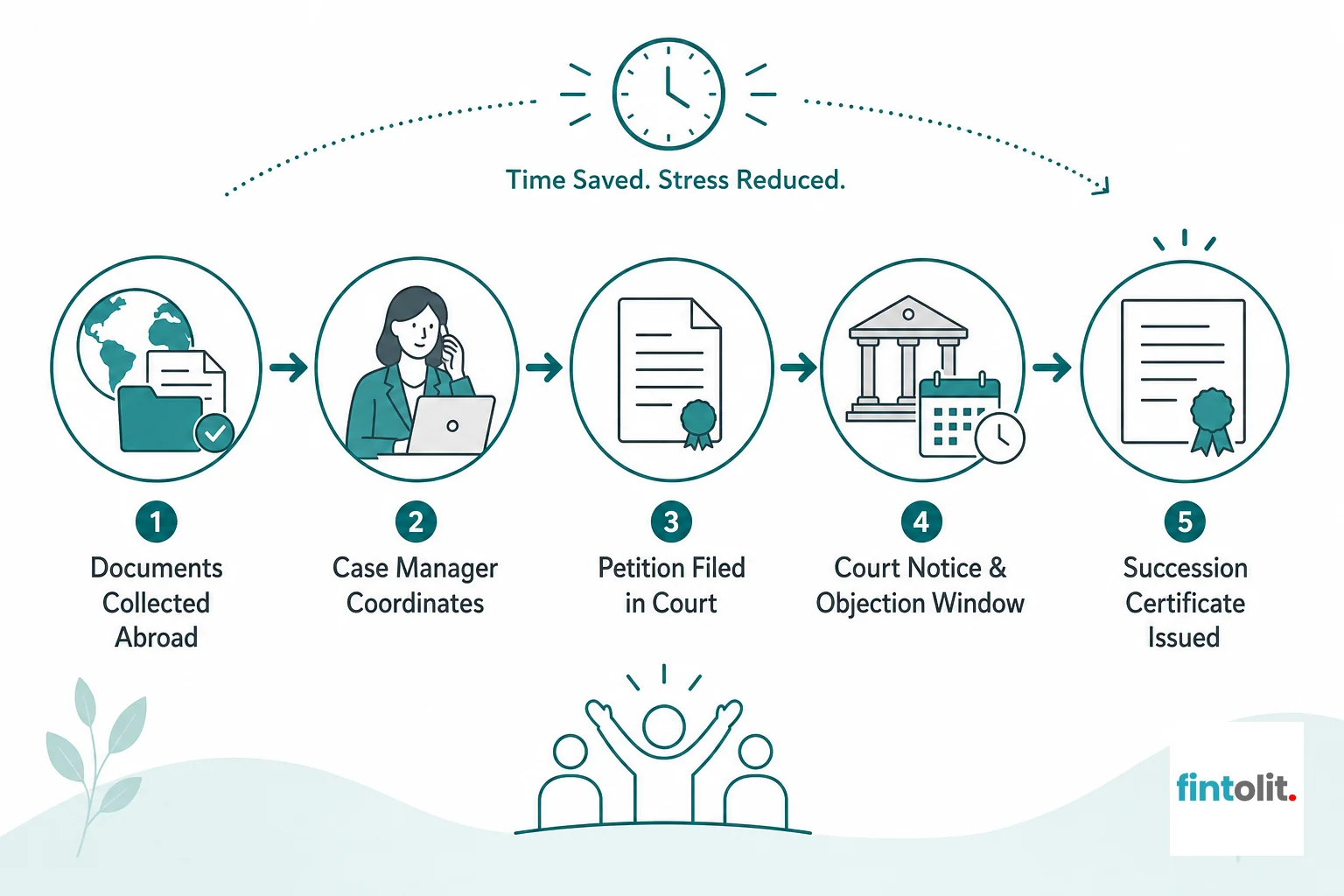
Fintolit assigns the same case manager and the same verified lawyer from your first consultation to the day the certificate is in hand. No handoffs, no re-explaining the family situation to a new person halfway through. You can read more about how a legal case manager helps you if you want the mechanics behind this.
How Long Does the Succession Certificate Process Take for NRIs?
Most petitions move through a public notice period of roughly 30 to 45 days, during which anyone can raise an objection, followed by the court's final order once that window closes clean.
The paperwork stage, not the court stage, is usually what stretches the timeline for NRI families. Waiting on a sibling in Toronto to notarise and courier an NOC can add weeks that have nothing to do with the judge's calendar. Getting all documents apostilled and ready before filing is the single biggest lever you have over how fast this moves.
Succession Certificate vs Legal Heir Certificate: Which Do NRIs Actually Need
A legal heir certificate confirms who the heirs are, full stop. A succession certificate goes further: it actively authorises the named person to collect and manage specific movable assets. NRIs dealing with bank accounts, shares, or insurance almost always need the succession certificate, not just the simpler heir certificate.
| Feature | Succession Certificate | Legal Heir Certificate |
|---|---|---|
| Issuing authority | District Court | Tehsildar / Revenue office |
| Legal basis | Indian Succession Act, 1925 | State-specific revenue rules |
| Covers | Bank accounts, shares, FDs, insurance, debts | Pension, employment dues, smaller benefits |
| Process complexity | Higher, court petition with notice period | Lower, faster administrative process |
| Typical use for NRIs | Transferring or withdrawing financial assets in India | Simpler claims like provident fund or gratuity |
If you're unsure which one your specific situation calls for, our earlier piece on choosing between a legal consultant and a lawyer touches on how to scope a case correctly before you file anything.
Need a Lawyer for clarity on your case?
Local Support: Filing From Delhi, Gurugram, or Noida
District courts across Delhi, Gurugram, and Noida each handle succession petitions, and the right court usually depends on where the deceased last resided or where the assets are held. Filing in the correct jurisdiction the first time avoids a refiling delay.

Local presence matters here in a practical way: someone needs to physically submit documents, respond to court queries, and collect the order once it's ready. Fintolit's online legal consultation option lets you start the process from wherever you are, while a case manager on the ground in Delhi NCR handles the in-person parts.
Frequently Asked Questions
Who can apply for a succession certificate in India?
Legal heirs recognised under the applicable succession law can apply, typically the spouse, children, or parents of the deceased, depending on which personal law governs the family.
How much does a lawyer cost for a succession certificate case?
Costs vary by court fees, the number of heirs involved, and whether objections arise, so fixed, upfront pricing from your lawyer before filing is worth insisting on. Our legal fees breakdown explains what typically drives cost up or down.
Can the entire process be done without visiting India?
In most cases, yes, provided a valid Power of Attorney is in place and a local representative or case manager handles court appearances and document submission on your behalf.
If you're staring at a folder of scattered documents and don't know where to start, that's exactly the gap a dedicated case manager is built to close. Book a consultation with a verified Fintolit lawyer to get your specific document list confirmed before you spend a single rupee on notarisation, or chat with us on WhatsApp if you'd rather talk through your family's situation first.
Recommended Resources
You're just getting to the good part.