

Someone has built a wall three feet into your plot, or a shop has quietly expanded onto land that carries your name on the sale deed. Property encroachment legal action in India starts with documentation, moves through a municipal complaint or legal notice, and, if the encroacher won't budge, ends in a civil suit for possession or injunction. You don't need to wait years for this to become "settled" against you either; encroachment is wrongful entry that owners can act against immediately.
Key Takeaways
- Act early: Encroachment is actionable the moment it happens; you don't need to wait 12 years, and delay only makes removal harder.
- Documentation wins cases: A dated photo with a location pin, your sale deed, mutation record, and a survey report form the backbone of every remedy that follows.
- Municipal route works for public land and illegal construction: A written complaint to the Encroachment or Town Planning department, or a Stop Work Order request, can resolve cases involving unauthorised structures on setback or common land.
- Private land almost always needs a civil suit: For a suit for possession, injunction, or mesne profits (compensation for wrongful use), a property lawyer builds the case around your title chain and survey evidence.
- Police help with safety, not ownership: An Executive Magistrate can step in under the BNSS to prevent violence, but that's separate from actually reclaiming the land.
At a Glance: Encroachment Remedies in India
| Remedy | Who Handles It | Best For | Typical Timeline |
|---|---|---|---|
| Municipal complaint | Municipal Corporation (Encroachment/Town Planning dept.) | Encroachment on public land, footpaths, or setbacks | Weeks to a few months |
| Stop Work Order | Building Inspector / local Municipal Corporation | Illegal construction still in progress | Days to weeks |
| Legal notice | Property lawyer, sent to the encroacher | Giving formal warning before litigation | 1-2 weeks to draft and send |
| Police complaint / BNSS Section 164 | Local police station, Executive Magistrate | Preventing violence or breach of peace during a dispute | Immediate, but doesn't decide ownership |
| Civil suit for injunction | Civil Court | Stopping further construction or encroachment | Months (interim orders can come faster) |
| Civil suit for possession | Civil Court | Reclaiming land already occupied | Can run into years, depending on evidence and court load |
1. Confirm It's Actually an Encroachment, Not a Boundary Dispute
Not every disagreement over a wall or a fence is an encroachment. Sometimes it's just a boundary confusion where both neighbours genuinely believe they're right, and a fresh survey settles it in an afternoon. Encroachment is different: someone has knowingly occupied land that isn't theirs, whether that's a shop owner extending a counter onto a footpath or a neighbour who built past the shared line on purpose.
Getting a revenue survey done first tells you which situation you're in. This matters because a genuine boundary mix-up often gets resolved through discussion or mediation, while a deliberate encroachment usually needs the formal steps below. If you're not sure which one you're dealing with, our guide on what to do first in a property boundary dispute walks through that first check in detail.
2. Document Everything Before You Approach Anyone
Whatever you do next, it stands or falls on your paper trail. Take dated photographs of the encroachment with a visible landmark and, where possible, a Google Maps location pin. Pull out your sale deed, the mutation record showing you as the registered owner, and any survey settlement map you have on file.

Keep a written log too: the date you noticed the encroachment, any conversation you had with the occupier, and copies of anything you send them. Courts and municipal officers both respond faster to a complaint backed by clear, dated proof than one built on assertions alone. This single habit is often what separates a case that resolves in months from one that drags on for years.
Need a Lawyer for clarity on your case?
3. File a Written Complaint With the Municipal Corporation
If the encroachment sits on public land, a footpath, or a setback area governed by building bylaws, your local municipal body is the right first stop. In Delhi that's the MCD, in Gurgaon it's the local Municipal Corporation of Gurugram (MCG), and in Noida it's the Noida Authority. File your written complaint with the Encroachment or Town Planning department, attaching your photos and location details.
For encroachment tied to illegal construction, ask specifically about a Stop Work Order. Under most state Municipal Corporation Acts, the Building Inspector can direct the owner to halt construction pending regularisation or demolition. This won't resolve a private-land ownership dispute, but it can freeze the situation while you pursue further action.
4. Involve the Police When There's a Risk of Confrontation
Calling the police makes sense when tempers are running high, not as a substitute for the civil process. If a dispute over encroached land looks like it could turn violent, an Executive Magistrate can step in quickly to prevent a breach of peace and pass interim orders about who stays in possession while the underlying dispute gets sorted out.
That power exists to keep the peace, not to decide who legally owns the land. Think of it as buying safety and time, while the civil remedies below do the actual work of restoring your title.
5. Send a Legal Notice Before You Go to Court
A legal notice puts the encroacher on formal record: it states your ownership, describes the encroachment, and demands removal within a fixed period. Many disputes end right here, because a properly drafted notice signals that you're prepared to litigate and that you have the documentation to back it up.
Getting the wording right matters more than people expect; vague or overly aggressive notices can weaken your position later in court. Our detailed breakdown on how to draft a legal notice in India covers the format, cost, and clauses a property lawyer typically includes for encroachment cases.
6. File a Civil Suit for Possession or Injunction
When the notice goes unanswered, or the encroachment is too serious to wait out, a civil suit is the remedy that actually moves land back into your hands. A suit for possession asks the court to restore the property to you. A suit for injunction stops the encroacher from building further or from continuing to occupy the space. Courts can also award mesne profits, compensation for the time the encroacher wrongfully used your land.
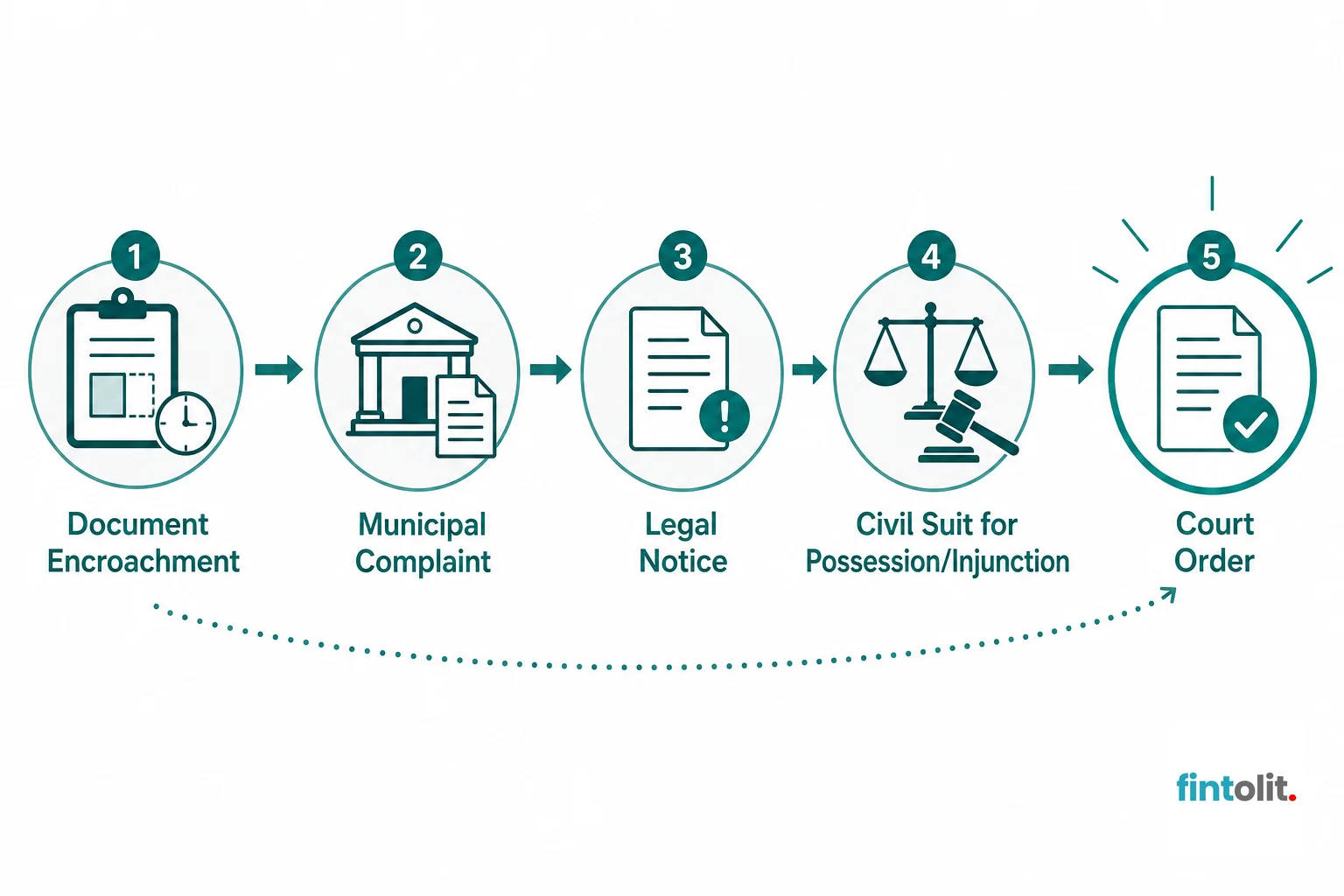
One point worth repeating: encroachment does not need twelve years to become adverse possession, and it does not automatically become the encroacher's land just because time has passed. That twelve-year clock applies to a very specific, narrow legal doctrine, not to ordinary trespass. A property lawyer builds your case around the title chain from your sale deed, the mutation record, the survey report, and witness statements where relevant, which is exactly the combination courts look for before granting relief.
Can You Remove an Encroachment Without Going to Court?
Sometimes, yes. If the encroachment sits on public land or involves unauthorised construction, a municipal complaint or a Stop Work Order can get it removed without a lawsuit. Private land disputes almost always need a civil suit, because only a court order can force removal from privately owned property.
That said, even the municipal route moves faster with a lawyer behind it. Departments handle hundreds of complaints, and one that arrives with a clear property description, photographs, and a citation of the relevant provision tends to get prioritised over one that doesn't.
What Does Legal Action Against Encroachment Cost in Delhi, Gurgaon & Noida?
Costs for encroachment cases in Delhi NCR usually break down into three parts: legal notice drafting, lawyer consultation and representation fees, and court fees, which scale with the declared value of the disputed property. On top of that, a fresh survey or a certified copy of land records adds a smaller, fairly fixed cost.
Need a Lawyer for clarity on your case?

What varies most between firms isn't the government fees, it's the lawyer's own charges. Hourly billing can turn a straightforward possession suit into an unpredictable bill, especially once hearings get adjourned or documentation needs revisiting. A fixed, upfront fee structure removes that guesswork, which matters a great deal to owners in Gurgaon and Noida managing a property remotely, or NRIs handling this from abroad. For a fuller sense of what different legal services typically charge across property matters, see our 2026 legal fees breakdown for India.
How Fintolit's Property Lawyers Strengthen Your Encroachment Case
Fintolit connects you with a verified property lawyer, someone with 10+ years of experience, whose name and background you see before you pay anything. You get a dedicated case manager who keeps you updated at every stage, from the first documentation review through to the civil suit if it comes to that. The same lawyer stays with your case from consultation to closure, so you're never explaining your encroachment dispute to a new person halfway through.
For owners in Delhi, Gurgaon, or Noida who'd rather have a lawyer physically walk the disputed boundary with them, Fintolit's "Lawyer at Home" service brings that consultation to your property. If you're managing this remotely or simply prefer speaking from your own space first, our online legal consultation in Delhi option covers the same ground over video, at a fixed upfront fee, morning or evening.
Frequently Asked Questions
How do I respond to legal charges the encroacher files back against me?
Reply through your lawyer, in writing, and never ignore a court notice or police summons. Encroachers sometimes file counter-complaints to pressure owners into backing off; your documentation from step two is exactly what defeats these attempts and keeps the focus on your ownership.
What should I do first about a disputed property near me?
Get a fresh survey done, gather your title documents, and consult a property lawyer before you approach the occupier directly. Acting on assumptions, or confronting someone without documentation ready, tends to make disputed property situations harder to resolve later.
How long does an encroachment court case usually take?
Interim injunction orders can come within weeks in urgent cases, but a full suit for possession can take anywhere from several months to a few years, depending on the court's caseload and how contested the facts are. Strong documentation from the start meaningfully shortens this.
If someone is sitting on land that's legally yours, waiting rarely improves your position. Talk to a verified Fintolit property lawyer who handles encroachment, possession, and injunction cases across Delhi, Gurgaon, and Noida, and get a clear resolution plan for your specific plot. Book a consultation to start building your case today, or chat with us on WhatsApp if you'd rather describe the situation first and figure out next steps together.
Recommended Resources
You're just getting to the good part.