

If you're dealing with a property boundary dispute with neighbor in India right now, you probably know that quiet, unsettled feeling. A wall shifts. A fence moves. A shed suddenly extends a few feet further than it used to. These disputes rarely start with a bang. They start with confusion, and confusion is exactly why so many homeowners in Delhi, Gurugram, and Noida freeze instead of acting. This guide walks through what to do in the first days and weeks, before you say a single word to your neighbor about it.
Why Property Boundary Disputes With Neighbors Are So Common in India
Boundary disputes aren't rare or unusual. They're one of the most common property problems across Indian cities, and there's a reason for that. Land records in most Indian states were built up over decades through hand-drawn revenue maps, khasra and khatauni entries, and mutation records that were never fully digitized in a consistent way. When two neighboring plots were carved out of a larger ancestral holding, the original partition was often informal, agreed upon by families rather than measured by a certified surveyor.
Add to that the pace of urban growth. Delhi NCR, Gurugram, and Noida have seen decades of construction, reconstruction, and plot subdivisions. A boundary wall built in 1998 may not sit exactly where the original 1975 revenue map says it should. Nobody notices until someone rebuilds a wall, sells a plot, or a new owner brings in a surveyor for a home loan or resale. That's usually when the mismatch surfaces, and by then, the two families involved may have lived side by side peacefully for years.
There's an emotional layer too. Boundary disputes often erupt between people who used to exchange festival sweets or lend each other a ladder. That history makes both sides reluctant to escalate quickly, but it also makes the eventual conflict feel more personal and painful than a stranger's lawsuit ever would.
1. Document Everything Before You Confront Your Neighbor
Before you say anything to your neighbor, build your paper trail. Whatever you decide to do next, whether that's a calm conversation, mediation, or a legal notice, your case will only be as strong as the documents backing it. Here's what to gather:
- Sale deed and mutation record (Dakhil Kharij): These establish your legal ownership and the boundaries as recorded when you or your family acquired the property.
- Khasra, khatauni, or property card: Depending on your state, these revenue records show the plot's dimensions and adjoining plot numbers.
- Approved building plan and site plan: Obtained from your municipal authority (MCD, GMDA, or NOIDA Authority depending on your location), these show what was legally sanctioned to be built and where.
- Photographs and videos, timestamped: Capture the disputed area from multiple angles. Note the date it changed if you can pinpoint it.
- Old survey or settlement records: If your family has held the property for generations, look for any earlier partition deed or settlement record that describes the original boundary.
- A record of the timeline: When did the wall or fence shift? Was there construction activity you noticed? Did you raise it informally with the neighbor at the time?
Keep physical and digital copies of everything. If you're unsure which documents apply to your specific property type, whether it's a DDA flat, a freehold plot, or an ancestral house, a quick consultation can save you weeks of guesswork. Fintolit's property lawyer in Delhi guide breaks down exactly which papers matter for different property types across the region.
2. Get the Boundary Professionally Surveyed
Your memory of where the fence used to be isn't evidence. A professional survey is. If your dispute is genuinely about where the boundary line falls, rather than about behavior or access, a licensed survey settles the factual question before anyone spends money on lawyers.
Need a Lawyer for clarity on your case?
You have two main paths for this in India:
- Government demarcation: You can apply to the local Tehsildar's office or the revenue department for an official demarcation of your plot. A government surveyor visits the site, measures against the recorded khasra map, and issues a demarcation report. This carries weight in later legal proceedings because it comes from an official source.
- Licensed private surveyor: In urban areas, especially where revenue maps are outdated, a private licensed surveyor can conduct a modern measurement using your sale deed dimensions. This is faster but carries slightly less official standing unless paired with municipal records.
A proper survey report should clearly state the recorded dimensions of your plot, the actual measured dimensions on the ground, and the exact location and extent of any discrepancy. Expect this process to take a few weeks depending on how backed up your local Tehsildar's office is. It's not instant, but it's one of the few steps that turns "I feel like the wall moved" into "here is documented proof of where the wall should be."
3. Try Mediation Before You Escalate
Here's something worth sitting with before you draft an angry WhatsApp message: most boundary disputes between neighbors in India are resolved without ever reaching a courtroom. Litigation over a shared wall or a three-foot strip of land can drag on for years and cost far more, in money and peace of mind, than the disputed land is worth.
Start with a calm, direct conversation once you have your documents and, ideally, your survey report in hand. Many disputes turn out to be genuine misunderstandings rather than deliberate encroachment. If a direct conversation doesn't work, or feels too tense to attempt alone, consider these informal routes before filing a suit:
- Resident Welfare Association (RWA) mediation: If you live in a housing society or a colony with an active RWA, many disputes get resolved through their informal grievance process, especially useful in Gurugram and Noida's planned residential sectors.
- Lok Adalat: These are informal, state-run dispute resolution forums designed exactly for matters like this. They're faster, cheaper, and the settlements reached carry the same legal force as a civil court decree.
- A written, documented settlement: If mediation succeeds, get the agreed boundary line and any compensation or corrective action in writing, signed by both parties, ideally with witnesses.
Mediation works best when both sides still have some goodwill left and when the evidence isn't wildly disputed. It tends to fail when one party has a financial incentive to hold onto the disputed land, when there's a history of bad blood, or when the encroachment was deliberate rather than accidental. If your attempts at conversation go nowhere after a reasonable effort, it's time to move to the next stage.
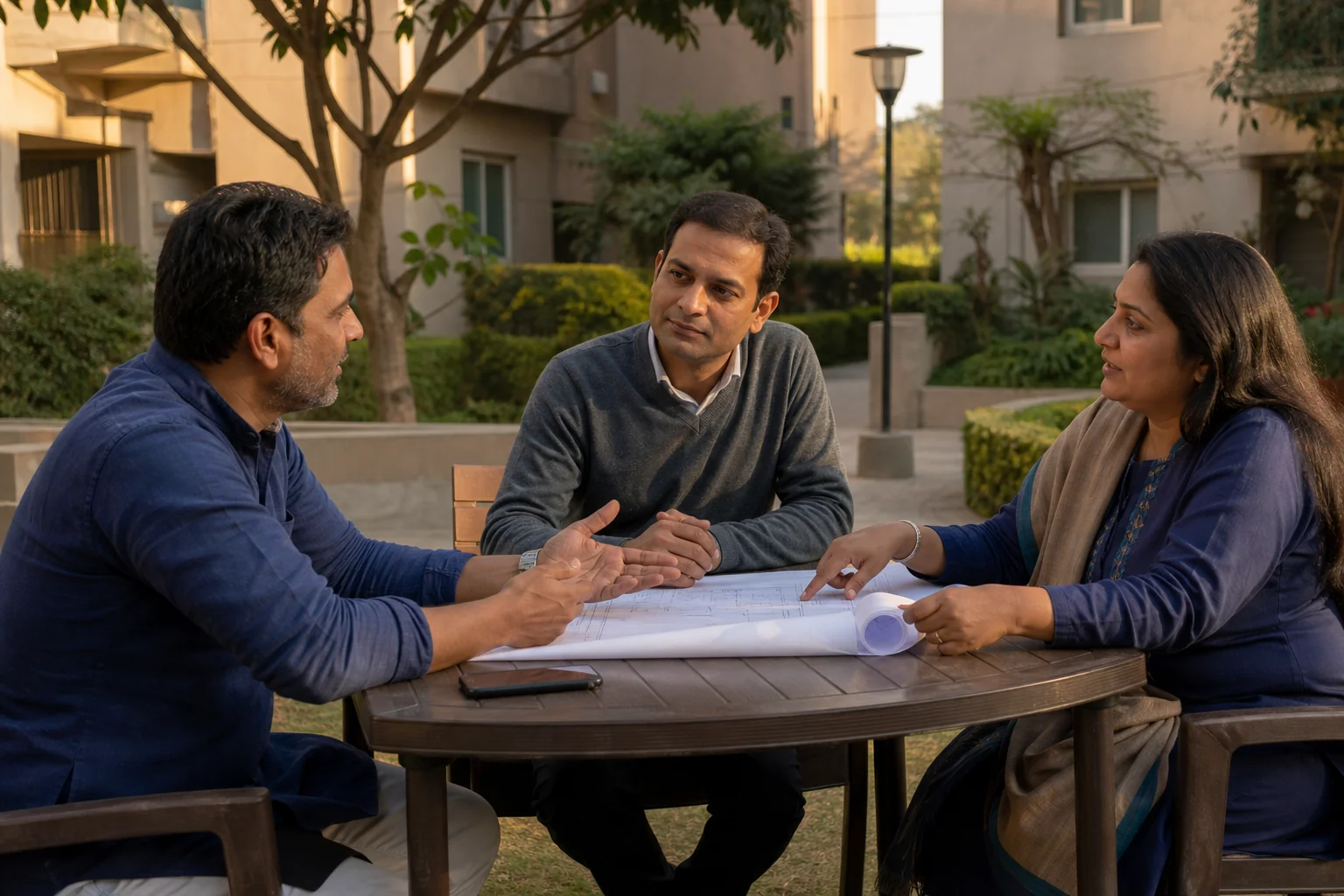
4. Know Your Legal Remedies If Mediation Fails
When talking and informal mediation don't resolve things, Indian law gives you several formal paths, and the right one depends on exactly what's happening on your boundary.
- Suit for declaration and permanent injunction: Filed under the Specific Relief Act, 1963, this asks the court to declare your rightful boundary and permanently stop your neighbor from further encroachment. This is the most common route for a straightforward "the wall moved" dispute.
- Suit for possession: If your neighbor has occupied and is using land that legally belongs to you, you can seek a court order for possession to be handed back.
- Partition suit: Where the dispute stems from an unclear division of ancestral or jointly-owned property, a partition suit formally divides the property and settles boundaries as part of that process.
- Police complaint: Only relevant where there's trespass, threats, damage to property, or physical altercation involved. A civil boundary disagreement on its own is not a police matter, but if things turn hostile, a complaint under relevant provisions of the Bharatiya Nyaya Sanhita may be necessary alongside your civil case.
- Municipal complaint for illegal construction: If your neighbor's encroaching structure violates the sanctioned building plan, a complaint to the local municipal authority (MCD, GMDA, or the Noida Authority) can trigger a demolition or compounding action independent of your civil suit.
Civil suits over property boundaries in India typically take time, often a year or more depending on your local court's backlog, so most people treat litigation as a last resort rather than a first step. That said, once documentation and mediation attempts have failed, delay usually works against you, especially if your neighbor continues building or using the disputed land.
Need a Lawyer for clarity on your case?
Mediation vs Civil Suit vs Local Authority Complaint: Which Route Fits Your Situation?
Not every boundary dispute calls for the same response. Here's how the three most common paths compare, so you can match your situation to the right route instead of guessing.
| Factor | Mediation / RWA / Lok Adalat | Civil Suit (Injunction/Partition) | Municipal Authority Complaint |
|---|---|---|---|
| Typical cost | Low to none | Moderate to high (court fees, lawyer fees) | Low (mostly application and follow-up) |
| Typical timeline | Weeks | Several months to over a year | Weeks to a few months |
| Formality of outcome | Binding if signed settlement or Lok Adalat award | Fully binding court decree | Administrative action, doesn't settle ownership |
| Best suited for | Genuine misunderstandings, good neighbor relations | Clear encroachment, ownership disputes, hostile neighbor | Illegal or unsanctioned construction on the boundary |
| Relationship impact | Preserves neighborly relations | Often ends the relationship for good | Neutral, handled by authority not you directly |
| Evidence needed | Basic documents and willingness to talk | Full documentation, survey report, legal representation | Proof of building plan violation |
If your neighbor is reasonable and the encroachment seems accidental, start on the left side of this table. If there's a history of conflict, financial stakes are high, or your neighbor refuses to engage, you'll likely end up somewhere in the middle. Illegal construction that overlaps your boundary often benefits from a two-track approach: a municipal complaint alongside your civil suit.
5. Red Flags to Watch For When Choosing a Property Lawyer
Once you decide you need legal help, choosing the right lawyer matters as much as the legal strategy itself. Property disputes attract their fair share of lawyers who overpromise and underdeliver, and the hidden costs of hiring a lawyer in India often show up only after you've already committed. Watch for these warning signs:
- Vague or shifting fee structures. If a lawyer can't give you a clear, upfront number for the consultation and can't explain how future fees will work, that's a problem. Fixed, transparent pricing should be the norm, not a favor.
- Guaranteed outcomes. No honest lawyer can promise you'll win a boundary suit. Anyone who guarantees a result is either inexperienced or not being straight with you.
- No clarity on who handles your file. Many larger firms hand your case between juniors and associates. You end up re-explaining your situation to a new face every few months. Ask directly who will be your point of contact throughout.
- Limited property law experience. Property disputes involve revenue records, survey law, and local municipal regulations that a generalist lawyer may not deal with often. Ask specifically about their experience with boundary and encroachment matters.
- No verification before payment. You should know exactly who you're consulting, their background and experience, before you pay a rupee.
If you're unsure how to vet a lawyer properly, Fintolit's guide on how to choose the right lawyer for your case in India covers the questions worth asking before you commit to anyone.
How Fintolit Helps You Resolve a Boundary Dispute Without Dragging It Through Court
Boundary disputes are stressful precisely because they combine legal uncertainty with a personal relationship you'd rather not destroy. Fintolit was built around exactly this kind of problem: a legal issue you don't fully understand, with a neighbor you probably still have to see at the gate every day.
Here's what that looks like in practice. You start with a 60-minute consultation with a verified property lawyer who has 10 or more years of dedicated experience, not a generalist juggling five different practice areas. Before you pay anything, you see the lawyer's name and background, so you know exactly who's reviewing your documents and advising you. The consultation happens either online from anywhere or in person at your home through Fintolit's "Lawyer at Home" service, useful if you'd rather have someone physically look at the boundary wall or disputed structure with you.
Need a Lawyer for clarity on your case?
Once you move forward, a dedicated case manager is assigned to your file. They coordinate document collection, survey requests, and communication with your neighbor's side if a legal notice or mediation attempt is needed, sending you proactive updates instead of leaving you to chase down status. And the same lawyer who took your first call stays with your case through to resolution. No re-explaining your situation to someone new halfway through.
The process is deliberately simple:
- Describe your problem in a short intake, including where you are (Delhi, Gurugram, or Noida) and what's happened so far.
- Consult a verified property lawyer who reviews your documents and situation directly.
- Get a resolution plan, whether that's a mediation strategy, a legal notice draft, or guidance on filing a civil suit, at a fixed, upfront fee with no hidden surprises later.

If your dispute has already reached the point of a legal notice, either one you've received or one you need to send, Fintolit's guide on how to respond to a legal notice without losing ground is worth reading alongside this one. And if you're comparing whether an online consultation or an in-person visit makes more sense for your specific situation, how Lawyer at Home service works in India lays out exactly what to expect from a home visit.
Frequently Asked Questions
Can I resolve a property boundary dispute without going to court?
Yes, in many cases. Direct conversation backed by documentation, RWA-led mediation, or a Lok Adalat settlement resolve a large share of boundary disputes without a civil suit. Courts are usually a last resort when the other party refuses to cooperate or the encroachment is deliberate and financially significant.
What documents prove property boundaries in India?
Your sale deed, mutation record, khasra/khatauni or property card, approved building plan, and any earlier partition or settlement deed together establish your boundary. A fresh licensed survey or government demarcation report adds current, on-ground proof to these older records.
How long does a property boundary dispute civil suit take in India?
Timelines vary widely by state and local court backlog, but civil suits involving property boundaries often take a year or more to reach a decision, longer if appealed. This is exactly why most lawyers recommend exhausting mediation options first.
Can the police help with a boundary dispute with my neighbor?
Police typically won't intervene in a purely civil boundary disagreement. They become relevant only if the dispute involves trespass, threats, physical damage, or violence, in which case a police complaint can run alongside your civil case, not instead of it.
What if my neighbor refuses to allow a survey of the boundary?
You can still request an official demarcation from the Tehsildar or revenue department, which doesn't require your neighbor's consent to proceed. If they physically obstruct government surveyors, that obstruction itself can become part of your legal case.
Is a boundary dispute different from a property title dispute?
Yes. A boundary dispute is about where the line between two properties falls. A title dispute is about who legally owns a property at all. The two can overlap, especially in inherited property, but they call for different documents and different legal strategies.
A boundary dispute rarely gets better by waiting. The neighbor who quietly extended a wall by three feet last year is unlikely to move it back on their own next year. Acting early, with proper documentation, almost always costs less than acting late.
A property boundary dispute with a neighbor in India doesn't have to turn into a years-long legal battle or a permanently broken relationship. Start by documenting what you see, get a professional survey if the facts are disputed, and try a calm conversation or mediation before anything formal. If that doesn't resolve things, you deserve a property lawyer who tells you exactly what it will cost, exactly who's handling your case, and exactly what to expect next, not vague promises and mounting bills.
Need a Lawyer for clarity on your case?
Fintolit connects you with a verified, senior property lawyer for a fixed-fee, 60-minute consultation, backed by a dedicated case manager who keeps you updated at every step, whether you're in Delhi, Gurugram, or Noida. Book your consultation today and get a clear resolution plan for your boundary dispute, or chat with us on WhatsApp if you'd rather talk through your situation first. If you want to understand the full landscape of property matters before you commit, our complete guide to property lawyers in Delhi is a good next read, or explore how our verified lawyer matching process works before you decide who to trust with your case.
You're just getting to the good part.