
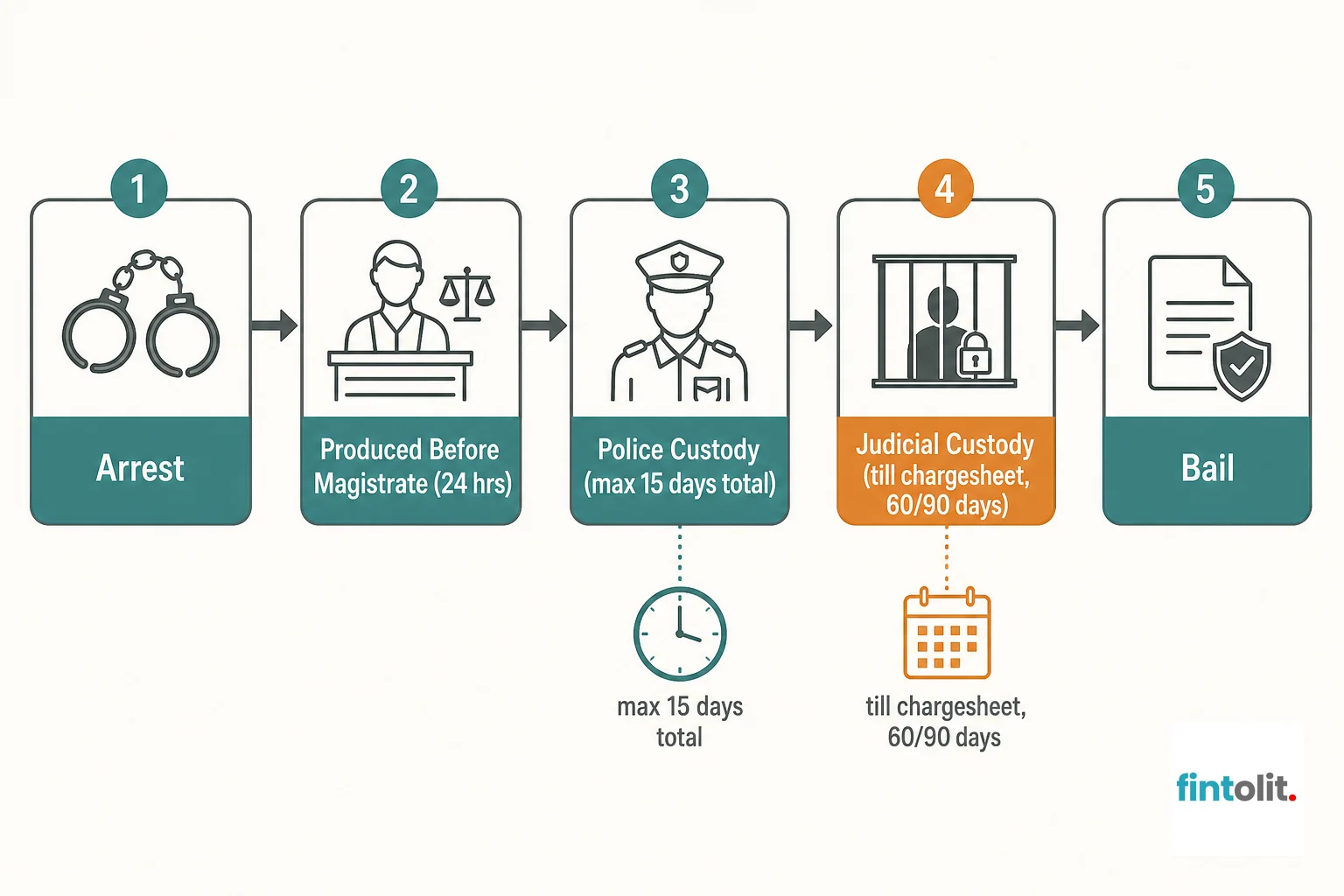
A phone call at midnight saying "he's been taken to the station" is where most families first hear these two terms, and the difference decides everything that happens next. In police custody, the accused stays with the investigating police, usually inside a lock-up, for questioning. In judicial custody, the same person moves to jail, under a magistrate's watch, once the police no longer need direct access for interrogation. Understanding police custody vs judicial custody in India tells a family exactly what they can and can't do right now.
Key Takeaways
- 15-day cap: Police custody can total a maximum of 15 days, and under BNSS Section 187(2) this can now be spread in short stretches ("intermittent police custody") across the first 40 or 60 days of the case, depending on the offence, as detailed by Bar and Bench.
- Jail, not just custody: Judicial custody means the person is in jail, not at a police station, and stays there until bail, a chargesheet-linked release, or trial outcome changes that.
- 60/90-day chargesheet clock: Police must file a chargesheet within 60 or 90 days of arrest (depending on offence severity), or the accused can seek default bail.
- Visitation is not equal: Meeting someone in police custody needs magistrate permission; judicial custody allows scheduled jail visits under prison rules.
- A lawyer changes the timeline: Fast legal action at the remand hearing stage, not weeks later, is usually what shortens time in custody.
At a Glance: Police Custody vs Judicial Custody
| Aspect | Police Custody | Judicial Custody |
|---|---|---|
| Where held | Police station lock-up | District jail |
| Who controls access | Investigating police officer | Jail superintendent, under magistrate's supervision |
| Purpose | Interrogation, recovery of evidence | Safe detention pending trial or bail |
| Maximum duration | 15 days total (can be spread over 40/60 days per BNSS 187(2)) | Until chargesheet filed (60/90 days) or bail granted |
| Who authorises | Magistrate, on police application | Magistrate, by default once police custody ends or expires |
| Family visitation | Needs magistrate's written permission | Scheduled jail mulaqat slots under prison rules |
| Lawyer's access | Limited, often only during production before magistrate | Easier, through jail visit applications |
What Actually Happens When Someone Is Arrested in Delhi NCR
An arrest anywhere in Delhi, Gurugram, or Noida follows the same basic drill. Police must produce the person before a magistrate within 24 hours of arrest. That magistrate, not the police, decides whether the person goes into police custody, judicial custody, or is released on bail right away.
This first hearing matters more than families realise. It's usually rushed, brief, and easy to miss if you don't know it's happening. A lawyer present at this stage can argue against unnecessary police custody, push for shorter remand periods, or flag procedural lapses in the arrest itself.
Local courts across the National Capital Region handle remand hearings daily, often within minutes of each other. If nobody shows up to represent the accused, the magistrate typically grants whatever custody the police ask for. That's the gap a criminal lawyer closes.
Police Custody: Who Controls the Accused, and Why
Police custody is what it sounds like: the accused stays with the police who arrested them, at the station, so investigators can question them directly. It's granted by a magistrate, not decided unilaterally by the station house officer.
The police ask for it when they believe direct access to the accused helps recover evidence, weapons, stolen property, or get a confession. But that access has a hard ceiling. Police custody cannot exceed 15 days in total, and under the newer BNSS framework, those 15 days can now be split into shorter stretches spread across the first 40 or 60 days after arrest, instead of one continuous block, according to iPleaders and LegacyIAS.
That change means a family can't assume the 15 days are over just because the accused was moved to jail once. Police can come back and ask for a few more days of custody later in the investigation, as long as the total stays within the 15-day cap.
Need a Lawyer for clarity on your case?
Judicial Custody: What Changes Once Someone Is Sent to Jail
Judicial custody means the accused is no longer with the police. They're in jail, under the supervision of the court through the jail superintendent. The police can still question them, but only with fresh permission, and it stops being routine.
This is where daily life for the accused changes shape. Jail comes with fixed rules: meal timings, a cell instead of a lock-up, and a formal process for family or lawyer visits instead of ad hoc police discretion.
Judicial custody can run considerably longer than police custody. The law gives police up to 60 days to file a chargesheet for most offences, and up to 90 days for offences carrying the death penalty, life imprisonment, or sentences of ten years or more. If that chargesheet doesn't come in on time, the accused becomes eligible for what's called default or statutory bail, as explained by Jus Corpus.
Can Police Custody Turn Into Judicial Custody, or the Other Way Around?
Yes, and it usually goes one direction: from police custody into judicial custody, and it stays there unless bail is granted. Once the 15-day police custody cap is used up, whether in one stretch or several short ones, the accused sits in judicial custody for the rest of the case timeline.

Going the other way, from judicial custody back to police custody, is rarer but possible. If investigators uncover a new lead that genuinely needs the accused's direct presence, they can apply to the magistrate again, as long as the 15-day total hasn't been exhausted. This "intermittent" model under BNSS Section 187(2) replaced the older single 15-day block that existed under Section 167 CrPC, per Bar and Bench's reporting.
It's a small procedural shift with a real consequence for families: a relative moved to jail isn't necessarily done with police custody for good. Track the case, don't assume the worst part is over.
Visitation Rules Families Should Know
Can a family meet someone in police custody? Only with the magistrate's written permission, and even then, station rules can limit how long and how often. It's the single most confusing part of this whole process for families, because there's no fixed visiting schedule like a jail has.
Judicial custody works differently. Jails run scheduled mulaqat (meeting) slots, usually a few days a week, with ID checks and a limited item list for what you can bring in. It's still restrictive, but it's predictable, which matters when you're trying to plan around work and travel from Gurugram or Noida into the city.

A lawyer can speed up both. For police custody, they can apply directly to the magistrate for a visitation order. For judicial custody, they can help you navigate jail paperwork that otherwise eats up days you don't have to spare.
What Families in Delhi, Gurugram and Noida Should Do Next
Start by getting a certified copy of the remand order from the court. It tells you exactly what type of custody was granted, for how long, and under which sections. Without that paper, you're guessing.
Next, get a criminal lawyer involved immediately, not after the first remand period ends. Every day without representation is a day the police can act with less resistance, and a day closer to losing ground on a bail application. Our guide on finding a verified lawyer online in India walks through how to check credentials before you commit.
Once the custody window allows it, apply for regular bail. Timing this application well, right as police custody nears its cap or right after a chargesheet delay, often makes the difference between weeks and months in judicial custody. If you're also weighing whether to fight or negotiate a resolution elsewhere in the case, our piece on mediation vs litigation costs in India is worth reading alongside this.
Need a Lawyer for clarity on your case?

Fintolit connects families in Delhi, Gurugram, and Noida with verified criminal lawyers who have handled arrest and remand matters directly, not generalists learning on the job. You get a dedicated case manager who tracks every hearing date so you're not calling the police station for updates. If documentation around the case, like a power of attorney for someone abroad, also needs sorting, see our guide on power of attorney types in India.
Frequently Asked Questions
How much does a lawyer cost in India for a remand or bail matter?
Fees vary by city and lawyer experience, but urgent remand and bail work typically costs more than a routine consultation because of the same-day pressure involved. Ask for a fixed, upfront quote before you commit, rather than an hourly estimate that can grow once the case is underway.
How do I find a good lawyer in India on short notice after an arrest?
Look for someone with a verified track record in criminal remand and bail work specifically, not just a general practice. A platform that shares the lawyer's name and background before you pay removes the guesswork families face when searching under pressure.
Can family members meet someone in police custody?
Only with a magistrate's written permission, and access can still be limited by the station. This is far more restrictive than judicial custody, where jails run fixed weekly visiting slots for registered family members.
How long can judicial custody last before someone becomes eligible for bail?
If police don't file a chargesheet within 60 days (most offences) or 90 days (serious offences carrying long sentences), the accused can apply for default bail. Beyond that, regular bail can be sought at any stage based on the facts of the case.
If someone in your family has just been arrested, don't wait for the next hearing to figure out your options. Book a consultation with a verified criminal lawyer who can act on the remand hearing before it locks in weeks of custody, or chat with us on WhatsApp right now for urgent guidance on what to do in the next 24 hours.
Recommended Resources
You're just getting to the good part.