
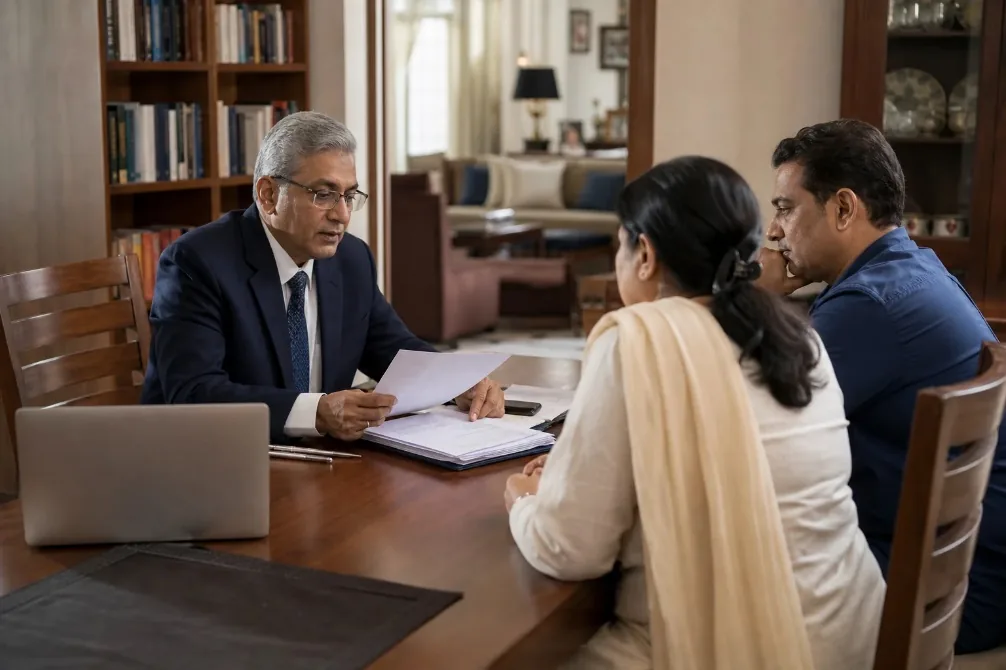
When a legal dispute lands on your plate, the instinct is to ask "which lawyer should I hire" before asking "which path should I take." That second question matters more than most people realise, because in India, the difference between mediation and litigation isn't just about speed. It's about money, years of your life, and often, the relationship you're fighting to protect.
If you're searching for a lawyer near me right now because of a property dispute, a business disagreement, or a marriage that's falling apart, this comparison, done honestly, with real numbers, should be the first thing you read.
The Real Cost of Litigation in India
Start with the scale of the problem. <cite index="41-1">As of June 2026, India had more than 56 million pending court cases across all levels, with over 180,000 cases pending for more than 30 years in district and high courts. </cite> <cite index="41-1">Roughly 85% of all pending cases sit in district courts alone. </cite>
That backlog translates directly into your case's timeline. <cite index="44-1">Research from Daksh, a civil society organisation, found that the average pendency of a case across 21 high courts is about three years and one month, while a case in a subordinate court takes close to six years on average.</cite> <cite index="44-1">If your case is appealed to a higher court, the average litigant is realistically looking at more than 10 years in the system , and if it reaches the Supreme Court, add roughly three more years on top of that.</cite>
Now the money. <cite index="44-1">A 2015–16 Daksh survey found that 90% of litigants earn less than ₹3 lakh a year, yet the average civil litigant loses close to ₹1,341 for every single day spent attending court , combining direct costs and lost wages.</cite> <cite index="44-1">Add advocate's fees on top, and litigation costs India's litigants roughly ₹80,000 crore annually , around 0.70% of the country's GDP at the time of the study.</cite> Corporate and high-value disputes are a different order of magnitude entirely: <cite index="44-1">affluent clients and companies routinely spend ₹2–3 crore fighting a single case through to conclusion.</cite>
The Supreme Court itself has flagged this as a systemic problem. In Vinod Seth v. Devinder Bajaj, the Court observed that <cite index="42-1">the absence of realistic cost provisions has fuelled a steady rise in malicious, vexatious, and speculative suits, and has made Section 89 of the CPC , the provision meant to push cases toward settlement , largely ineffective in practice.</cite> The Court went further, noting that <cite index="42-1">a litigant who starts a case, and later cannot bear the mounting delay and cost, often simply gives up and settles on unfavourable terms , much like a creditor forced to write off a debt they're owed.</cite> In other words: delay itself becomes a weapon, and the party with deeper pockets usually wins by attrition, not by merit.
The Real Cost of Mediation
Compare that to mediation. A typical mediated settlement, whether court-referred, private, or through a Lok Adalat, is usually resolved in weeks to a few months, not years. There's no equivalent of multiple rounds of appeal; a mediated settlement, once signed, is enforceable and final. Under the Mediation Act, 2023, a registered mediated settlement agreement carries the same force as a court decree, meaning you get finality without the decade-long wait.
The cost difference follows the same pattern. Mediation typically involves a handful of sessions with a mediator, rather than dozens of hearings spread across years, each with its own advocate fee, travel cost, and lost workday. There's no equivalent of the ₹1,341-per-day drain that litigant absorb simply by showing up to court repeatedly.
Need a Lawyer for clarity on your case?
What the Courts Themselves Have Said About This Trade-Off
This isn't a marketing argument, it's the reasoning the Supreme Court has used to actively push cases toward settlement.
In Afcons Infrastructure Ltd. v. Cherian Varkey Construction Co. (2010) 8 SCC 24, arising from a construction payment dispute worth over ₹2 crore, the Supreme Court held that <cite index="21-1">the entire purpose of Section 89 CPC is to make courts actively attempt to facilitate an out-of-court settlement , through arbitration, conciliation, judicial settlement, or mediation , before a matter is even allowed to go to trial.</cite> The Court also clarified <cite index="24-1">that while arbitration and conciliation require both parties' consent, mediation, judicial settlement, and Lok Adalat referrals can be ordered by the court without consent</cite> , underlining just how strongly the judiciary favours settlement wherever remotely possible.
In K. Srinivas Rao v. D.A. Deepa (2013) 5 SCC 226, a matrimonial dispute involving cross-allegations of cruelty and dowry, the Supreme Court noted from its own experience that <cite index="31-1">roughly 10 to 15% of matrimonial disputes referred to mediation centres end up getting resolved through mediation.</cite> It directed that <cite index="31-1">even serious, non-compoundable complaints like those under Section 498-A IPC should be referred to mediation wherever both parties are willing and settlement appears possible , without diluting the seriousness of the underlying law.</cite> This is a big part of why a family court lawyer in India today will almost never recommend jumping straight to a contested trial without first testing whether mediation can resolve things faster and with less damage on both sides.
Where Litigation Is Still the Right Call
None of this means litigation is always wrong. Cases involving serious fraud, matters that need a binding legal precedent, disputes involving a minor's protection, or situations where the other side has no genuine intention of settling in good faith often need a court's authority to resolve. The skill isn't picking mediation by default, it's having a lawyer assess, honestly, which route actually serves your interest before you commit years and lakhs to one path.
How Fintolit Helps You Make the Right Call, And Handles Either Path
This is exactly the judgment call Fintolit's consultations are built for. As a DPIIT-certified legal services platform, Fintolit only works with lawyers who are vetted to the core, specialists with 10+ years of active courtroom experience, so the recommendation you get on mediation versus litigation is grounded in real practice, not a generic checklist.
Here's what every Fintolit client gets, regardless of which path your case ultimately needs:
- A dedicated case manager who handles your case personally from start to finish
- A full 60-minute consultation with a senior specialist lawyer, no meter, no per-minute billing, the complete hour, flat
- 15-day lawyer access, reach out anytime within 15 days and Fintolit reconnects you with your lawyer, no re-booking friction
- A written consultation summary and legal roadmap, a documented comparison of your mediation vs. litigation options, timelines, and costs
- 24x7 case manager support for anything that comes up
- Fixed, transparent pricing, no meter, no surprises, complete convenience
- EMI options, pay as your case progresses, so cost never forces a decision you'll regret later
- End-to-end support, if your lawyer recommends mediation, arbitration, settlement drafting, or full representation in court, Fintolit handles it all under one roof, so you don't have to coordinate between multiple providers
Whether you're facing a property dispute, a business disagreement, or considering a mutual divorce lawyer in India for an amicable separation, the first move should be the same: get a real cost-and-timeline comparison from a specialist before choosing your path.
Need a Lawyer for clarity on your case?
Frequently Asked Questions
Is mediation cheaper than litigation in India? Generally, yes, mediation resolves in weeks to months with a handful of sessions, while litigation can run for years with recurring advocate fees, court fees, and lost work time at every hearing.
Can I be forced into mediation? Courts can refer you to mediation, judicial settlement, or Lok Adalat without your consent under Section 89 CPC, but arbitration and conciliation require both parties to agree.
Is a mediated settlement legally binding? Yes, under the Mediation Act, 2023, a registered mediated settlement agreement is enforceable like a court decree.
Does mediation work for divorce cases in India? Family Courts are required to attempt mediation before trial under Section 9 of the Family Courts Act, and courts have specifically encouraged it in matrimonial disputes, including those involving criminal complaints.
How do I decide between mediation and litigation for my case? A structured consultation with a specialist lawyer, one that maps out realistic cost and timeline for both routes, is the only reliable way to decide, rather than guessing based on how the other side is behaving.
Before you commit years and lakhs to a courtroom battle, get a real comparison first. The right lawyer near you isn't the one who promises to fight hardest, it's the one who tells you honestly whether you need to fight at all.
You're just getting to the good part.