

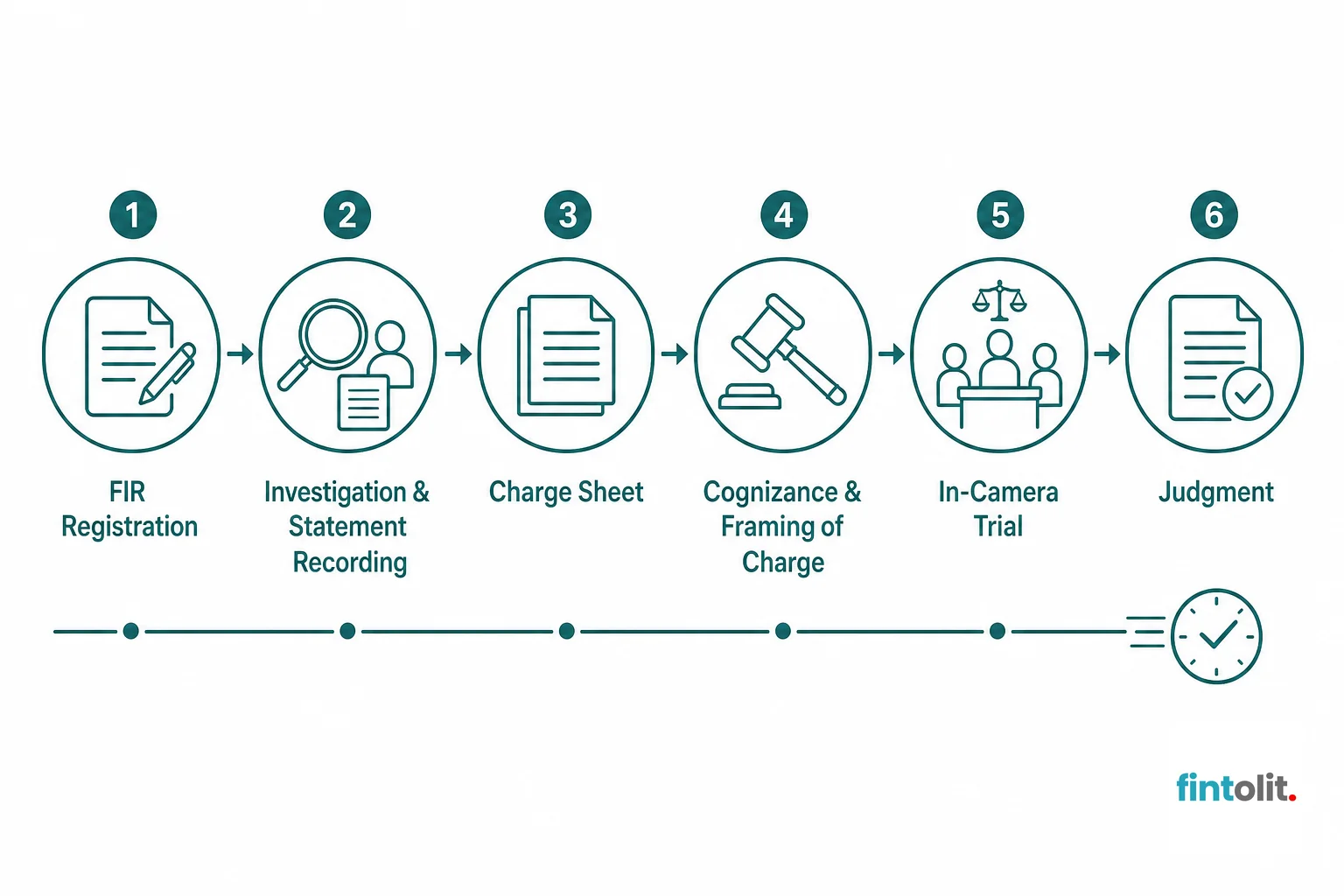
A POCSO case moves through five real stages: FIR, investigation, charge sheet, Special Court trial, and judgment, and at every one of those stages the accused has fewer default protections than in an ordinary criminal matter. Knowing exactly where your case sits, and what the law lets you do at that point, is what separates a family that reacts in panic from one that builds a real defence.
Key Takeaways
- Bail is harder, not impossible: Sections 29 and 30 create a reverse presumption of guilt in specific circumstances, but courts still grant bail when facts support it, as tracked by recent case analysis.
- Trials run through a Special Court: These courts are set up only for POCSO matters and follow a child-friendly, in-camera procedure that also shapes how the defence gets to test evidence.
- The first 48 hours decide a lot: Getting a certified FIR copy, checking arrest risk, and calling a criminal lawyer before speaking further to police protects the accused's position.
- Bail can go to Sessions or High Court: Under Section 483 of the BNSS (formerly Section 439 CrPC), both courts can grant bail depending on the facts, as explained by recent commentary on POCSO bail practice.
- A dedicated case manager reduces missed deadlines: Families juggling court dates, documentation, and emotional stress benefit from someone tracking the file full-time.
At a Glance: POCSO Case Timeline and Facts
| Stage | What happens | Who's involved |
|---|---|---|
| FIR registration | Complaint recorded, case registered with the police station | Complainant, police, child welfare committee |
| Medical exam & statement | Medical examination and statement recorded, often at the child's home | Doctor, police, support person |
| Investigation | Evidence gathering, forensic reports, statement under Section 183 BNSS (formerly 164 CrPC) | Investigating officer, Magistrate |
| Charge sheet | Police file findings before the Special Court | Investigating officer, public prosecutor |
| Cognizance & framing of charge | Court decides whether a trial should proceed on specific charges | Special Court judge |
| Trial (in-camera) | Evidence recorded, witnesses examined away from public view | Judge, prosecution, defence lawyer |
| Judgment & appeal | Verdict delivered; either side can appeal to the High Court | Special Court, High Court |
What is the POCSO Act and why does it feel so heavy on the accused?
The POCSO Act was written to protect children, and courts read it that way from the first hearing. For some sections, the law presumes guilt once the prosecution shows basic facts, and the accused has to disprove it rather than the other way around. That's a real shift from how most criminal cases work, and it's exactly why early legal help matters more here than almost anywhere else.
Parents often get the first notice from police or hear about an FIR through a phone call, and the confusion sets in fast. Complaints can come from genuine harm, but also from school disputes, neighbourhood friction, or messy breakups that spill into criminal allegations. None of that changes the procedure the accused now has to go through, so the response has to be careful, not emotional.
Whatever the backstory, the case still needs a real defence built on facts and documentation, not on hoping it resolves itself. Families who search for guidance often land on generic pages about "how to respond to legal charges" without realising POCSO has its own rulebook layered on top of ordinary criminal procedure.
How does an FIR turn into a POCSO case?
An FIR under POCSO gets registered the same way as other FIRs, but what follows moves faster and involves more people. The child gives a statement in a safe setting, often at home, a medical exam may be ordered, and a Child Welfare Committee gets looped in to look after the child's interests through the process.
For the accused, this stage is where the paper trail starts. Every WhatsApp message, school record, CCTV footage, or witness account that could matter later needs to be identified and preserved now, because evidence gets harder to find once weeks pass. This is also the point where a lawyer familiar with rights during police interrogation can stop an accused person from saying something that gets used against them later.
Need a Lawyer for clarity on your case?
What happens during the investigation stage?
Investigation covers evidence collection, forensic testing where relevant, and a statement recorded before a Magistrate under Section 183 of the BNSS. This stage decides what actually goes into the charge sheet, so gaps or contradictions the defence spots here carry weight all the way to trial.
Police must avoid aggressive questioning of the child and follow a structured process built around reducing trauma, a point several legal practitioners have flagged when explaining how POCSO procedure differs from a typical criminal case. That same structure means the accused's lawyer needs to track every document filed, every witness named, and every timeline gap, because the Special Court will lean on the investigation record heavily once trial starts.
What are the Special Court stages after the charge sheet?
Once police file the charge sheet, the case goes to a Special Court set up specifically for POCSO matters. The judge first takes cognizance, then frames charges if there's enough on record to proceed, and only after that does the actual trial begin.
Trial hearings happen in-camera, meaning closed to the public, and evidence gets recorded in stages: the child's testimony, other witnesses, forensic experts, and finally the defence's evidence and arguments. Courts aim to finish these matters faster than regular criminal trials given the sensitivity involved, but real-world timelines still stretch across months depending on how contested the facts are and how many witnesses need examination.
Can the accused get bail in a POCSO case?
Yes, bail is possible in a POCSO case, but the reverse presumption under Sections 29 and 30 puts the burden on the accused to show why they should get it, unlike most other offences where the prosecution carries that burden.
Sessions Courts and the High Court both hear POCSO bail applications, usually under Section 483 of the BNSS. Judges look at the severity of the allegation, the accused's role, flight risk, tampering risk, and how far the investigation has progressed. A strong bail application lays out specific facts on each of these points rather than general assurances, and that's where an experienced criminal lawyer's drafting makes a measurable difference to the outcome.
How to respond when POCSO charges surface
Stay quiet with the police, get the FIR copy fast, and call a specialised criminal lawyer before answering any more questions. That single sequence protects rights that are otherwise easy to lose in the first conversation with an investigating officer.
A certified copy of the FIR tells you exactly which sections have been invoked, and that changes everything about strategy, from bail prospects to how long the case might run. Don't approach the complainant's family directly, even with good intentions; it can be read as intimidation and used against the accused later.
Write down a timeline of your own movements and interactions around the dates named in the complaint while memory is fresh. Save any messages, calls, or documents that support your version of events, because these details fade or get deleted faster than families expect.
What should a family do in the first 48 hours?
The first 48 hours set the tone for the entire case, so families need a short, specific checklist rather than general advice.
- Get a certified copy of the FIR and read the exact sections named in it.
- Call a criminal lawyer who has actually handled POCSO matters, not a general practitioner.
- Avoid any direct or indirect contact with the complainant or their family.
- Preserve phone records, messages, and any digital evidence relevant to the dates in question.
- Keep a written log of every police interaction, including names, times, and what was asked.
Families juggling this checklist alongside work, other children at home, and their own fear often miss a filing window or a hearing date simply from exhaustion. That's where a legal notice reply or a bail draft needs someone tracking it full-time, not squeezed in between other obligations.
Need a Lawyer for clarity on your case?
How Fintolit supports families through a POCSO case
Fintolit connects accused individuals and their families with verified criminal lawyers who have handled sensitive cases like this before, not general practitioners learning on the job.

Every case gets a dedicated case manager who tracks hearing dates, documentation, and next steps, so families aren't left guessing between calls to a busy lawyer's office. You see the lawyer's name and background before you pay anything, and the same lawyer stays with your case from the first consultation to its close, with no handoffs mid-way.
Consultations run seven days a week, online or through the Lawyer at Home option across Delhi, Gurugram, Noida, and the wider NCR, for families who'd rather not sit in a waiting room while carrying this kind of stress. If the case also touches property, custody, or family disputes tied to the allegation, the same platform covers child custody matters under one roof.
Frequently Asked Questions
Is a POCSO case bailable?
Most serious offences under the POCSO Act are non-bailable, meaning bail isn't automatic and requires a court order. A Sessions Court or High Court decides based on the facts, the reverse presumption under Sections 29-30, and how far the investigation has moved.
How long does a POCSO trial actually take in India?
Special Courts aim to move faster than ordinary criminal trials given the sensitivity of these cases, but contested matters with multiple witnesses commonly run several months to over a year. The exact timeline depends on court backlog, the number of witnesses, and whether either side seeks adjournments.
Can a POCSO case be settled outside court?
No. POCSO offences aren't compoundable, meaning the complainant and accused can't simply agree to drop the case privately. The matter proceeds through the police and Special Court regardless of any private settlement attempt, though a settlement can sometimes influence sentencing in specific, limited circumstances.
What if the FIR itself is false or exaggerated?
A false or exaggerated FIR can still be challenged, but only through the right legal channel, not by ignoring it. Options include contesting the charge sheet, applying for bail with a strong factual record, or in rare cases seeking quashing at the High Court where the allegations don't hold up even if taken at face value.
Every allegation deserves a careful, fact-based response, whether it stems from genuine harm or a misunderstanding that spiralled through police involvement.
If someone in your family is facing a POCSO allegation, don't wait for the next hearing date to figure out your options. Book a consultation with a verified criminal lawyer who has actually handled these cases, or chat with us on WhatsApp to get a same-day case manager assigned to your file. The sooner someone experienced reviews the FIR, the more options stay open for your family.
Recommended Resources
You're just getting to the good part.