

Every person questioned by police in India keeps three protections no officer can take away: the right to stay silent, the right to know why they're being held, and the right to consult a lawyer during interrogation. These come from Article 20(3) of the Constitution and Sections 35 to 58 of the Bharatiya Nagarik Suraksha Sanhita (BNSS). Knowing them changes how an interrogation actually plays out.
Key Takeaways
- You cannot be forced to speak: Article 20(3) protects against self-incrimination, and a confession made to police is inadmissible under Section 23 of the Bharatiya Sakshya Adhiniyam.
- You must still give your name and address: BNSS Section 35(2) requires this basic identification even if you stay silent on the offence itself.
- You can meet a lawyer during interrogation: Section 38 of BNSS guarantees the right to consult a lawyer, though not necessarily to have them physically present through every question.
- Someone must be told where you are: Section 48 requires police to inform a relative or friend of the arrest and the place of detention.
- The clock is short: An arrested person must be produced before a magistrate within 24 hours, excluding travel time, and has the right to a medical exam under Section 53.
At a Glance: Your Rights During Interrogation
| Right | Legal Basis | What It Means in Practice |
|---|---|---|
| Right to silence | Article 20(3), BSA Sec. 23 | You can decline to answer questions that incriminate you; police confessions don't hold up in court |
| Right to know grounds of arrest | BNSS Sec. 47 | Police must tell you why you're being arrested, in words you understand |
| Right to legal counsel | BNSS Sec. 38 | You can consult a lawyer during interrogation |
| Right to inform a relative | BNSS Sec. 48 | Police must inform someone close to you of your arrest and location |
| Right to medical examination | BNSS Sec. 53 | You can request a medical exam, which also documents any injuries |
| Right to be produced before a magistrate | BNSS Sec. 58 and related provisions | Must happen within 24 hours of arrest, minus travel time |
| Duty to give name and address | BNSS Sec. 35(2) | Silence covers the offence, not your basic identity |
What Actually Happens When Police Call You In
A police call rarely starts with handcuffs. It usually starts with a phone call, a notice, or a knock at the door asking you to "come in for questioning." That distinction matters. A summons under Section 35 is not the same as an arrest, and how you respond in the first hour often shapes everything that follows.
Most people panic and start explaining themselves before they've even sat down. That's the mistake. Stay calm, ask for the notice in writing if there is one, and note the officer's name and the police station. These small details protect you later.
If the visit turns into detention, everything from here on is governed by strict rules. The officer has to follow procedure, and you have specific things you're owed, not favors, but rights.
Can the Police Force You to Answer Questions?
No. Article 20(3) means you cannot be compelled to be a witness against yourself, and any confession you give directly to police cannot be used against you in court under Section 23 of the Bharatiya Sakshya Adhiniyam.
Only a confession recorded before a magistrate carries weight, and even then you can refuse to give one. Staying quiet is not an admission of guilt. It's a legal choice, and one the law expects you to be free to make without pressure.
There's a limit though. You still have to give your correct name and address when lawfully asked, under Section 35(2) of BNSS. Silence protects you from self-incrimination, not from basic identification.
Do You Have the Right to a Lawyer During Interrogation?
Yes. BNSS Section 38 gives every accused person the right to consult a lawyer of their choice during interrogation, a real shift from the old Code of Criminal Procedure's vaguer language.
Need a Lawyer for clarity on your case?
In practice, this usually means meeting your lawyer before and after specific rounds of questioning, rather than having them seated beside you for every single question. Courts have read this right broadly, but enforcement on the ground still varies from station to station.
This is exactly where things go wrong for people who don't act fast. A lawyer who steps in early can flag procedural lapses, stop coercive questioning, and start building your defence before a single statement is recorded. If you're unsure how a legal consultant differs from a defence lawyer in this kind of situation, it's worth getting that clarity before you need it urgently.
What Else BNSS Guarantees You
Beyond silence and legal counsel, the law gives you a handful of other protections that most people never hear about until it's too late.
- Grounds of arrest: Police must tell you why you're being arrested, in language you understand, not legal jargon read off a form.
- A relative informed: Someone close to you gets told where you are and why.
- Medical examination: You can ask for one, and it becomes a record of your physical condition at the time.
- Production before a magistrate: This has to happen within 24 hours, minus the time it takes to travel to court.
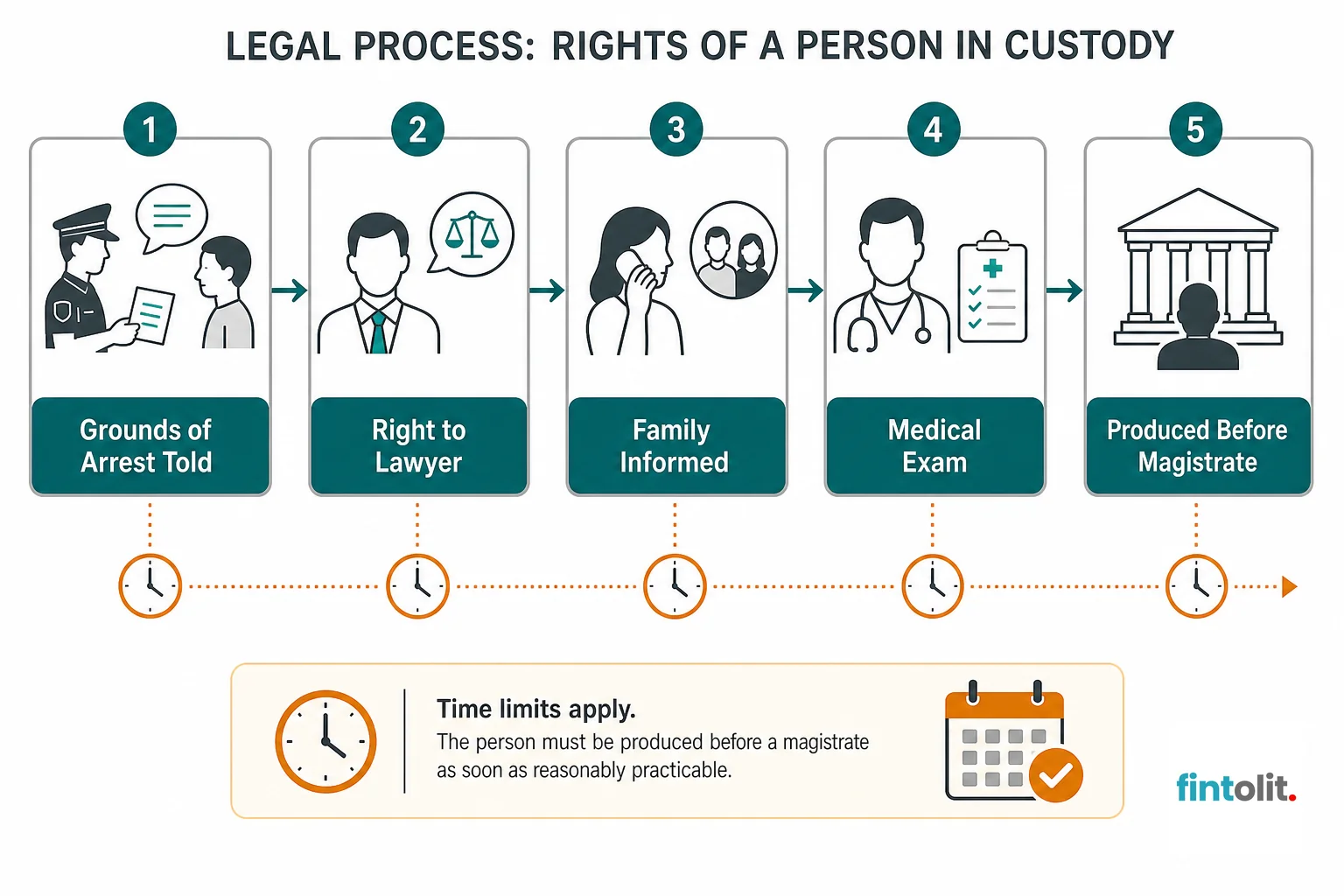
These aren't bureaucratic formalities. Each one exists because, historically, its absence led to abuse. A missed medical exam, for instance, has been the deciding factor in more than one custodial injury case.
How to Spot When Your Rights Are Being Violated
Rights on paper mean little if you can't recognize when they're being ignored. Watch for these warning signs.
- No one tells you why you're being questioned or held.
- You ask for a lawyer and get told to "just answer first."
- Your family has no idea where you are, hours after you left.
- Officers pressure, threaten, or physically intimidate you to sign a statement.
- You're kept well past 24 hours without being taken to a magistrate.
If any of this happens, say clearly that you want a lawyer, and repeat it. Don't sign anything you haven't read carefully, and don't assume cooperation without counsel will end things faster. It usually does the opposite.
Why It Moves Fast and Why Legal Help Early Changes Outcomes
Once questioning starts, decisions get made quickly. Statements get recorded, custody gets extended, and bail arguments get built on whatever happened in those first hours. That's why waiting to "see how it goes" before calling a lawyer usually costs more than it saves.
A lawyer involved from the start can push back on procedural shortcuts, request the medical exam you're entitled to, and start preparing an anticipatory bail or regular bail application without losing a day. Families searching for a clear checklist of documents and steps often realize too late that criminal matters run on a different, faster clock than civil ones.
What To Do If You or a Family Member Gets a Police Call in Delhi NCR
In Delhi, Gurugram, and Noida, police stations handle a high volume of cases, and procedure can slip when things get busy. Knowing your local police station's jurisdiction and having a lawyer on call before trouble starts puts you ahead.
If a family member gets a call or notice, the first move is simple: don't send them alone. Get a lawyer briefed on the situation before they walk in, not after.

Fintolit connects families across Delhi NCR with verified criminal lawyers who have handled interrogation, arrest, and bail matters for years, not months. You get the same lawyer from your first call to case closure, along with a dedicated case manager who keeps you updated instead of leaving you to guess. Whether it's an FIR, a Section 41A notice, or a sudden call from the station, you can book a consultation and get a clear read on your position within hours, not days.
Need a Lawyer for clarity on your case?
Frequently Asked Questions
Can police interrogate you without a lawyer present?
Police can begin questioning you, but you have the right under Section 38 of BNSS to ask for a lawyer to be consulted during the process. Refusing your request outright is a violation you should flag immediately.
What happens if you refuse to answer questions?
Refusing to answer incriminating questions is your right under Article 20(3), and it cannot be used as proof of guilt. You still must give your name and address when lawfully asked under Section 35(2) of BNSS.
Can family be present during interrogation?
Family members aren't guaranteed a seat in the interrogation room, but Section 48 of BNSS requires police to inform a relative or friend of the arrest and where you're being held.
Is staying silent treated as an admission of guilt?
No. Silence during interrogation is a protected legal choice, not evidence against you. Courts cannot treat your decision not to speak as proof that you committed an offence.
If you or someone you know has a police matter moving faster than expected, don't wait for the situation to escalate before getting legal advice. Book a consultation with a verified criminal lawyer or message us on WhatsApp for an immediate read on your rights and next steps. The sooner someone experienced is on your side, the more options stay open.
Recommended Resources
You're just getting to the good part.