

A landlord in India cannot force a tenant out overnight, no matter what the rent agreement says. The landlord tenant eviction process in India requires a valid legal ground, a proper written notice, and, in most contested cases, an order from a Rent Court or civil court. Skip any of these and the eviction itself can be challenged, and even reversed.
Key Takeaways
- Valid ground required: Non-payment of rent, subletting, personal need, or major repairs are the accepted reasons, not simply a landlord wanting the tenant gone.
- Notice period varies: Most states require 15 days to a few months of written notice depending on the ground and the applicable law.
- Two-month rule: Under the Model Tenancy Act, failure to pay rent for more than two consecutive months lets a landlord approach the Rent Court.
- No self-help evictions: Locking out a tenant or cutting utilities without a court order has real consequences for the landlord, even if the tenant is clearly in the wrong.
- Timelines differ by state: States that have adopted Rent Court structures under the Model Tenancy Act tend to resolve disputes faster than areas still under older Rent Control Acts.
At a Glance: Eviction Grounds, Notice & Timeline
| Ground for Eviction | Typical Notice Period | Governing Law | Realistic Timeline |
|---|---|---|---|
| Non-payment of rent (2+ months) | 15-30 days written demand | Model Tenancy Act / state Rent Control Act | 3-8 months uncontested |
| Subletting without consent | 30 days | State Rent Control Act | 4-10 months |
| Bona fide personal need | 1-3 months | State Rent Control Act | 6-18 months, often contested |
| Structural repair or rebuilding | 1-2 months | State Rent Control Act | 6-12 months |
| Illegal use of premises | Immediate to 15 days | Rent Control Act / lease terms | 3-6 months |
| Lease term expiry, no renewal | As per Transfer of Property Act, Section 106 | Transfer of Property Act, 1882 | 2-6 months |
What counts as a valid reason to evict a tenant in India?
A landlord needs one of a short list of accepted grounds, not just a change of mind. The most common one is non-payment of rent for more than two consecutive months, which the Model Tenancy Act treats as grounds to approach the Rent Court, provided the landlord has documented proof like bank statements and rent receipts.
Subletting without written consent is another common ground. So is the landlord's genuine, bona fide need for the property, say, a parent moving back to Delhi from abroad. Structural repairs, demolition plans, illegal activity on the premises, and a lease that has simply run its term without renewal round out the usual list.
Courts look closely at whether the stated reason is real or just a cover for wanting a higher-paying tenant. Documented evidence carries far more weight than a landlord's word alone, on either side of the dispute.
How does the eviction notice and process actually work?
The process starts with a written notice stating the ground and giving the tenant time to fix the issue or vacate. If the tenant doesn't comply, the landlord files with the Rent Court (in states that have adopted the Model Tenancy Act) or the civil court handling rent matters. The tenant then gets a chance to respond before any order is passed.
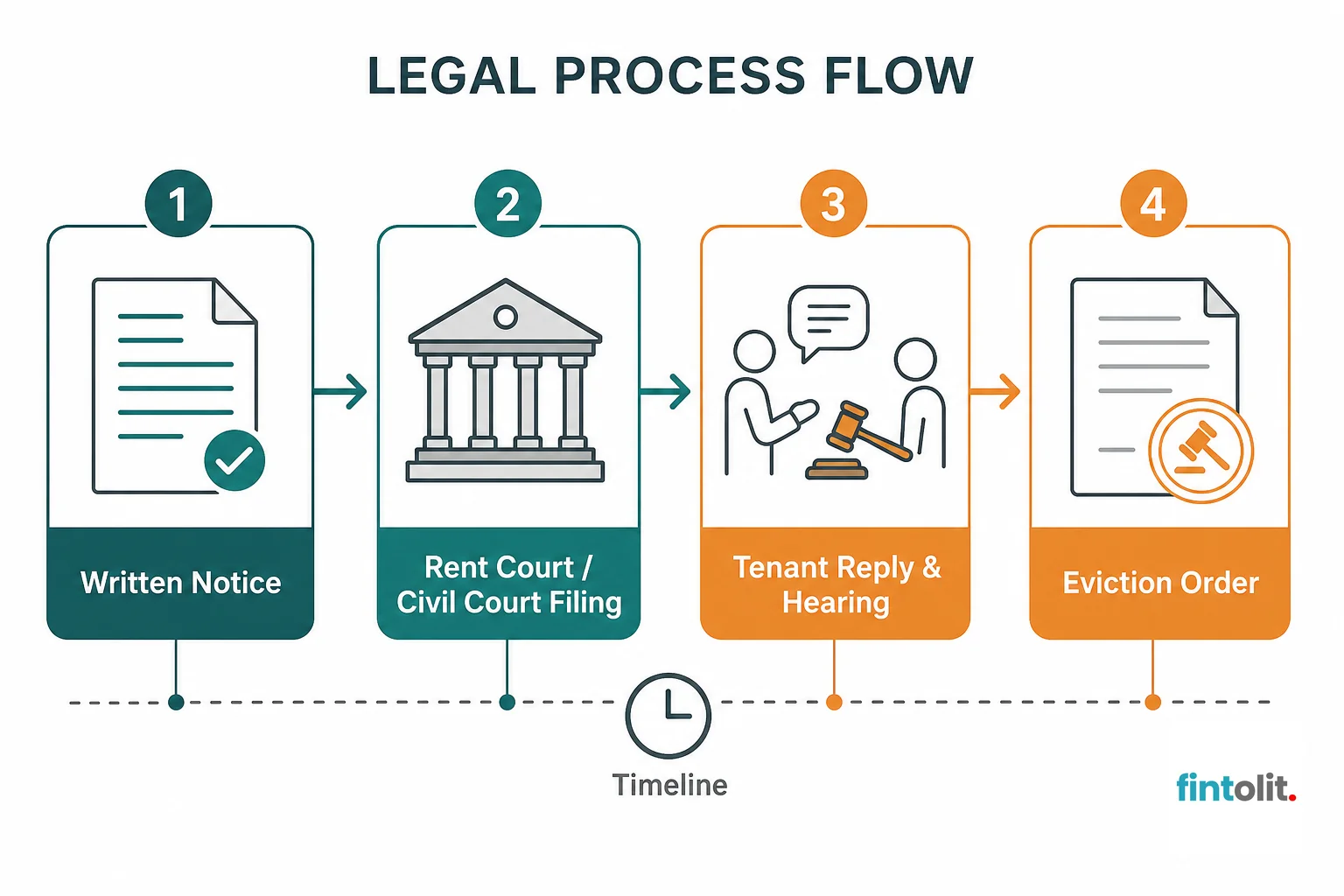
States that have set up dedicated Rent Authorities and Rent Courts under the Model Tenancy Act generally move faster than places still relying on older Rent Control Acts, where general civil courts handle these disputes alongside everything else on their docket. Delhi, Gurugram, and Noida landlords deal with a mix of both systems depending on which law the specific tenancy falls under.
Under the Transfer of Property Act, 1882, Section 106 sets the notice a landlord must serve before suing for ejectment on a periodic tenancy, and Section 111 lists the ways a lease can end. Rent agreements drafted with these sections in mind avoid a lot of confusion later. If your agreement is missing key clauses like a defined notice period, a lawyer can review it before you send anything; see our guide to drafting a legal notice in India for the exact clauses that hold up in court.
Need a Lawyer for clarity on your case?
Model Tenancy Act states vs older Rent Control states
The Model Tenancy Act, adopted at different paces by different states, sets up a three-tier structure: Rent Authority, Rent Court, and Rent Tribunal. This is meant to resolve disputes faster than the general court system. States that haven't adopted it still route eviction suits through regular civil courts, which tend to take longer simply because of caseload.
How long does eviction actually take in Delhi NCR?
An uncontested eviction, where the tenant doesn't fight the case, can resolve in a few months once the notice period and filing are done correctly. A contested case, where the tenant disputes the ground or delays hearings, can run well past a year.
Delhi, Gurugram, and Noida courts carry heavy caseloads, and adjournments are common. Landlords who keep clean records, rent receipts, bank transfers, a written notice with proof of delivery, tend to move through hearings faster because there's less for the tenant to dispute. Property owners across the wider service area, including Faridabad and Ghaziabad, see similar patterns; the paperwork decides the pace more than the city does.
What can a tenant do if they get an eviction notice?
A tenant who receives an eviction notice should first check whether the stated ground is actually valid and whether the notice period matches what the law or the rent agreement requires. A notice that's too short, vague, or based on a ground that isn't recognised can be challenged before the Rent Court.
Responding in writing matters more than most tenants realise. Silence can be read as acceptance. A written reply, disputing the ground, offering to clear arrears, or asking for more time, keeps the tenant's position on record. If the dispute involves an unreturned security deposit alongside the eviction, our piece on what to do when a landlord withholds a security deposit covers that specific fight in more detail.
Can a landlord evict a tenant without going to court?
No. A landlord cannot lock a tenant out, cut off water or electricity, or remove belongings without a court or Rent Authority order, even when the tenant is clearly at fault. Doing so has real consequences for the landlord, including potential criminal complaints and damages claims.

Eviction notices in India are governed by strict procedure precisely to stop landlords from taking shortcuts. The only lawful route to removing an unwilling tenant is through the Rent Court, Rent Tribunal, or civil court, depending on the state and which law applies to the tenancy.
Common mistakes landlords make
- Sending a verbal warning instead of a written notice with proof of delivery.
- Skipping bank records and relying only on cash rent collection.
- Trying to change locks or shut off utilities before any hearing.
- Using a rent agreement that never mentions notice periods or grounds for termination.
How much does a lawyer for eviction cases cost in India?
Fees for an eviction case depend on whether it's contested, how many hearings it takes, and the city where the property sits. An uncontested case with clean documentation costs less because there's less back-and-forth in court. A contested case with appeals can run considerably higher, since every hearing adds to the bill under hourly billing models.
This is one reason a fixed, upfront fee matters more in property disputes than in almost any other legal matter, cases can drag, and hourly billing punishes exactly the situations where a landlord or tenant most needs cost certainty. Our detailed breakdown of legal fees in India for 2026 walks through what drives cost up in property matters specifically.
Practical steps for landlords before filing
Start collecting rent receipts, bank transfer records, and any written communication about late payment or property misuse well before sending a notice. Courts favour the party with the paper trail, and a thin file slows everything down.
Need a Lawyer for clarity on your case?

Send the written notice first, clearly stating the ground and the notice period, and keep proof it reached the tenant. Many disputes settle at this stage without ever reaching court, especially when both sides can see the paperwork lines up. Mediation is worth trying before litigation; it's faster and cheaper, and a Fintolit case manager can help set that conversation up alongside a verified property lawyer.
Before any of this, have your original rent agreement reviewed. A missing notice clause or an undefined lock-in period is often what turns a simple eviction into a year-long fight. Fintolit's Lawyer at Home service can review your documents in person if you'd rather not manage this over email and phone calls, useful for landlords across Delhi, Gurugram, and Noida who want someone to physically check the paperwork.
FAQs
How do I find a good lawyer for an eviction case in India?
Look for a lawyer with real property law experience, a verified profile you can review before paying, and a fixed fee quoted upfront. Avoid anyone who won't give you a name or a clear cost estimate before the first consultation.
What do lawyer fees for property disputes in India typically depend on?
Fees usually scale with whether the case is contested, the number of hearings expected, and the city where the property is located. Fixed-fee models remove the uncertainty that comes with hourly billing on a case that might run long.
Can a tenant be evicted without a written rental agreement?
Yes, but it's harder. Without a written agreement, the landlord relies on the Transfer of Property Act and other evidence, like bank transfers and utility bills, to prove the tenancy existed and to establish the correct notice period.
Whether you're a landlord tired of chasing rent or a tenant unsure if a notice is even valid, the fastest way out of the uncertainty is getting the actual document, your rent agreement or your eviction notice, in front of a lawyer who deals with these cases regularly.
If you're facing an eviction notice, or you're a landlord ready to file one, don't wait for the situation to escalate on its own. Book a consultation with a verified property lawyer who can review your documents and lay out a realistic timeline for your specific case. Prefer to talk it through first? Chat with us on WhatsApp and a case manager will help you figure out the next step.
Recommended Resources
You're just getting to the good part.