
Copyright registration in India gives creators something copyright law itself doesn't: proof. Your work is protected the moment you create it under the Copyright Act, 1957, but proving that in a courtroom or a licensing negotiation is a different problem. Registration solves that problem by creating an official, dated public record you can point to.
Key Takeaways
- Registration is optional, not mandatory: your copyright exists from the moment you create the work, no filing required.
- It's the strongest evidence you can hold: under Section 48 of the Copyright Act, a certified copy of your registration entry counts as prima facie proof of ownership in court.
- The government fee is low: a literary, dramatic, musical or artistic work costs ₹500 to register, with higher slabs for sound recordings and films.
- It makes your work a tradeable asset: publishers, producers and platforms move faster on licensing deals when ownership isn't in question.
- Unregistered works can still sue: but they carry a heavier burden of proving they made the work first.
Advantages of Copyright Registration in India at a Glance
| Aspect | Without Registration | With Registration |
|---|---|---|
| Proof of ownership | Must be reconstructed from emails, drafts, timestamps | Official certificate with filing date |
| Court evidence | Ordinary evidence, open to challenge | Prima facie evidence under Section 48 |
| Government fee (literary/artistic work) | Not applicable | Around ₹500 |
| Licensing & business deals | Slower, more due diligence needed | Faster, ownership pre-verified |
| Infringement action | Possible, but harder to establish | Stronger footing, quicker relief |
| Timeline to certificate | N/A | Several months, plus a mandatory objection window |
Is Copyright Registration Mandatory in India?
No, copyright registration is not mandatory in India. Copyright protection begins automatically the instant you create an original literary, artistic, musical or dramatic work, or a film or sound recording, under the Copyright Act, 1957. Registration simply gives you documented proof of a right you already hold.
That distinction confuses a lot of creators. They assume no certificate means no protection, so they either skip registration entirely or panic when someone copies their work before they've filed anything. Neither reaction is correct.
Your song, your blog post, your product design, your app's interface, all of it is protected from the second you fix it in a tangible form. The gap is evidentiary, not legal. If someone lifts your work and you end up in court, you still need to convince a judge that you made it first, and that's exactly where an unregistered creator struggles.
What Are the Advantages of Copyright Registration in India?
The core advantages of copyright registration in India come down to five things: proof, evidence, deterrence, monetisation and speed. Each one solves a specific, practical problem a creator or business runs into once their work starts generating value.
Proof of ownership. A registration certificate names you, states what the work is, and carries a filing date. That combination is hard to argue with, whether you're facing a rival claimant or a bank asking for collateral documentation.
A public record that outlasts memory. Emails get deleted, drafts get overwritten, and collaborators move on. The Copyright Office's register doesn't forget who filed first.
A deterrent effect. A registered work signals to competitors, agencies and platforms that you've taken the legal step. Infringers who might chance an unregistered work often back off once they see a certificate exists.
Easier licensing and business deals. Studios, publishers and app stores routinely ask for proof of ownership before signing. A registered copyright shortens that conversation considerably.
A cleaner path to damages. Courts still award relief for unregistered works, but a registered entry removes one entire argument the other side would otherwise raise: whether you actually own what you're suing over.
How Registration Strengthens an Infringement Claim
Registration strengthens an infringement claim because Section 48 of the Copyright Act makes the Register of Copyrights prima facie evidence of everything entered in it. A certified copy of your entry, sealed by the Copyright Office, is admissible in court on its own, shifting the burden onto the person disputing your ownership rather than onto you.
Need a Lawyer for clarity on your case?
In practice, that changes how a case unfolds. Without registration, the first several hearings can get consumed by arguments over whether you even own the work being copied. With a registered entry sealed by the Copyright Office, that fight mostly disappears, and the case moves straight to the actual infringement question.
That matters more than it sounds. A drawn-out ownership dispute can cost months, and every month an infringer keeps using your work is lost revenue you're unlikely to fully recover, even after winning.
What Documents and Steps Are Needed to Register?
Registering a copyright in India means filing an online application with copies of the work, a statement of particulars, and, where relevant, a no-objection certificate from co-authors or collaborators. The process runs through the Copyright Office portal and typically takes several months, including a mandatory 30-day window for objections.
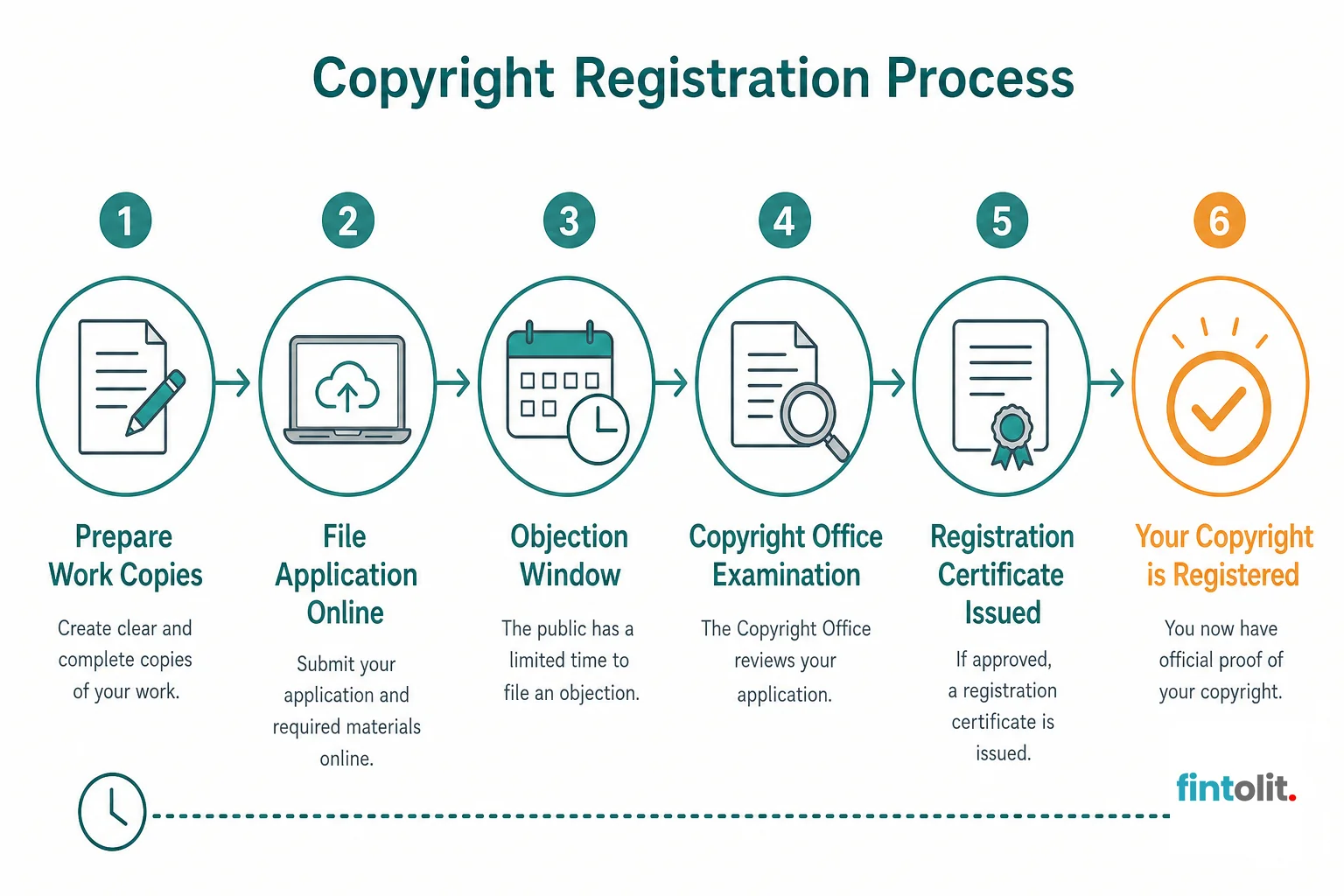
The government fee for a literary, dramatic, musical or artistic work is around ₹500, with separate, higher fee slabs for sound recordings and cinematograph films. You'll need:
- A completed application form (Form XIV) with your details and the work's category
- Two copies of the work itself, or a script/description if it can't be physically submitted
- A demand draft or online payment for the government fee
- A statement of authorship, and NOC from co-authors, publishers or previous rights holders where applicable
- A power of attorney if a lawyer or agent is filing on your behalf
Mistakes here are common. A missing NOC, a wrongly filled category, or an incomplete description of the work can send the application back for correction, adding weeks to the timeline. If you're filing for a business or a work with multiple collaborators, getting the paperwork right the first time matters more than moving fast.
Who Should Register: Writers, Musicians, Filmmakers, Businesses
Any creator whose work has commercial value or shared authorship benefits from registering it. That includes authors publishing through royalty deals, musicians releasing tracks that get licensed for films or ads, filmmakers financing projects with investors, and software developers whose code is the company's core asset.
Startups building original branding, course content or proprietary tools face a specific risk: a co-founder leaves, or a freelancer claims joint ownership of what they were paid to build. A registered copyright with clear authorship on record heads off that argument before it starts. If you're also locking down the underlying agreements, our guide on legal documentation founders skip and regret later covers what else tends to get missed.
Individual creators working with freelancers or collaborators should also get contracts in writing before work begins. Ambiguity over who owns what gets expensive fast, and our piece on freelancer client agreements walks through the clauses that prevent it.
Registered vs Unregistered Copyright in India
| Factor | Unregistered Copyright | Registered Copyright |
|---|---|---|
| Exists from | Moment of creation | Moment of creation (registration is retrospective proof, not the origin of the right) |
| Burden in court | Owner must prove authorship and date from scratch | Certified register entry is prima facie evidence |
| Cost | None | Around ₹500 for literary/artistic works, more for films and sound recordings |
| Best suited for | Low-value, personal or short-lived works | Commercial works, collaborations, anything you plan to license or sell |
| Dispute resolution speed | Slower, ownership often contested first | Faster, ownership rarely the point of dispute |
When Should You Get Legal Help for Copyright Registration?
Get legal help when your work involves multiple authors, prior publishing agreements, cross-border rights, or any commercial licensing plan, since a filing error in these situations can delay your certificate by months or weaken your position in a future dispute. A straightforward, single-author work is often manageable alone.
Where things get complicated is exactly where a lawyer earns their fee: co-authorship disputes, works created during employment, adaptations of existing IP, or a registration that's step one of a bigger licensing deal. Getting the ownership statement wrong at this stage can undercut you later, when you're actually trying to enforce the copyright in a legal notice or in court.
Need a Lawyer for clarity on your case?
Fintolit connects you with verified lawyers experienced in intellectual property and copyright matters, available for a fixed-fee 60-minute consultation, online or as a Lawyer at Home session across Delhi NCR, Gurugram and Noida.
You get a dedicated case manager and the same lawyer from your first call through registration and, if it comes to it, enforcement. If you'd rather compare the costs of doing this yourself versus hiring counsel, our breakdown of legal fees in India is a useful starting point.
Frequently Asked Questions
How do I find a good IP lawyer in India?
Look for a lawyer with a specific track record in copyright or intellectual property matters, not just general civil practice, and check whether they've handled registrations, licensing agreements or infringement suits before. Ask for their experience upfront and get their fee structure in writing before the first session, rather than negotiating case by case.
What do lawyer fees for copyright registration typically look like?
Fees vary by whether you need only a filing service or a lawyer to also draft NOCs, resolve co-authorship questions or handle a dispute. Ask any platform or lawyer for a written fee breakdown before you commit, so government charges and professional fees aren't bundled into one unclear number.
How long does copyright registration actually take?
Expect several months from filing to certificate, most of it taken up by the mandatory objection window and the Copyright Office's internal review. Filing your application correctly the first time is the single biggest thing you control to avoid extra delay.
Registration doesn't create your copyright. It creates the proof that saves you when someone else tries to claim it did.
If you've written a book, composed music, built software, or created any original work you plan to license, sell or defend, don't wait for a dispute to find out your evidence is thin. Book a consultation with a verified Fintolit lawyer who handles copyright and IP matters, or chat with us on WhatsApp to ask what registering your specific type of work will actually involve.
Recommended Resources
You're just getting to the good part.