

You can verify property documents from abroad without flying to India, using state land record portals, an encumbrance certificate covering the last 30 years, and a verified lawyer who physically checks originals on your behalf. The combination closes most of the gaps a scanned PDF from a seller can hide, and it usually takes about a week when someone competent is running it end to end.
Key Takeaways
- Start with the full document set: sale deed, encumbrance certificate for 30 years, five years of tax receipts, mutation certificate, and approved building plan, before you spend a rupee on anything else.
- Online portals cover ownership, not litigation: most state land record sites confirm current mutation and khata, but a separate court record search is the only way to catch a pending property dispute.
- A verified property lawyer replaces a physical visit: someone who checks the original documents at the sub-registrar's office and reports back to you does the job a plane ticket used to.
- A properly drafted power of attorney lets a trusted person act for you locally, but the wrong wording can void the whole document.
- Seven days is realistic: document collection, online checks, litigation search, and lawyer review can be completed in roughly a week for most straightforward purchases.
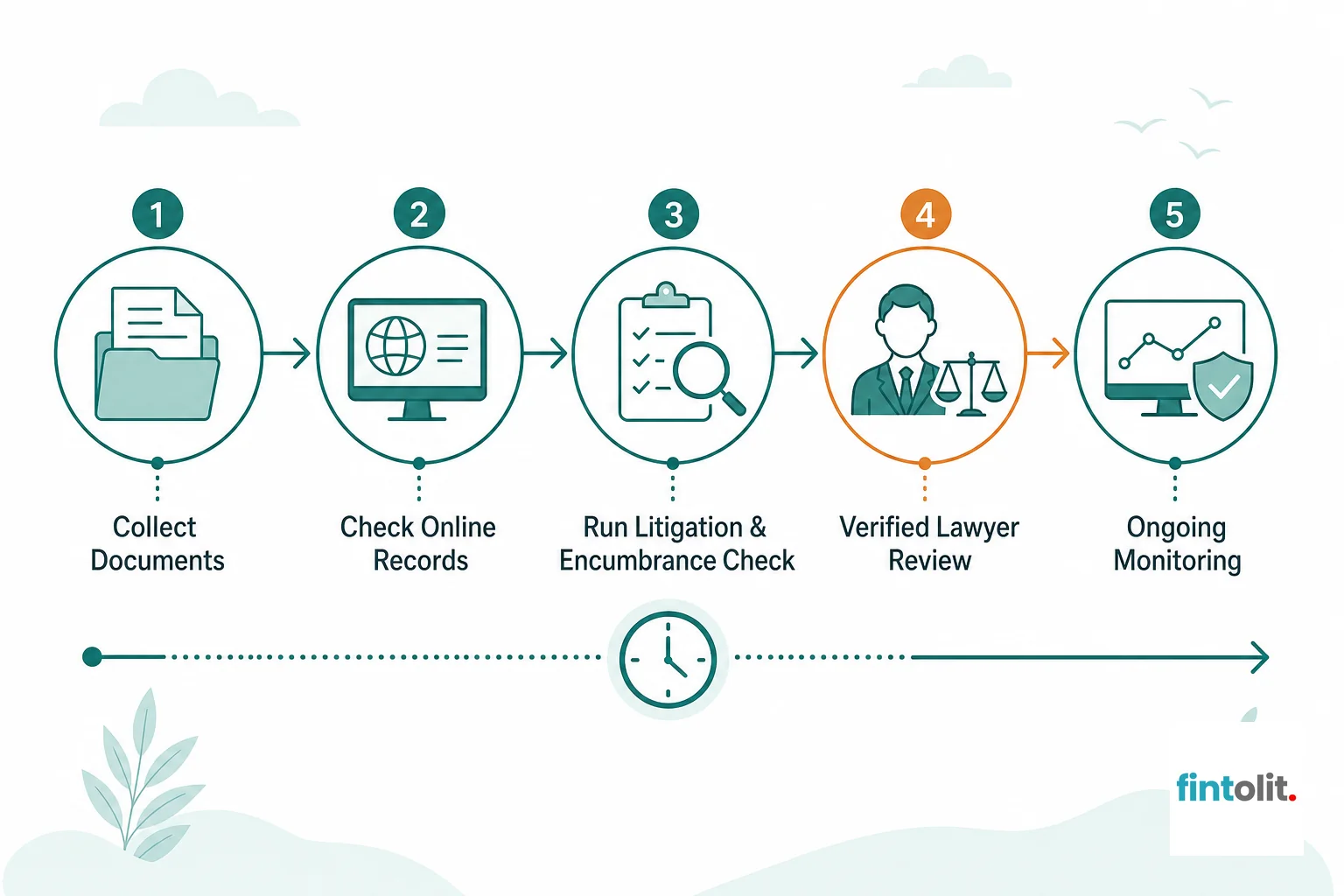
At a Glance: Verification Checklist
| Step | What You Do | Who Handles It | Typical Time |
|---|---|---|---|
| 1 | Collect sale deed, EC, tax receipts, mutation, building plan | Seller + you | 1-2 days |
| 2 | Check ownership and mutation on state land record portal | You, online | 1 day |
| 3 | Run litigation and encumbrance search | Lawyer or clerk locally | 1-2 days |
| 4 | Verified lawyer reviews originals and gives written opinion | Property lawyer | 1-2 days |
| 5 | Set up ongoing monitoring through registration | Lawyer / POA holder | Until closing |
1. Get the Complete Document Set From the Seller First
Before you check anything online, ask the seller for a specific list. Don't accept "I'll send what I have." You need the original registered sale deed, the encumbrance certificate for the last 30 years, property tax receipts for the last five years, the mutation certificate (also called patta or khata depending on the state), and the approved building plan with occupancy certificate if it's a built property.
This list isn't arbitrary. Each document answers a different question: who owns it now, who owned it before, whether any loan or claim is sitting against it, and whether it was built legally. Sellers who hesitate on any one of these are telling you something. Ask early, in writing, and keep every reply.
2. Pull Whatever Records You Can Online Before Involving Anyone Else
Most Indian states now put land records online, and you don't need a local contact to access them. A step-by-step walkthrough of these portals shows how ownership, land classification, and registration history can be checked directly by the buyer, no travel required, as covered in Bhulekh India's guide to verifying property documents online.

If the property sits in the Delhi, Gurugram, or Noida belt, you're dealing with three separate systems: Delhi's DLRC portal, Haryana's Jamabandi, and Uttar Pradesh's Bhulekh UP. None of them talk to each other, and each has its own quirks around khasra numbers and revenit records. Cross-check the seller's name and khasra number against whichever portal covers that district before you go further.
Online records confirm current ownership on paper. They rarely show whether the property is stuck in a court case, mortgaged informally, or tied up in a family dispute that hasn't reached a registry yet. That gap is exactly why the next step matters.
3. Run an Independent Litigation and Encumbrance Check
Ownership records and litigation records live in different systems, and a clean mutation certificate says nothing about whether the property is named in a pending case. You need both: an encumbrance certificate and a separate court record search across the relevant district and high court, run by someone who knows where to look.
Need a Lawyer for clarity on your case?
A seven-day framework for exactly this kind of remote check, built for NRIs verifying property from the US, breaks the work into document collection, online records, and a dedicated litigation search as separate days, not one combined step, as described in LegiScore's guide to verifying India property without travelling back. Treating them as one step is where a lot of remote buyers get caught out. Sellers rarely lie outright about litigation. They just don't bring it up unless asked directly, and a portal search alone won't surface it.
4. Get a Verified Property Lawyer to Read the Documents, Not Just Skim Them
A lawyer physically present at the sub-registrar's office can compare the seller's copy against the original registered deed, something no scan or PDF lets you do. That single check catches forged stamps, altered survey numbers, and mismatched signatures that online portals simply can't flag.

This is where a dedicated property lawyer earns their fee. A verified professional doesn't just confirm the paperwork is present; they read the encumbrance certificate line by line for gaps in the 30-year chain, check whether the building plan matches what's actually built, and flag anything that needs a fresh title search. Fintolit connects you with a senior property lawyer in Delhi and the wider NCR for exactly this kind of remote review, through a detailed online legal consultation where you get a written opinion before you commit any money. If you'd rather understand the fuller picture of what a specialist covers first, this guide to hiring a property lawyer in Delhi walks through the full scope.
Why does dispute property so often trace back to skipped verification?
Most disputed property cases in Delhi and Gurugram start with a step someone skipped: an encumbrance certificate that only covered 10 years instead of 30, or a mutation record nobody cross-checked against the sale deed. By the time the dispute surfaces, the buyer has already paid.
Family property held jointly for decades is a frequent trigger. One heir sells without the others' knowledge, a POA gets misused, or a partition never got formally registered. None of this shows up on a basic ownership search; it only shows up when a lawyer checks the full chain of title going back three decades, not just the current owner's name. If you're already staring down a live conflict rather than a purchase decision, the practical next steps are laid out in this guide to resolving a property dispute in Delhi.
5. Set Up Ongoing Monitoring Until Registration Closes
Verification isn't a one-time event. Between the day you clear the checks and the day registration actually happens, weeks can pass, and a property's status can change. A pending loan default, a fresh court filing, or a family objection can surface in that window.
This is where a power of attorney to a trusted person, or your lawyer's office, matters. It lets someone track the file locally, attend the registration in your absence, and flag anything unusual before money changes hands. The wrong wording on a POA, though, can void it entirely or leave you without the authority you thought you'd granted; the situations where this goes wrong are specific and avoidable, covered in this breakdown of power of attorney mistakes in India.
How much does a lawyer cost for property disputes in India?
Property lawyer fees in India vary by city and case complexity, but a fixed, upfront consultation fee (rather than hourly billing) is now common for straightforward document verification and due diligence work. Ask for a clear number before you engage anyone, not an estimate that grows as the file grows.
Hourly billing on a property matter can spiral fast once a lawyer starts reviewing 30 years of encumbrance records and cross-checking court filings. A fixed-fee structure, where you know the cost of the full verification exercise before it starts, removes that uncertainty. For a full sense of what different legal services typically cost across India, this 2026 legal fees breakdown is worth reading before you commit to any provider.
Need a Lawyer for clarity on your case?
FAQs
Can I verify property documents without visiting India?
Yes. Online land record portals, a remote litigation search, and a local lawyer who checks originals in person cover nearly everything a physical visit would, without you needing to book a flight.
What if the seller refuses to share the encumbrance certificate?
Treat that as a serious warning sign. A genuine seller has no reason to withhold an EC; it's a public record you or your lawyer can also pull independently from the sub-registrar's office if they won't cooperate.
How long does remote verification take?
A straightforward property, with a cooperative seller, usually takes about a week from document collection to a written lawyer opinion. Complicated title chains or unresponsive sellers stretch that timeline.
Buying property in India while you're thousands of miles away comes with real risk, but it doesn't have to come with guesswork. A verified property lawyer who checks the originals, runs the litigation search, and gives you a written opinion does the job a personal visit used to do, minus the flight. Book a consultation with a verified property lawyer before you send a single rupee, or chat with us on WhatsApp if you'd rather talk through your specific situation first.
Recommended Resources
You're just getting to the good part.