
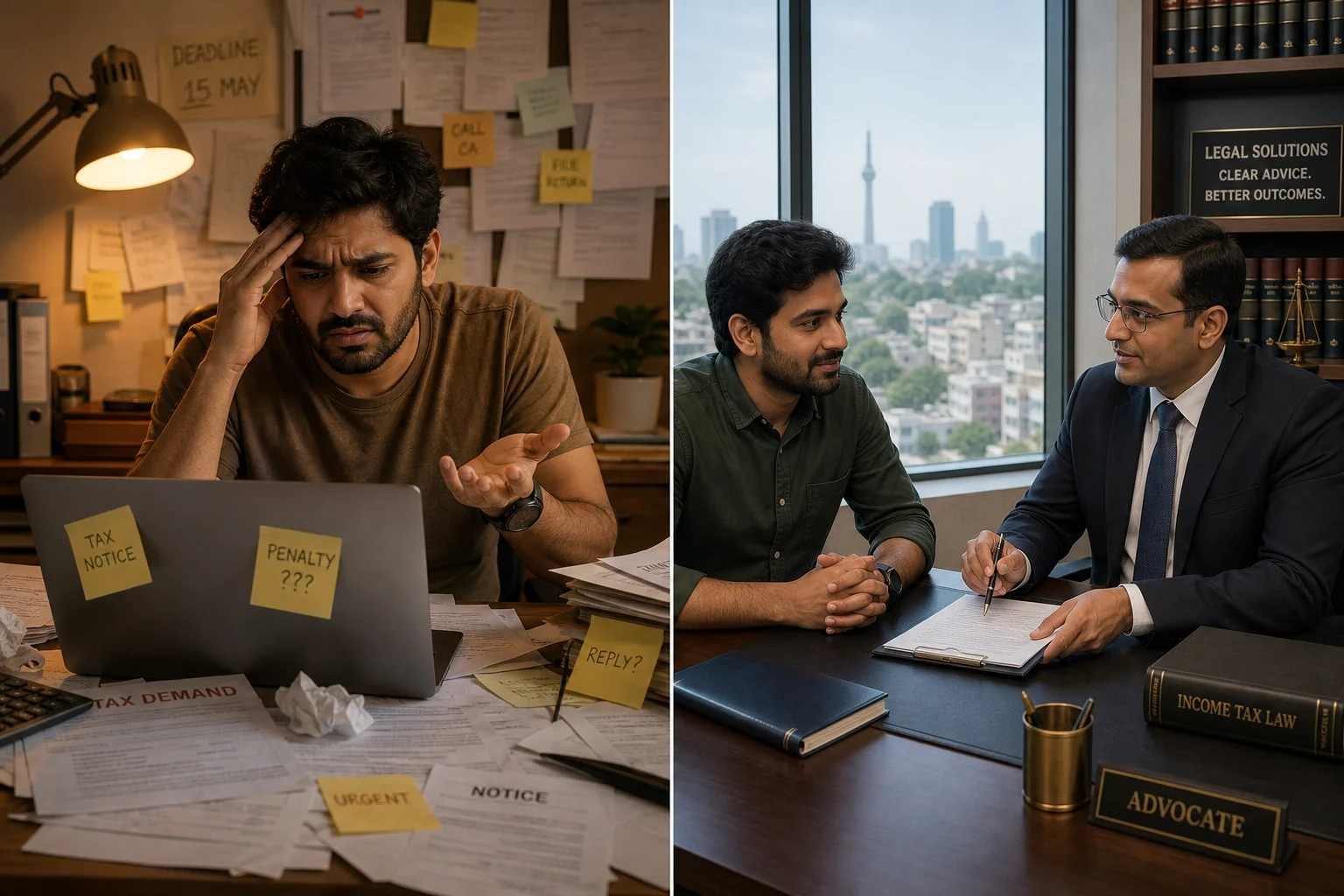
Most Delhi residents facing a legal problem ask the wrong first question. They ask, "Can I afford a lawyer?" The question that actually matters is: "Can I afford to get this wrong?" That shift in thinking changes everything about how you approach legal help in Delhi - and it's the lens this entire post is written through.
This is not a post that tells you lawyers are always necessary or that DIY is always reckless. The honest answer is more nuanced. Sometimes handling a legal matter yourself is perfectly sensible. Other times, it's the most expensive decision you'll ever make - even if it costs you nothing upfront. We'll walk through both sides, scenario by scenario, so you can make a genuinely informed call.
The Real Question Delhi Residents Are Getting Wrong
Here's a counter-intuitive truth: the decision between DIY legal help and hiring a lawyer in Delhi is rarely about money at the start. It's about risk tolerance and complexity. Most people who choose the DIY route don't do it because they've weighed the options carefully. They do it because the legal system feels intimidating, expensive, and opaque - so they avoid it altogether.
That avoidance is where the real cost begins. A property boundary dispute that could have been resolved with one well-drafted legal notice becomes a three-year court battle. A rent agreement with a missing clause turns into a ₹2 lakh deposit dispute. A workplace termination that had a clear legal remedy goes unaddressed because the employee didn't know their rights within the limitation period.
This post compares DIY legal approaches against professional legal help across the most common situations Delhi residents face: property disputes, rent agreements, family matters, workplace conflicts, legal notices, and documentation like wills and power of attorney. For each, we'll tell you honestly when you can manage on your own, and when going without expert guidance is likely to cost you far more than the consultation fee ever would.
What "DIY Legal Help" Actually Means in Delhi
DIY legal help isn't just downloading a template from the internet. It covers a wide spectrum of approaches that Delhi residents use every day:
- Google searches and legal forums, reading general information about laws, rights, and procedures
- Template documents, using pre-written rent agreements, affidavits, or contracts from websites
- Advice from friends or family, especially from someone who "knows a bit about law" or had a similar situation
- Free legal aid services, government-run legal aid clinics or NGO helplines
- Self-representation, appearing before a court, tribunal, or authority without a lawyer
Each of these has its place. The problem isn't that people use them, it's that people use them without knowing their limits. A Google search can tell you that the Transfer of Property Act governs property sales in India. It cannot tell you whether the specific sale deed you're about to sign has a clause that will void your ownership claim in five years.
The appeal of DIY is understandable. It's faster, cheaper upfront, and feels empowering. But there's a hidden assumption baked into every DIY legal decision: that you know enough to know what you don't know. In law, that's rarely true for non-specialists, and the gaps in knowledge are precisely where disputes, losses, and liabilities hide.
What Hiring a Lawyer in Delhi Actually Costs (and What You Get)
One of the biggest reasons people avoid professional legal help in Delhi is the fear of unpredictable, escalating fees. That fear is legitimate, traditional law firms in Delhi can charge anywhere from ₹3,000 to ₹15,000 for a single consultation, with retainer fees, court appearance charges, and documentation costs layered on top. For a straightforward matter, that billing model feels disproportionate.
Need a Lawyer for clarity on your case?
But the landscape has changed. Online legal consultation platforms now offer fixed, transparent pricing for a 30 to 60-minute session with a verified senior lawyer, no hidden charges, no per-minute billing anxiety. For a detailed breakdown of what different legal services actually cost in India today, see our guide on Legal Fees in India (2026): Complete Cost Breakdown.
What does a lawyer actually give you that a template or search engine cannot?
- Jurisdiction-specific advice, Delhi has its own local rules, court procedures, and enforcement norms that generic online information doesn't capture
- Risk identification, a trained lawyer spots the clause, the missing document, or the procedural error that will cause problems later
- Strategic guidance, knowing not just what your rights are, but which ones are worth asserting and how
- Document accuracy, agreements drafted or reviewed by a lawyer are enforceable; templates often aren't
- Deadline management, limitation periods, notice requirements, and filing deadlines are easy to miss and impossible to recover from
A dedicated case manager, someone who stays with your matter from first consultation to resolution, adds another layer of value that most people don't expect. Rather than re-explaining your situation every time you call, you have one point of contact who knows your case, tracks its progress, and keeps you informed. For a deeper look at what this role involves, read Legal Consultant vs. Lawyer: Which One Do You Need?
Scenario-by-Scenario Comparison: DIY vs. Lawyer
Let's get specific. Here's how the DIY versus professional comparison plays out across the most common legal situations in Delhi.

Property Disputes and Title Verification
DIY risk level: Very High. Property law in Delhi involves multiple registrations, encumbrance checks, mutation records, and local authority approvals. A buyer who skips professional title verification to save ₹5,000 in legal fees can end up purchasing a property with a disputed title, an undisclosed mortgage, or a forged sale deed. These errors are not easily corrected, and in some cases, not correctable at all.
If you're involved in a property dispute, buying or selling property, or dealing with inheritance of real estate, professional legal help is not optional. It's the difference between owning your property and litigating over it for a decade. Our detailed resource on Property Lawyer in Delhi: The Complete Expert Guide covers exactly what to look for.
Rent Agreements and Landlord-Tenant Conflicts
DIY risk level: Medium to High. A basic rent agreement template downloaded online might look complete. But does it correctly specify the notice period for eviction? Does it comply with the Delhi Rent Control Act where applicable? Does it protect your security deposit with the right clauses? Most templates don't, and most tenants don't find out until there's a dispute.
For a straightforward renewal of an existing, well-drafted agreement between parties who trust each other, a template may suffice. For any new tenancy, any high-value deposit, or any situation where the landlord has their own lawyer, you need professional review at minimum.
Family Matters: Divorce, Custody, Inheritance
DIY risk level: Very High. Family law matters in Delhi carry emotional weight that makes clear thinking difficult, and legal complexity that makes DIY approaches genuinely dangerous. Divorce proceedings, child custody arrangements, and inheritance disputes involve court filings, mediation, and often opposing parties with legal representation. Attempting self-representation here almost always results in worse outcomes, longer timelines, and greater emotional cost.
Even for matters that seem straightforward, like drafting a family settlement agreement, the document must be legally sound to be enforceable. A poorly drafted settlement can be challenged years later. For guidance on navigating family legal matters with professional support, see Family Lawyer in Delhi: Online Consultations Explained.
Workplace Issues: Wrongful Termination, Salary Disputes
DIY risk level: Medium to High. Delhi employees have real legal protections under the Industrial Disputes Act, the Payment of Wages Act, and the POSH Act, among others. But asserting those rights requires knowing the correct forum, the correct procedure, and the correct timeline. A complaint filed in the wrong forum, or after the limitation period, is dismissed regardless of its merits.
Need a Lawyer for clarity on your case?
Many workplace disputes can be resolved through a single well-drafted legal notice, but that notice needs to cite the right provisions and make the right demands. Getting it wrong can actually weaken your position. For a full breakdown of your rights, see Workplace Lawyer Delhi: Complete Guide to Your Rights.
Receiving and Replying to Legal Notices
DIY risk level: High. This is one of the most dangerous areas for DIY legal help. A legal notice is not just a letter, it's a formal legal document that may be used as evidence in subsequent proceedings. How you respond (or whether you respond, and when) can significantly affect your legal position. Ignoring a notice, responding emotionally, or inadvertently admitting liability in your reply are all common DIY mistakes with serious consequences.
Will Drafting and Power of Attorney
DIY risk level: Medium. A will drafted without legal guidance may be valid in its basic form, but it may also be ambiguous, incomplete, or vulnerable to challenge. The same applies to power of attorney documents, which carry significant legal authority and must be drafted precisely to be effective and safe. For wills specifically, the stakes are high enough that professional drafting is strongly recommended. See our complete guide: Will Drafting in Delhi: Complete Guide (2026).
When DIY Legal Help Is Acceptable (and When It Isn't)
To be fair, there are situations where handling a legal matter yourself is entirely reasonable. Here's a practical framework.
Green Light: DIY Is Probably Fine
- You're renewing an existing, professionally drafted rent agreement with no changes
- You need a basic affidavit for a routine administrative purpose (address proof, name change, etc.)
- You're gathering information to understand your general rights before deciding whether to take action
- The matter is genuinely low-stakes, well-documented, and the other party is cooperative
- You're using free legal aid for an initial orientation, not as your primary legal strategy
Red Flag: You Need Professional Legal Help
- The opposing party has a lawyer (you should always match representation)
- Money, property, or custody is at stake
- There are criminal implications, even peripheral ones
- You've received a formal legal notice or court summons
- A deadline is approaching (limitation periods are strict and non-extendable)
- The agreement you're signing will govern a relationship worth more than a few thousand rupees
- You're dealing with a government authority, court, or tribunal
- The matter involves your employment, your home, or your family
The honest rule of thumb: if the consequences of getting it wrong are significant, the cost of getting it right is almost always worth it. The complexity threshold, the point at which a matter exceeds what a non-specialist can safely handle, is lower than most people think.
The Hidden Costs of Getting It Wrong

The financial case for professional legal help in Delhi becomes clearest when you look at what DIY errors actually cost. These aren't hypothetical, they're patterns that play out regularly across Delhi's courts and dispute resolution forums.
Missed Deadlines
Under the Limitation Act, 1963, most civil claims in India must be filed within a specific period, often three years, sometimes less. Miss that window and your claim is permanently barred, regardless of how strong it is. DIY legal help rarely includes a systematic check of applicable limitation periods. Professional legal guidance always does.
Inadvertent Admissions
Replying to a legal notice without legal guidance is one of the most common ways people damage their own position. A single sentence that acknowledges a debt, confirms a fact, or concedes a point can be used against you in court. Lawyers know exactly what to say, and what not to say, in formal legal correspondence.
Unenforceable Agreements
A ₹500 template rent agreement or business contract may look professional. But if it lacks proper stamp duty, correct witness signatures, or essential clauses required under Indian contract law, it may be unenforceable when you need it most. The cost of drafting a proper agreement professionally is a fraction of the cost of litigating an unenforceable one. For more on this, see Legal Documentation Cost in India: Why Prices Differ.
Need a Lawyer for clarity on your case?
Compounding Problems
Legal problems don't stay the same size while you delay. A property encroachment that goes unaddressed for two years becomes harder to reverse. A workplace dispute that isn't escalated within the right timeframe loses its legal remedy. A family matter that festers without formal documentation becomes a full-scale court battle. The cost of fixing a DIY mistake is almost always higher than the cost of doing it right the first time.
The Emotional and Time Cost
Beyond money, there's the cost of stress, lost time, and uncertainty. People who handle legal matters themselves often spend weeks researching, drafting, and worrying, only to end up in a worse position than if they'd spent an hour with a professional at the outset. That hour of professional consultation doesn't just give you legal guidance; it gives you clarity, a plan, and the confidence to act.
The Smart Middle Ground: Guided Legal Consultation

The choice between DIY legal help and a traditional law firm in Delhi isn't binary. There's a practical middle ground that most people don't know exists, and it's where the best outcomes tend to happen.
Platforms like Fintolit are built specifically for this gap. The model is straightforward: you describe your legal problem, get matched with a verified senior lawyer who specialises in your area, and have a focused 30 to 60-minute consultation at a fixed, transparent price. No retainer. No per-minute billing. No intimidating law firm reception desk.
What a Single Consultation Actually Changes
A one-hour session with the right lawyer doesn't just answer your immediate question. It gives you a resolution plan, a clear understanding of your legal position, your options, the risks of each, and the recommended next steps. That plan transforms a confusing, stressful situation into a manageable one. Most people leave a consultation knowing exactly what to do, whether that's sending a legal notice, filing a complaint, or simply adjusting a document before signing.
The Dedicated Case Manager Difference
One of the most underappreciated features of a guided consultation model is the dedicated case manager. Rather than navigating a complex legal matter alone, or re-explaining your situation to a new person every time you call, you have one consistent point of contact who knows your case, tracks its progress, and coordinates between you and your lawyer. For matters that span weeks or months, this continuity is invaluable.
Lawyer at Home: For Sensitive Matters
For family disputes, sensitive personal matters, or situations where you simply can't get to an office, Fintolit's Lawyer at Home service brings a verified lawyer to your location for a 60 to 80-minute in-person consultation. This is particularly valuable for elderly clients, for matters involving multiple family members, or for situations where privacy and comfort are priorities. It's a level of accessibility that traditional law firms simply don't offer.
Transparent Pricing vs. Traditional Billing
The fixed-fee model solves one of the most common complaints about legal services in Delhi: unpredictable costs. You know what you're paying before you book. There are no surprise invoices, no hourly billing that escalates with every phone call, and no pressure to engage services you don't need. For anyone who has been put off by the opacity of traditional legal fees, this transparency alone is a significant reason to consider the guided consultation route.
Fintolit covers six core legal domains, family, property, cybercrime, workplace, consumer, and agreements, with verified senior lawyers in each. Whether you need a property lawyer in Delhi, guidance on a workplace dispute, or help drafting a will, the same accessible, confidential model applies. You can also explore how this compares to traditional options in our post on Law Firms vs. Online Legal Services in Delhi.
Need a Lawyer for clarity on your case?
Frequently Asked Questions
Can I draft my own rent agreement in Delhi?
Technically, yes. But a self-drafted or template rent agreement may lack clauses that protect your deposit, correctly specify eviction procedures, or comply with applicable Delhi rent regulations. For any tenancy involving a significant deposit or a landlord you don't know well, professional drafting or review is strongly recommended.
What happens if I reply to a legal notice without a lawyer?
You risk making statements that can be used against you in subsequent legal proceedings. A poorly worded reply can inadvertently admit liability, waive a right, or miss a procedural requirement. Legal notice replies should always be reviewed, or drafted, by a qualified lawyer before being sent.
Is online legal consultation as reliable as visiting a law firm?
For advice, guidance, and documentation, yes, provided the platform uses verified, senior lawyers. The quality of legal advice depends on the lawyer's expertise, not the medium. Online consultations also offer advantages in speed, cost, and convenience that traditional law firms cannot match. See our full comparison: Online Legal Consultation Delhi: The Complete Guide.
How much does a basic legal consultation cost in Delhi?
Traditional law firm consultations in Delhi typically range from ₹3,000 to ₹15,000 or more, depending on the lawyer's seniority and the firm's profile. Online consultation platforms offer fixed-fee sessions at significantly lower price points, with full transparency on what's included. Contact Fintolit directly for current pricing on specific services.
When should I definitely not try to handle a legal matter myself?
Any time the opposing party has legal representation, any time a court or tribunal is involved, any time a limitation period is approaching, and any time the matter involves property, custody, employment rights, or a formal legal notice. In these situations, the cost of professional legal help is almost always less than the cost of the mistakes DIY approaches tend to produce.
What is a legal case manager and do I need one?
A legal case manager is a dedicated professional who coordinates your legal matter from start to finish, tracking deadlines, liaising with your lawyer, and keeping you informed at every stage. For any matter that spans more than a single consultation, having a case manager significantly improves outcomes and reduces the stress of navigating the process alone.
Make the Right Call Before It Costs You
The DIY versus professional debate around legal help in Delhi ultimately comes down to one honest question: what are the real consequences if this goes wrong? For low-stakes, well-documented, cooperative situations, DIY can work. For anything involving property, family, employment, formal notices, or significant money, the risk of getting it wrong almost always outweighs the cost of getting it right with professional guidance.
You don't have to choose between an expensive traditional law firm and going it alone. Fintolit's guided consultation model gives you access to verified senior lawyers, a dedicated case manager, and fixed transparent pricing, whether you need a quick 30-minute online session or an in-person Lawyer at Home visit. It's legal help that's actually accessible, without the fear or the financial uncertainty.
If you're facing a legal matter right now and aren't sure whether to handle it yourself or get professional help, the safest first step is a single consultation. Book your consultation with Fintolit today and get a clear resolution plan from a verified expert, before a manageable problem becomes an expensive one. You can also chat with us on WhatsApp if you'd prefer to describe your situation first and understand your options before booking.
You're just getting to the good part.