

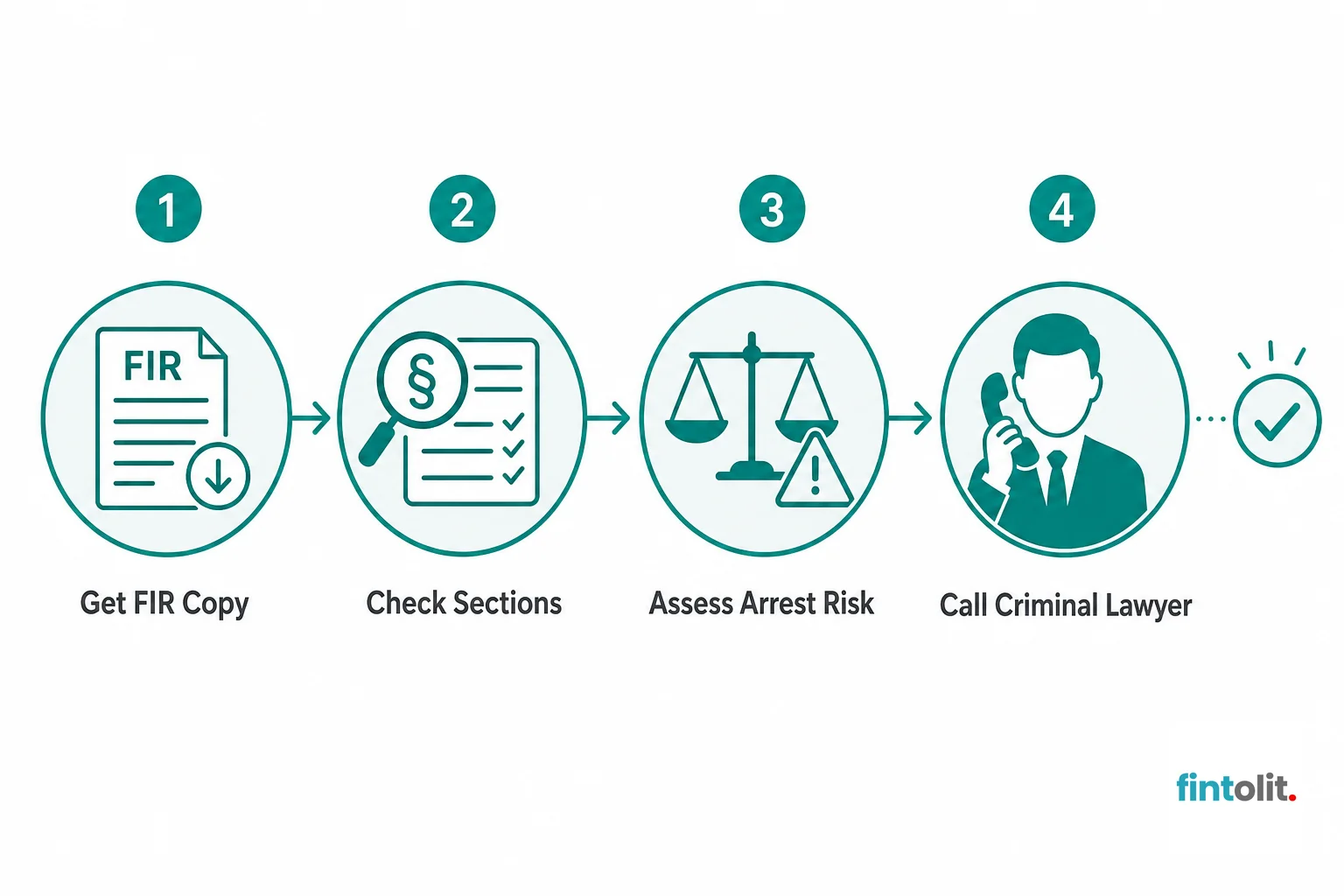
The first 48 hours after an FIR is registered against you decide most of what happens next. Get a certified copy of the FIR, read the exact sections named in it, check your arrest risk, and call a criminal lawyer before you say anything else to the police or the complainant. Skipping any one of these steps costs you options you can't easily get back.
Key Takeaways
- Get the FIR copy immediately: You're entitled to a free copy without delay under Section 173(2), and you cannot plan a defence without it.
- Check bailable vs non-bailable before you panic: This single fact decides whether you can walk into a police station calmly or need to move for anticipatory bail within days.
- Silence beats improvisation: Anything said to police without legal advice can be used against you later, even if it was meant to help.
- Anticipatory bail has a shrinking window: The earlier you file, the more the Sessions Court or High Court sees a person cooperating, not a person hiding.
- A lawyer in the first 48 hours changes outcomes: Early legal advice shapes your statement strategy, your bail filing, and whether you get arrested at all.
At a Glance: The FIR Problem and Your 48-Hour Solution Checklist
| Step (Solution) | Timing | Why It Matters (Problem It Solves) |
|---|---|---|
| Get certified FIR copy | Within hours | Confirms exact sections and allegations against you |
| Read the sections named | Same day | Tells you if the offence is bailable or not |
| Assess arrest risk | Within 24 hours | Decides if anticipatory bail is urgent |
| Call a criminal lawyer | Within 24 hours | Shapes every decision that follows |
| Preserve evidence | Ongoing from day one | Protects your version of events |
| Avoid contact with complainant | Immediately | Prevents witness tampering allegations |
| File anticipatory bail if needed | Within 48-72 hours | Options shrink the longer you wait |
Problem 1: You Don't Have the FIR — Solution: Get a Copy First
You cannot fight an allegation you haven't read. Walk into the police station or check your state's police portal, and ask for the FIR by number if you have it. Most states now put registered FIRs online within a day, searchable by name or station.
If the station stalls, remind them politely that you're entitled to a copy without delay. Section 173(2) makes this a right, not a favour, and stations that drag their feet usually respond once you mention it.
Problem 2: You Don't Know What You're Actually Charged With — Solution: Read the Sections Named in the FIR
Every FIR lists specific legal sections, and those sections tell you almost everything about what comes next. A cheating or defamation charge behaves very differently from an assault or robbery charge on paper and in practice.
Don't guess based on what a relative or a WhatsApp forward tells you. Sit down with the actual document and, ideally, a lawyer who can translate it in plain terms within the hour, not days later.
Problem 3: You Don't Know If Arrest Is Coming — Solution: Assess Your Arrest Risk Fast
Is an FIR Filed Against You the Same as an Arrest?
No. An FIR only starts an investigation; it does not mean police are coming for you tonight. Arrest depends on the offence type, your flight risk, and whether police believe custodial interrogation is genuinely needed.
A quick risk read looks at three things: is the offence classed as one where arrest is common, do you have a clean record, and is there any reason police would think you'd run or tamper with evidence. Families dealing with arrest risk assessments often find that a calm, documented approach lowers the odds significantly compared to going silent or defensive.

Problem 4: You're Facing This Without Legal Guidance — Solution: Call a Criminal Lawyer Before You Say Anything Else
Every hour you wait to get legal advice is an hour you might spend making a statement you can't take back. A criminal lawyer reads the FIR, tells you what section 41A notices mean if one arrives, and decides with you whether anticipatory bail should be filed now or held in reserve.
Need a Lawyer for clarity on your case?
This is exactly where a platform like Fintolit's criminal law consultation earns its keep. You get a verified lawyer with real courtroom experience, not a generalist reading the Bharatiya Nyaya Sanhita for the first time on your case. A dedicated case manager tracks your file so you're never chasing updates during the most stressful week of your year.
If you'd rather talk through your situation before booking anything formal, message the Fintolit team on WhatsApp and describe what's in the FIR. You'll get a sense of your options the same day.
Consult an experienced criminal lawyer and preserve all evidence before you make any statement to police, according to Advocate J.S. Rohilla's guidance on FIR response.
Problem 5: Evidence and Statements Can Slip Away — Solution: Preserve Evidence and Watch What You Say
Screenshot every message that could matter, save call logs, and gather receipts or documents relevant to the dispute before phones get lost or apps auto-delete chats. This work is easiest in the first 48 hours, before memory fades and devices change hands.
Stay off social media about the case entirely. A single post can look like intimidation of a witness or an admission, even when you meant it as venting. Don't contact the complainant either, not to apologise, not to argue, not to "sort it out" quietly. Let your lawyer handle every conversation that touches the case.
Problem 6: Waiting Too Long on Bail — Solution: Decide on Anticipatory Bail Early, Not Late
When Should You File for Anticipatory Bail?
File as soon as your lawyer confirms real arrest risk, ideally within 48 to 72 hours of learning about the FIR. Courts read early filings as cooperation, while last-minute applications after police visits look defensive and land you a tougher hearing.
For non-bailable offences, the anticipatory bail route runs through the Sessions Court first, then the High Court if needed. Your lawyer will weigh the sections named, your record, and the complainant's claims before deciding which court to approach and how strong the ground for bail actually is.
Common Concern: Does an FIR Mean You Will Be Arrested?
No, an FIR alone does not guarantee arrest. It opens an investigation, and arrest only follows if police decide custodial questioning is genuinely necessary for the offence involved. Many FIRs, especially for bailable offences, never lead to arrest at all if you cooperate and stay reachable.
Regional Challenge: What Does an FIR Filed Against You in Delhi or Gurugram Actually Change — And How to Solve It
Where your FIR is registered decides which police station you deal with and which court will eventually hear your bail application, whether that's a Delhi district court, a Gurugram Sessions Court, or the Punjab & Haryana High Court for Gurgaon-area matters. Noida and Ghaziabad cases route through Uttar Pradesh courts instead, with their own listing timelines.
This matters practically. A Delhi lawyer who knows the local Metropolitan Magistrate courts moves faster than someone unfamiliar with local listing patterns, and the same goes for Gurugram's District Court or Noida's Sector 62 courts. If you're weighing your options for legal help in the capital, this guide on online legal consultation in Delhi breaks down how remote consultations work when speed matters more than a physical office visit.
NRIs facing an FIR back home in Delhi NCR face an extra layer: coordinating a lawyer, a case manager, and sometimes a power of attorney from abroad. If that applies to you, our piece on Lawyer at Home service in India explains how in-person legal support works even when family members are managing things on your behalf, as the solution to a distance problem.
Frequently Asked Problems and Their Solutions
Problem: Can I get the FIR quashed instead of fighting the case?
Yes, in specific situations. The solution is an FIR can be quashed by the High Court if the allegations don't add up to a crime even if true, or if it's really a civil dispute dressed up as a criminal one. This isn't automatic and needs a proper petition built around your specific facts.
Need a Lawyer for clarity on your case?
Problem: Should I talk to the police without a lawyer present?
It's risky. The fix is that you're allowed to consult a lawyer before and during questioning, and using that right protects you from statements that get twisted later. Politely ask for time to arrange counsel before answering substantive questions.
Problem: What happens if I ignore the FIR completely?
Ignoring it doesn't make it go away. Investigation continues without your input, notices can escalate to summons or warrants, and your side of the story never gets recorded. The solution is engagement, not silence: silence toward the process, not silence toward specific questions, is the mistake to avoid.
Problem: How much does hiring a criminal lawyer cost in Delhi NCR?
Costs vary by seniority and case complexity, and traditional firms often keep pricing vague until after the first meeting. Fixed, upfront consultation pricing removes that guesswork; see our breakdown on lawyer consultation costs in India in 2026 for what to expect before you book.
An FIR against you is unsettling, but it isn't a verdict. What you do in the next 48 hours, getting the copy, reading the sections, checking your arrest risk, and getting a real lawyer on the phone, shapes almost everything that follows. Book a consultation with a verified criminal lawyer at Fintolit today and get a clear strategy instead of guesswork, or chat with the Fintolit team on WhatsApp right now if you need to talk to someone immediately.
Recommended Resources
You're just getting to the good part.