

Indian courts don't use a fixed formula for maintenance alimony, but most judges anchor around a common benchmark: roughly 20-25% of the husband's net monthly income for the wife, adjusted up or down based on her own earnings, the couple's lifestyle during the marriage, and how many dependents each side supports. Maintenance alimony laws India apply differently depending on which personal law or which section you file under, and that choice can change both the amount and how fast you get it.
Key Takeaways
- No fixed percentage in law: Courts use the 20-25% figure as a guiding range from precedent, not a statutory rule, and can move well outside it based on facts.
- Route matters: Filing under Section 125 CrPC/BNSS moves faster than a Hindu Marriage Act Section 24/25 petition, but the amounts awarded can differ significantly.
- Interim maintenance usually arrives first: Courts often grant interim support within a few months, while the final permanent alimony order can take one to three years.
- A working wife can still claim maintenance if there's a real income gap between her earnings and the lifestyle she had during the marriage.
- Non-payment has real consequences: courts can attach salary, order arrest, or use contempt proceedings under Section 128 CrPC.
At a Glance: Maintenance Laws in India
| Law / Provision | Who Can Claim | Typical Timeline | Nature of Relief |
|---|---|---|---|
| Section 125 CrPC / BNSS equivalent | Wife, children, aged parents (any religion) | 3-9 months for interim order | Monthly maintenance |
| Hindu Marriage Act, Sections 24 & 25 | Hindu spouses during and after divorce | Interim: months; permanent: 1-3 years | Interim + permanent alimony, lump sum possible |
| Hindu Adoption and Maintenance Act, 1956 | Hindu wife, children, dependents | Varies by case | Maintenance outside divorce proceedings |
| Muslim Women (Protection of Rights on Divorce) Act, 1986 | Divorced Muslim women | Case-dependent | Fair and reasonable provision, iddat period support |
| Special Marriage Act, 1954 | Inter-faith or civil marriages | Similar to HMA timelines | Interim and permanent alimony |
| Protection of Women from Domestic Violence Act, 2005 | Any woman in a domestic relationship | Fast-tracked, often within weeks for interim relief | Monetary relief alongside protection orders |
What Counts as Maintenance Under Indian Law?
Maintenance is money one spouse pays the other to keep them from falling into financial hardship after separation or divorce. It isn't punishment. It's the law's way of saying nobody should be left destitute because a marriage ended.
Several laws cover this ground. Section 125 of the CrPC (now carried forward under the Bharatiya Nagarik Suraksha Sanhita) is the fastest, secular route open to wives, children, and elderly parents regardless of religion. The Hindu Marriage Act gives Hindu spouses two separate rights: interim maintenance under Section 24 while the case is pending, and permanent alimony under Section 25 once the divorce is decided.
Muslim women have their own framework under the Muslim Women (Protection of Rights on Divorce) Act, 1986, which requires a "fair and reasonable" settlement, not just support during the iddat period. The Special Marriage Act mirrors the Hindu Marriage Act's structure for inter-faith and civil marriages. And the Domestic Violence Act, 2005 lets a woman claim monetary relief as part of a protection order, often faster than any of the others.
Which Law Applies to Your Case?
The right law depends on your religion, your marriage type, and how quickly you need relief. A Hindu wife facing an urgent cash crunch might file under Section 125 CrPC first for speed, then pursue a Hindu Marriage Act claim for a larger permanent settlement later. Both petitions can run in parallel, though courts usually adjust the final amount to avoid double recovery.
This decision isn't one to make alone. A family lawyer in Delhi who reviews your income proof, marriage certificate, and lifestyle evidence can tell you within a single consultation which route gets you support faster and which gets you more.
Need a Lawyer for clarity on your case?
How Do Courts Actually Calculate Maintenance Amounts?
Courts calculate maintenance by weighing the paying spouse's net income against the claimant's reasonable needs, the marital standard of living, and how many people each side is responsible for. The Supreme Court has referenced 20-25% of net monthly income as a useful reference point, but no law fixes that number.
Judges look at payslips, income tax returns, bank statements, and sometimes lifestyle evidence like property ownership or travel history when a spouse's declared income looks suspiciously low. If the paying spouse is self-employed or runs a business, courts often estimate income from spending patterns rather than accepting a filed return at face value.
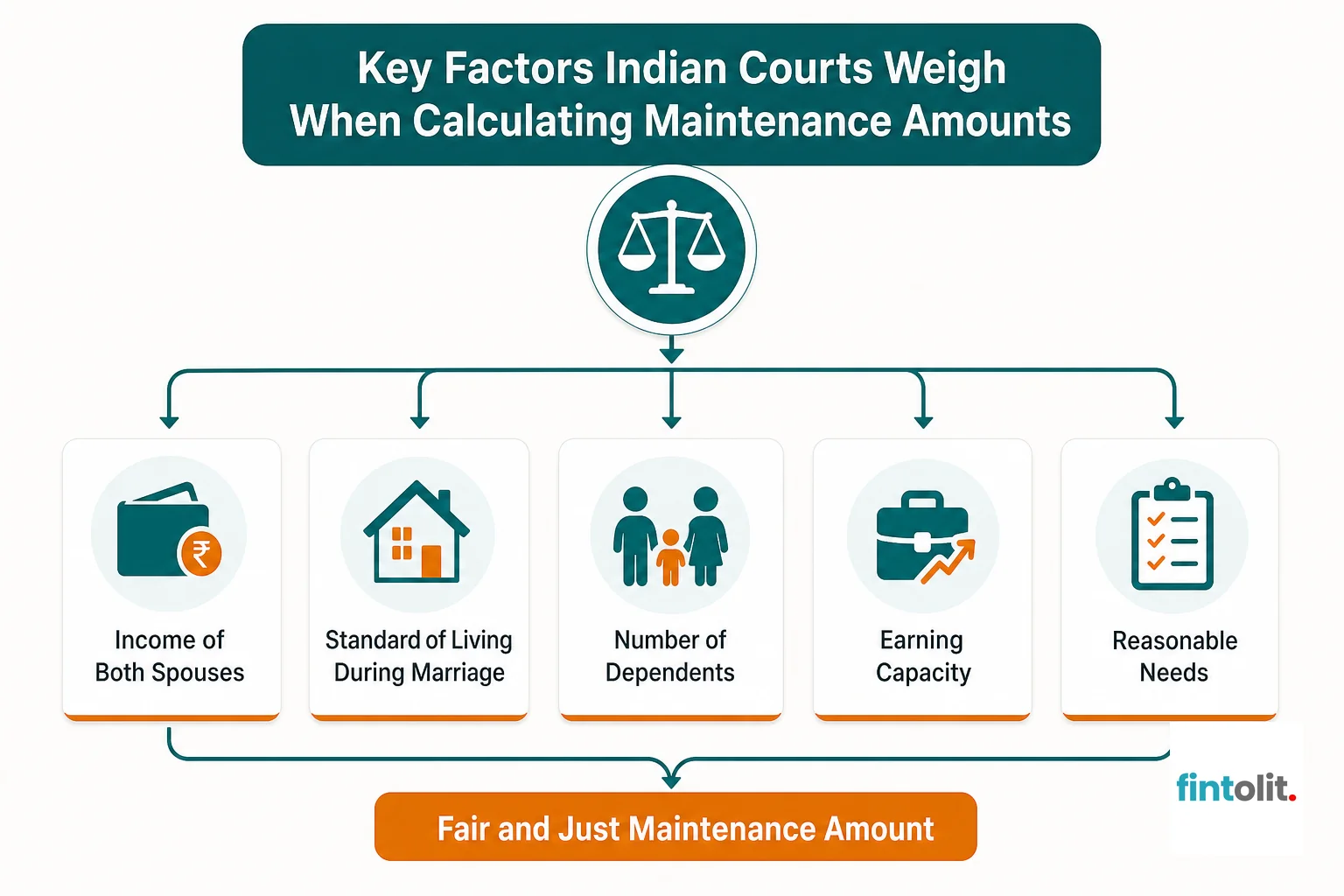
Dependents matter too. A husband supporting elderly parents or a second family from a prior marriage can see his liability reduced, while a wife with young children or health costs typically sees hers increase. None of this is mechanical; two similar-looking cases can land on different numbers because a judge weighed one factor more heavily than the other.
Interim Maintenance vs Permanent Alimony
Interim maintenance is a temporary monthly payment ordered while the main case is still being heard, meant to stop one spouse from suffering financial hardship during litigation. It usually gets decided faster than the main case itself.
Permanent alimony comes only after the divorce or maintenance case is finally decided. Courts can order it as a monthly payment, a one-time lump sum, or a mix of both. Lump sum settlements are increasingly common in mutual divorces because they close the financial chapter cleanly, with no monthly enforcement headaches down the line.
Can a Working Wife Claim Maintenance?
Yes. A working wife can claim maintenance if there's still a meaningful gap between her income and the standard of living she had during the marriage. Courts don't automatically deny support just because a woman has a job.
What matters is the gap, not the paycheck. A wife earning a modest salary after years out of the workforce raising children, married to a spouse earning several times more, will usually still get some maintenance. Courts have moved away from treating any income at all as disqualifying.
What If the Husband Refuses to Pay Maintenance?
Refusing to pay court-ordered maintenance has real consequences. Under Section 128 CrPC, a magistrate can issue a warrant, order attachment of salary or bank accounts, or send the defaulting spouse to jail for up to a month per default, and this can repeat until dues are cleared.
Wilful non-payment isn't a minor lapse the court overlooks. Once an order exists, enforcement is usually swift if the claimant files an execution petition, and employers can be directed to deduct maintenance straight from salary before it even reaches the paying spouse's account.
Child Maintenance: How Is It Different?
Child maintenance is a separate legal right from spousal maintenance and belongs to the child, not the parent claiming on their behalf. It continues until the child turns 18, or longer if they're pursuing higher education or have a disability that affects earning capacity.
Courts factor in school fees, medical costs, and the lifestyle the child had before the parents separated, not just bare survival needs. If you're navigating this alongside a custody question, it's worth reading how basic legal documents every Indian adult needs can support both the custody and maintenance paperwork together.
Maintenance Cases in Delhi, Gurugram and Noida: What to Expect Locally
Family courts in Delhi, Gurugram, and Noida all handle maintenance cases, but the pace differs by jurisdiction and case load. Delhi's family courts generally move faster on interim maintenance applications than Gurugram or Noida, where civil and family benches often carry heavier backlogs.
Need a Lawyer for clarity on your case?

Jurisdiction for filing usually falls where the wife resides, where the couple last lived together, or where the marriage happened, giving many women more flexibility than they realize. If you're weighing whether to file in Delhi versus Gurugram, an online legal consultation in Delhi can map out which court is likely to move fastest for your specific facts.
How a Family Lawyer Helps You Get a Fair Maintenance Amount
A family lawyer's real value in a maintenance case is documentation, not drama. Courts decide amounts based on paper: income proof, lifestyle evidence, dependents, and liabilities. A lawyer who knows how to build that file properly often gets a fairer order faster than someone filing on their own.

Fintolit connects you with a verified family law specialist who has handled these cases for 10+ years, and you know exactly who you're consulting before you pay a single rupee. You get a dedicated case manager who tracks deadlines and gives you proactive updates, and the same lawyer stays with your case from the first consultation to the final order, no handoffs, no re-explaining your situation to someone new.
Whether you prefer a video call or want the lawyer to visit your home, Fintolit offers both formats, seven days a week, morning and evening slots. If you're unsure whether your situation needs a lawyer or a simpler consultation first, this breakdown on legal consultant vs. lawyer can help you decide.
Frequently Asked Questions
How much does a lawyer consultation cost for a maintenance case in India?
Fintolit charges a fixed, upfront fee for a 60-minute consultation with a verified family lawyer, so you know the exact cost before booking. This removes the hourly billing uncertainty that often makes people avoid getting legal advice early.
How much maintenance can I expect to receive?
There's no single answer, since courts weigh income, lifestyle, and dependents on a case-by-case basis. A lawyer who reviews your specific income proof and marital lifestyle can give you a realistic range rather than a guess.
Can a maintenance order be changed later?
Yes, either spouse can apply to modify a maintenance order if there's a significant change in circumstances, such as a job loss, remarriage, or a major change in income. Courts don't treat the original order as permanently fixed.
If you're dealing with a maintenance dispute right now, don't wait for the numbers to feel less confusing on their own. Book your consultation with a verified Fintolit family lawyer who can review your income details and lifestyle evidence, and walk you through exactly what you can realistically claim or expect to pay. You can also chat with us on WhatsApp if you'd rather ask a quick question before committing to a full session. Whether you're in Delhi, Gurugram, or Noida, getting the right documentation together early is what actually moves a maintenance case toward a fair outcome.
You're just getting to the good part.