
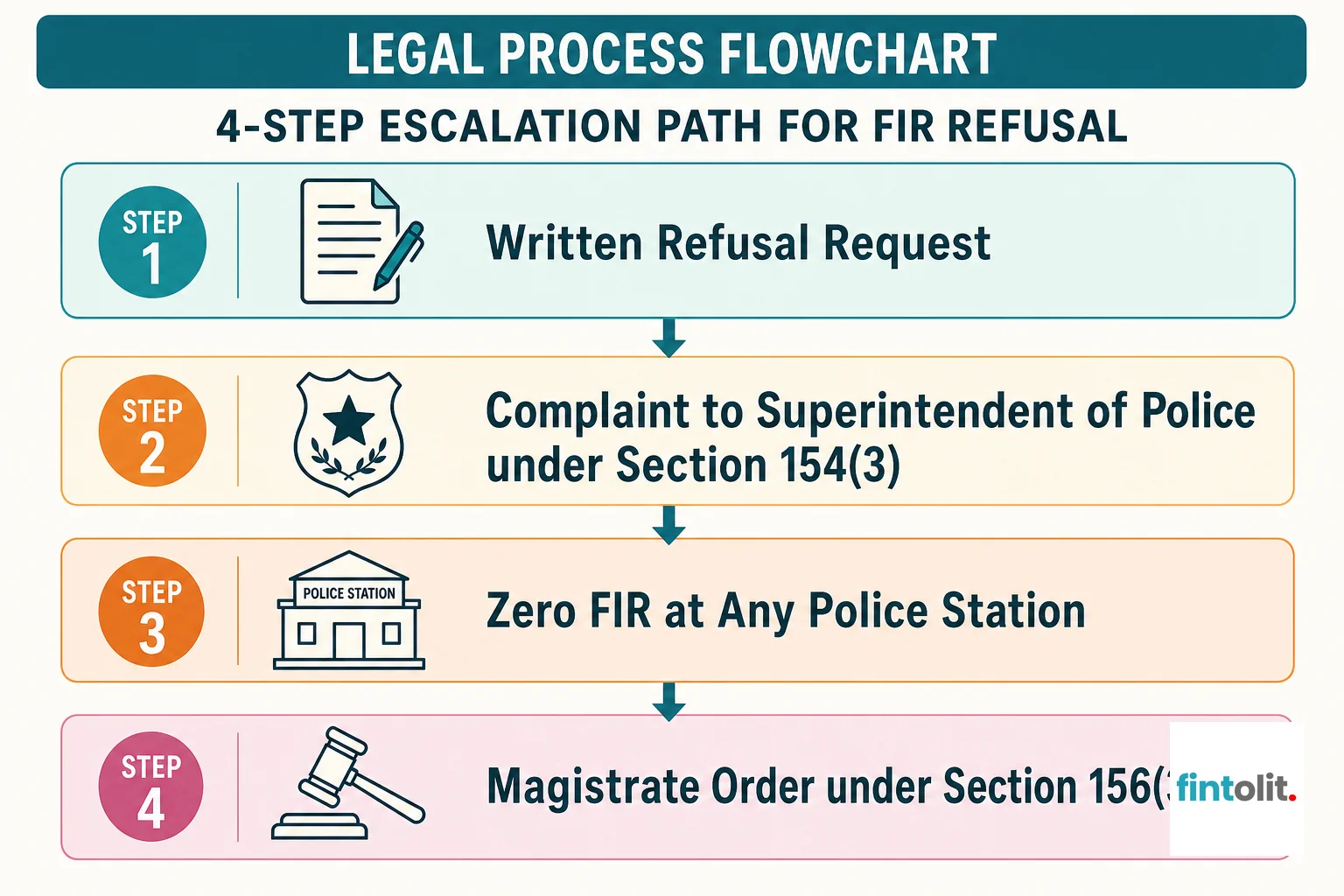
If a police officer tells you they "can't" register your FIR, that's usually not true. Learning how to register FIR India law actually requires means knowing that filing a First Information Report for a cognizable offence is free, mandatory, and refusal has real consequences for the officer who does it. You have at least four legal routes to force the issue, and none of them require you to accept "come back tomorrow."
Key Takeaways
- FIR registration is free and mandatory: For any cognizable offence, an officer-in-charge must record your FIR under Section 154 CrPC (now Section 173 of the BNSS) without asking for money or delaying it.
- Refusal has real consequences: An officer who refuses to register an FIR for a cognizable offence without lawful reason can face departmental action and, in serious cases, prosecution.
- Zero FIR bypasses jurisdiction excuses: Any police station in India must accept your complaint and forward it to the right jurisdiction if the crime happened elsewhere.
- The SP complaint route works fast: A written complaint to the Superintendent of Police under Section 154(3) usually gets movement within days.
- A magistrate can order the FIR directly: If police still stall, Section 156(3) lets a magistrate direct registration and investigation.
At a Glance: FIR Filing Options
| Route | Where to Go | Cost | Typical Response Time |
|---|---|---|---|
| Regular FIR | Police station with jurisdiction | Free | Immediate for cognizable offences |
| Zero FIR | Any police station, any city | Free | Filed same day, transferred in 1-2 weeks |
| Online complaint (Delhi Police portal) | delhipolice.gov.in or e-FIR (theft/vehicle) portals | Free | 24-72 hours for acknowledgment |
| Written complaint to SP | District SP office, by post or in person | Free | 3-7 days for action or reply |
| Magistrate order (Sec 156(3)) | Jurisdictional Magistrate court | Court fee, drafting cost | 1-4 weeks depending on court load |
| Private complaint (Sec 200) | Magistrate court | Court fee, drafting cost | Varies by case |
What Actually Happens When You Walk Into a Police Station
Most FIR trouble starts with one confusion: cognizable versus non-cognizable offences. A cognizable offence, think theft, assault, cheating, cybercrime, or anything involving violence, gives police the power to arrest without a warrant and the duty to register an FIR the moment you report it. A non-cognizable offence, like a minor dispute or defamation, only gets a General Diary entry unless a magistrate steps in.
The officer at the desk is supposed to write down what you say, read it back to you, and have you sign it. That's the whole procedure on paper. In practice, officers sometimes stall because the case looks complicated, involves someone influential, or falls outside their jurisdiction on a technicality that doesn't actually apply.
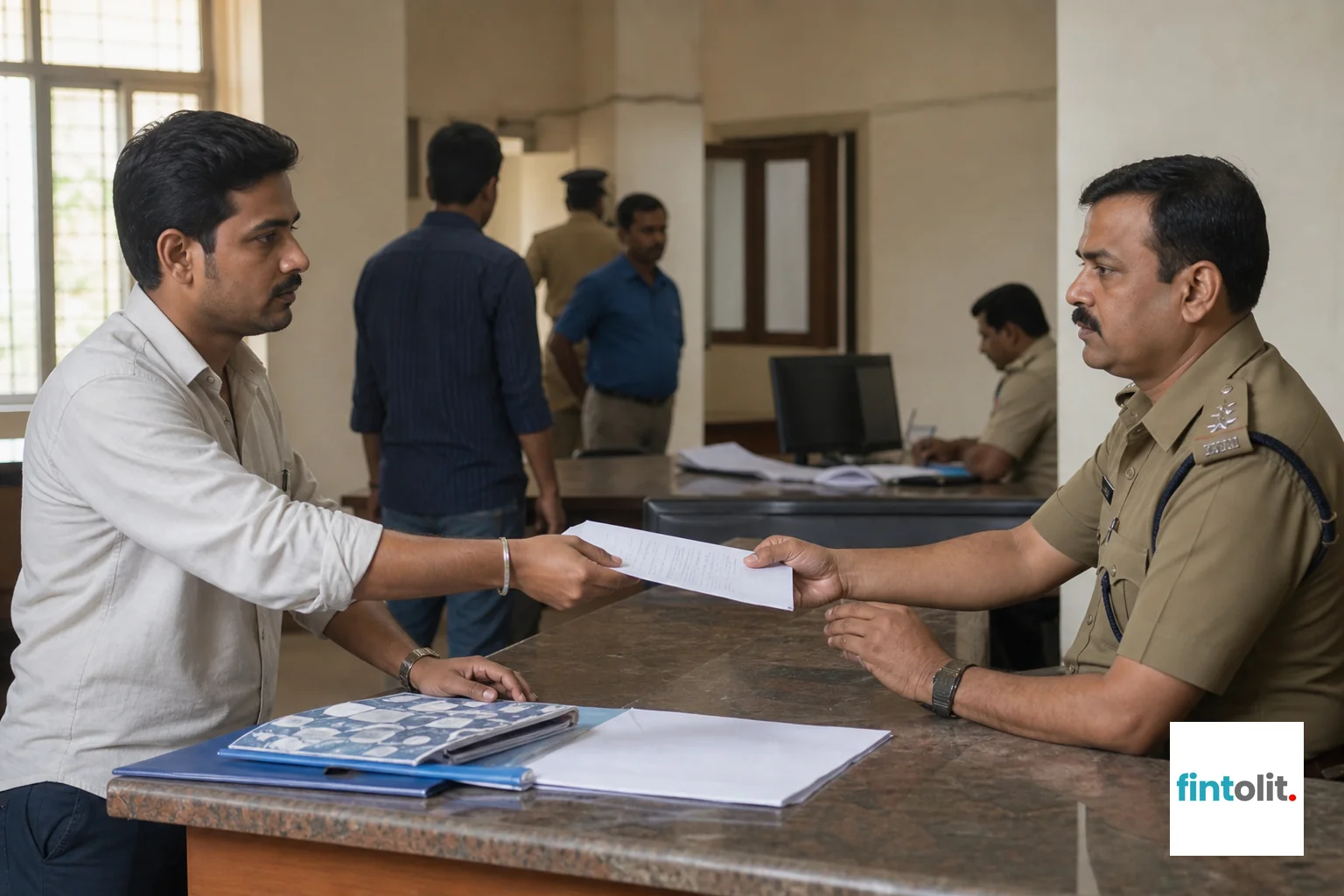
Why Do Police Refuse to File an FIR?
Refusal usually comes wrapped in an excuse, not a flat "no." Officers might say the matter is "civil in nature," that you should try mediation first, or that the crime happened in a different jurisdiction so they can't help. Sometimes it's workload. Sometimes it's pressure from the other party.
None of these excuses hold up legally when the offence is cognizable. Knowing the difference between a genuine jurisdiction issue and a stalling tactic saves you weeks of back-and-forth.
1. Ask for a Written Refusal
If an officer refuses to register your complaint, ask for the refusal in writing. This single step changes everything that follows. Verbal refusals disappear the moment you leave the station; a written one becomes your evidence for the next step.
You're entitled to a copy of whatever you submitted, stamped and signed as received, even if they haven't converted it into an FIR yet. Keep this paper. It's the backbone of your complaint to the SP or the court.
2. Send Your Complaint to the Superintendent of Police
Section 154(3) of the CrPC exists for exactly this situation. If a station house officer refuses to record your FIR, you can send the substance of your complaint in writing, by post or in person, directly to the Superintendent of Police or an equivalent senior officer.
Need a Lawyer for clarity on your case?
The SP then has to either investigate the case personally or direct another officer to register and investigate it. This route works because it puts the refusal on record with someone above the station level, and most SPs move quickly once a written complaint lands on their desk with a clear timeline attached.
Attach copies of your original complaint, the written refusal (if you got one), any evidence like screenshots, medical reports, or witness details, and a clear statement of dates. A vague letter gets a vague response; a specific one gets action.
3. File a Zero FIR at Any Police Station
A Zero FIR means you can walk into any police station in India, regardless of where the crime happened, and they must record your complaint. It's called "zero" because it's given a temporary serial number before being transferred to the station with actual jurisdiction.
This exists because victims shouldn't have to travel across cities before getting help, especially for crimes like sexual assault, accidents while traveling, or cybercrime where the "location" of the offence isn't obvious. If you moved to Gurugram from Lucknow and the incident happened back home, you don't have to fly back to file it.
4. Approach the Magistrate Under Section 156(3)
When both the station and the SP route fail to move things, the next stop is a magistrate. Under Section 156(3) CrPC, a magistrate who has the power to take cognizance of the offence can order the police to register an FIR and start investigating.
This isn't a courtroom drama with witnesses and cross-examination. It's usually a written application supported by your prior complaints, the refusal note, and any evidence you have. The magistrate reviews the paperwork and, if satisfied a cognizable offence is made out, directs the police to act. Getting the wording and documentation right here matters a lot, which is where a lawyer earns their fee instead of costing you time.
5. File a Private Criminal Complaint
Sometimes pushing for an FIR isn't actually the fastest path. Section 200 CrPC lets you file a private complaint directly before a magistrate, who can examine you and any witnesses and issue process against the accused without an FIR ever existing.
This route makes sense when police involvement seems unlikely to help, when the offence is technically non-cognizable, or when you want the matter heard by a judicial officer from day one rather than routed through a station that's already shown reluctance.
Can Police Really Refuse an FIR Legally?
No. For a cognizable offence, refusing to register an FIR is not a discretionary call, and it has real consequences for the officer who does it, including departmental inquiry and, under the Supreme Court's Lalita Kumari ruling, potential contempt or disciplinary proceedings.
The Supreme Court's 2013 constitution bench judgment in Lalita Kumari v. Government of Uttar Pradesh settled this question directly: registration of FIR is mandatory if the information discloses a cognizable offence, and no preliminary inquiry is permitted before that. There are narrow exceptions, matrimonial disputes, commercial disputes, and a handful of others, where a quick preliminary check is allowed, but "we need to verify first" is not a blanket excuse for delay.
When You Need a Lawyer, Not Just Persistence
Persistence gets you far, but drafting an SP complaint that actually gets read, or a Section 156(3) application a magistrate will act on, takes more than a well-meant letter. Wording, attached evidence, and legal citations matter, and getting them wrong can cost you weeks you don't have.
This is where a criminal law consultation actually pays for itself. Fintolit connects you with a verified senior lawyer, someone with 10+ years handling exactly this kind of pushback from local stations across Delhi NCR, Gurugram, and Noida. You get a dedicated case manager who tracks your complaint status so you're not the one calling the station every other day, and the same lawyer stays with your case from the first draft to resolution.
Need a Lawyer for clarity on your case?

If you're also dealing with a property matter alongside a criminal complaint, say a forged document tied to the same dispute, it's worth reading about property dispute rights and remedies in Delhi as well, since the two often overlap. And if you're unsure whether your situation needs a full lawyer or a lighter-touch legal consultant first, this guide on legal consultant vs. lawyer breaks down the difference.
FAQs
Is FIR registration free in India?
Yes, registering an FIR costs nothing. No police officer can legally ask you for money to record a cognizable offence, and any such demand is itself a punishable act under the law.
Can I file an FIR online in Delhi?
Delhi Police allows online reporting for specific offences like vehicle theft and lost property through their official e-FIR portal, but serious cognizable offences like assault or cybercrime still need an in-person or written complaint at a station or to the SP for full registration.
What if the crime happened in another city or state?
File a Zero FIR at your nearest police station regardless of location. The station is legally required to record it and transfer it to the station with actual jurisdiction, so you don't need to travel to file your first report.
How long does the SP have to act after a written complaint under Section 154(3)?
There's no fixed statutory deadline, but most SP offices in Delhi NCR respond within three to seven days once a clear, evidence-backed written complaint is submitted. If there's no response after two weeks, escalation to a magistrate under Section 156(3) becomes the next step.
Getting your FIR registered shouldn't take a fight you have to wage alone. If a station has already refused you once, don't wait to see if a second visit changes anything, get a lawyer drafting your SP complaint or magistrate application the right way the first time. Book a consultation with a verified criminal law specialist through Fintolit and get a dedicated case manager tracking your complaint from day one. You can also chat with us on WhatsApp if you'd rather describe what happened before booking, or book now to lock in a morning or evening slot this week.
You're just getting to the good part.