

If your employer hasn't paid your full and final settlement even weeks after your last working day, you don't have to just wait it out. The fastest fix is usually a written reminder to HR, followed by a formal legal notice, and then a complaint to the labour commissioner if the notice gets ignored. Most companies pay up once a lawyer's signature appears on the letter.
Key Takeaways
- There's no single legal deadline: most companies pay within 30 to 45 days of your last day, but this comes from company policy, not a fixed statute, so check your appointment letter first.
- A written HR reminder often works before a legal notice does: many delays are just administrative backlog, not a refusal to pay.
- A legal notice changes the tone of the conversation: once a lawyer sends it on letterhead, HR teams tend to move it up the priority list because it signals you're ready to escalate.
- The labour commissioner's office is free and faster than court: conciliation often resolves dues within a few months, without filing a full civil suit.
- You can usually claim interest on the delayed amount: a well-drafted notice or complaint should ask for the settlement dues plus interest for the delay period.
At a Glance: Full and Final Settlement Recovery Options
| Step | What It Involves | Typical Time | Cost |
|---|---|---|---|
| Written reminder to HR | Email restating dues and deadline | 1-2 weeks | Free |
| Formal legal notice | Lawyer-drafted letter demanding payment | 15-day response window | Fixed drafting fee |
| Labour Commissioner complaint | Conciliation between you and employer | 1-3 months | Free to file |
| Labour Court case | Formal adjudication if conciliation fails | 6-18 months | Court fees + lawyer fees |
| Civil recovery suit | Applies to dues not covered under labour law | 1-3 years | Court fees + lawyer fees |
1. Confirm Your Settlement Is Actually Overdue
Pull out your appointment letter and any HR exit policy document before you send a single email. Most Indian companies commit to paying full and final settlement within 30 to 45 days of the last working day, but this window comes from internal policy, not a single central law.
Check your relieving letter date against today's date. If you're past the window your own company promised, in writing, you already have grounds to act. If your letter is silent on timelines, 45 days is a reasonable benchmark used across most HR departments in Delhi NCR.
Don't confuse a delayed settlement with a disputed one. If HR has flagged a deduction, a bond clause, or a pending asset return, that's a dispute, not a delay, and it needs a slightly different approach than a straightforward non-payment. If you're unsure which situation you're in, a quick workplace lawyer consultation in Delhi can clear that up in one session.
2. Gather Proof Before You Send Anything
Every claim you make later needs paper behind it. Collect your relieving letter, your final payslip, your appointment letter, and the exit email thread where HR confirmed your last date and settlement amount.
If HR ever quoted a specific figure or a payment date over email or on a company portal, screenshot it. Verbal promises from a manager count for very little once a dispute reaches a notice or a court filing. Written proof is what actually moves your case forward.
3. Send a Written Reminder to HR First
Skip the legal notice on day one. A short, factual email to HR, cc'd to your personal address, restates your last working day, the settlement amount if known, and a firm deadline, usually seven working days.

Keep the tone plain, not angry. Something like: "My last working day was [date]. As per company policy, my full and final settlement was due by [date]. I have not received it. Please confirm the payment date within 7 working days, failing which I will pursue formal legal remedies."
Need a Lawyer for clarity on your case?
Many delays really are backlog, not refusal. This step costs nothing and resolves a surprising number of cases before they ever need a lawyer's letterhead.
4. Draft and Send a Formal Legal Notice
A legal notice for full and final settlement not paid usually works because it demonstrates you're serious, not because of any magic legal phrase inside it. It needs to be specific: your employment dates, the amount owed, the date it became overdue, and a clear deadline, typically 15 days, to pay before further action.
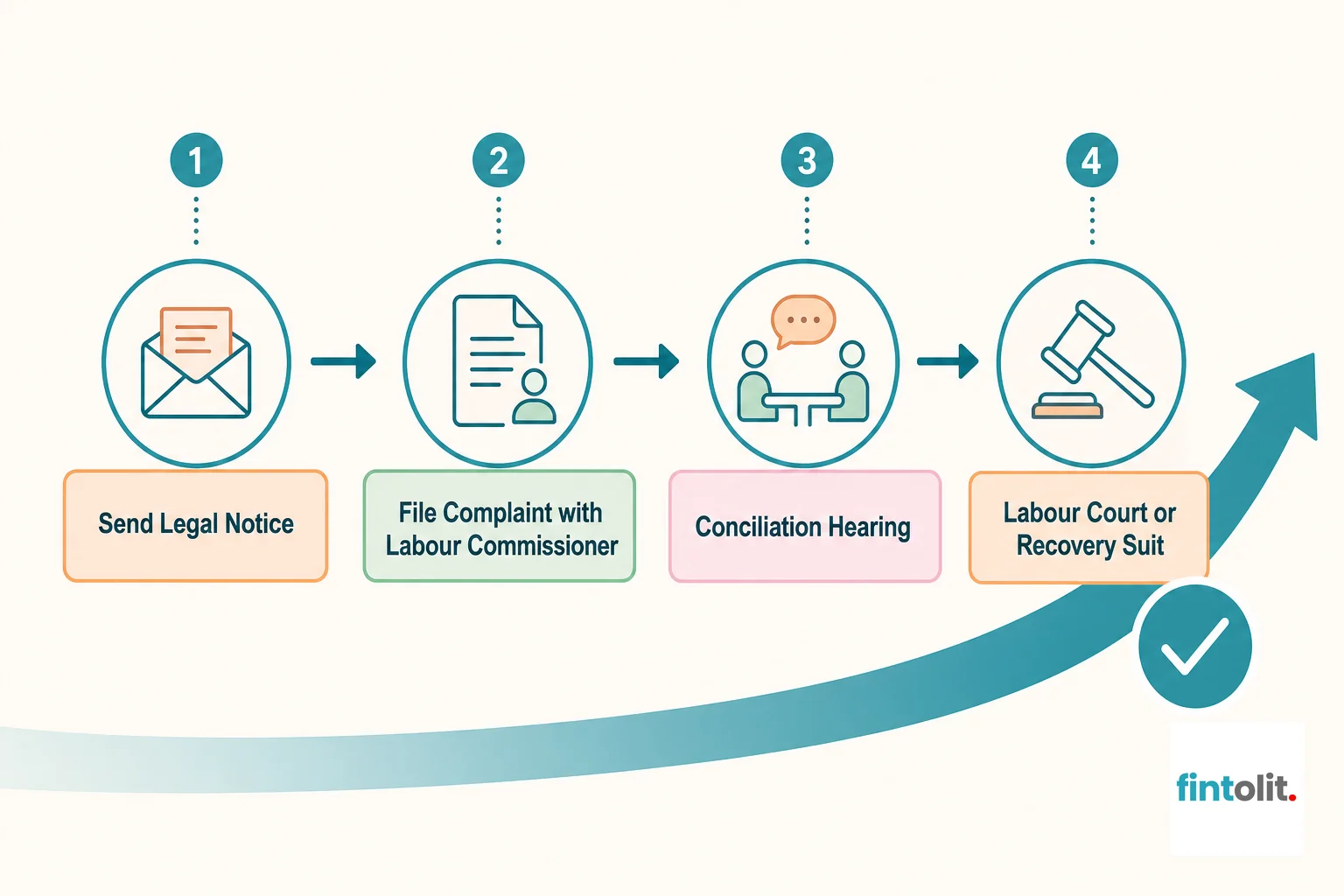
A basic template structure looks like this:
- Sender and recipient details (you and the company's registered address)
- A summary of your employment period and last working day
- The exact settlement amount due, broken down if possible
- Reference to the company's own policy or offer letter clause on settlement timelines
- A demand for payment within 15 days, plus interest for the delay
- A warning that non-compliance will lead to a labour department complaint or civil suit
You can write this yourself, but a lawyer-signed notice tends to get read faster and taken more seriously by a company's legal or HR team. Fintolit connects you with a verified employment lawyer who drafts this on your behalf, with your dedicated case manager tracking the company's response so you're not chasing anyone yourself. If you'd rather talk it through first, you can book a consultation before the notice goes out.
Full and Final Settlement Not Paid: What to Do If HR Disputes the Amount?
Send a written breakdown of your claimed amount immediately and ask HR to specify exactly which line item they dispute. Most amount disputes come down to unclear notice-pay calculations or unreturned company assets, and a clear written breakdown usually resolves the disagreement faster than a phone call.
5. Escalate to the Labour Commissioner or Labour Court
If the 15-day legal notice deadline passes with no payment, your next stop is the labour commissioner's office in your jurisdiction, which in Delhi NCR usually means the local Labour Department or the Sub-Divisional Magistrate's office depending on your employment category.

This step is free to file and starts with conciliation, where an officer calls both sides to the table and tries to settle the dispute without a full case. A large share of settlement disputes end here, because most companies would rather pay up than have a labour department inquiry attached to their name.
If conciliation fails, the matter moves to labour court, where a magistrate hears the case formally. This route takes longer, often 6 to 18 months in Delhi and Gurugram courts, but it carries the weight of a legal order, not just a demand letter.
How Long Can an Employer Delay a Full and Final Settlement Legally?
There's no single national law fixing an exact number of days for full and final settlement. Most employers follow a 30 to 45 day internal norm, and once that window closes without payment or explanation, you already have grounds to send a legal notice.
6. What If the Company Ignores the Legal Notice Too?
Ignoring a legal notice doesn't make the debt go away, it just moves your case to a slower, more formal track. At this stage, you're generally looking at either a labour court case (if your role qualifies as a "workman" under labour law) or a civil recovery suit for the outstanding amount plus interest.
Interest matters more than people realise. A well-drafted claim asks for the principal amount owed plus interest calculated from the date it became overdue, not just a flat demand for the settlement figure. Courts in Delhi NCR routinely award this when the delay is documented clearly.
Recovery suits and labour court cases both take time, often over a year once you account for hearings and adjournments. That's exactly why most people find the legal notice stage, backed by a credible lawyer, resolves things before it ever reaches this point.
Need a Lawyer for clarity on your case?
Full and Final Settlement Not Paid: Common Mistakes to Avoid
- Waiting too long to act: the longer you wait, the harder it gets to prove urgency or claim interest cleanly.
- Relying on verbal assurances: a manager saying "it's coming next week" three times over isn't evidence of anything.
- Sending a vague legal notice: a notice without an exact amount, date, and deadline reads as a bluff, not a real demand.
- Skipping the labour commissioner route: jumping straight to court when a free conciliation process might have settled it faster and cheaper.
- Not keeping copies: every email, notice, and reply needs to be saved somewhere outside your work inbox, since access to that inbox disappears the day you're relieved.
Frequently Asked Questions
Can I claim interest on a delayed full and final settlement?
Yes, you can claim interest for the period your settlement remained unpaid past the due date. Include this explicitly in your legal notice and in any labour commissioner complaint, since courts and conciliation officers rarely add it on their own if you didn't ask.
Do I need a lawyer to send a legal notice for unpaid settlement?
No, you can draft one yourself, but a lawyer-signed notice carries more weight with HR and legal teams and is less likely to be ignored. Given the fixed cost involved, most people find it's worth having a professional draft it correctly the first time rather than risk a weak notice that gets brushed off.
What documents do I need before filing a labour commissioner complaint?
You'll need your appointment letter, relieving letter, final payslip, the legal notice you sent, and any HR correspondence about the settlement amount. Missing documents are the most common reason conciliation hearings get delayed or adjourned.
Is a full and final settlement dispute the same as a wrongful termination case?
No, they're different claims even though they can overlap. A settlement dispute is about money owed after you've already left the job, while wrongful termination questions whether your exit itself was lawful, and the two often need separate legal strategies.
Chasing an employer for money you've already earned shouldn't take months of unanswered emails. Fintolit gives you a verified employment lawyer, a fixed upfront fee, and a dedicated case manager who tracks your notice and follow-up so you're not doing it alone. Book your consultation today and get a clear recovery plan, or chat with us on WhatsApp if you'd rather explain your situation first before committing to anything.
You're just getting to the good part.