

You can recover money from a defaulter legally even without a lawyer's fee upfront panic setting in, but you need proof, a proper notice, and the right court route before you file anything. Most friend-loan disputes in Delhi NCR stall not because the law is weak, but because the paperwork was rushed or skipped entirely.
Key Takeaways
- Proof beats promises: Bank transfer records, a signed IOU, or even a clear WhatsApp acknowledgment carry more weight in court than any verbal assurance ever will.
- A legal notice is step one, not optional: Courts expect you to have given the defaulter a documented chance to pay before you sue, usually a window of 15 to 30 days.
- Choose the right route for your amount: A summary suit under Order 37 CPC moves faster for written debt claims than a regular civil recovery suit.
- Wrong jurisdiction is the top delay cause: Filing in the wrong district court can push your case back by months while it gets transferred or refiled.
- A case manager catches errors before filing: Missing signatures, incomplete notice proof, or unclear amounts are exactly what stalls cases, and a dedicated case manager checks for these upfront.
At a Glance: Money Recovery Checklist
| Item | What You Need | Typical Timeline |
|---|---|---|
| Proof of loan | Bank transfer, UPI record, IOU, or written chat acknowledgment | Collect before notice |
| Legal demand notice | Drafted with amount, date, and repayment deadline | Response window: 15-30 days |
| Court route (written debt) | Summary suit under Order 37 CPC | 6-12 months for a decision if uncontested |
| Court route (cheque given) | Cheque bounce complaint under Section 138 NI Act | 12-18 months typically |
| Jurisdiction | File where defaulter resides or where money was handed over | Checked before filing |
| Case manager support | Document checklist, notice drafting, filing coordination | Assigned from day one |
Why Friends Are the Hardest Defaulters to Chase
Chasing a friend for money feels different from chasing a stranger. You hesitate to send a legal notice because you still see them at family functions or share the same college WhatsApp group. That hesitation is exactly what defaulters count on.
In Delhi, Gurugram, and Noida, we see the same pattern again and again. A friend lends money for a medical emergency or a business setup, gets paid back in small bits for a few months, and then the payments stop entirely. Months pass. The friendship gets awkward. And the money stays gone.
[[]]
Waiting doesn't protect the friendship. It just weakens your legal position, because delayed action can make evidence harder to gather and witnesses harder to reach.
1. Gather Proof Before You Do Anything Else
You cannot recover money from a defaulter legally on the strength of memory alone. Courts want a paper trail, and the good news is most of us already have one sitting in our phones.
- Bank or UPI transfer records: Screenshot the transaction with date, amount, and reference number.
- Written IOU or loan agreement: Even a one-page note with both signatures helps enormously.
- WhatsApp or email acknowledgment: A message where the defaulter admits owing the amount is strong supporting evidence.
- Witness details: Anyone present when the money changed hands, or who has seen the defaulter acknowledge the debt.
Weak proof is the single biggest reason recovery cases drag on. A case manager reviews everything you have and flags gaps early, before a court does it for you.
2. Send a Legal Demand Notice, Not a Personal Message
A legal demand notice must state the exact amount owed, the date it was lent, the repayment deadline you're giving, and a warning that legal action will follow if payment isn't made. This single document does more to move a stubborn defaulter than months of phone calls ever will.
Many people try sending an angry text instead. It rarely works, and it carries no legal weight in court. A properly drafted notice, sent through registered post or a lawyer's letterhead, puts the defaulter on formal record. It also often triggers a settlement before you even need to file a suit.
Need a Lawyer for clarity on your case?
[[ ]]
]]
This is where working with a dedicated lawyer pays off. At Fintolit, the same lawyer who reviews your case drafts this notice, tracks its delivery proof, and advises you on the next step if it goes unanswered. If you'd rather talk this through first, you can book a consultation and get a resolution plan drawn up around your specific situation.
3. Decide Which Legal Route Fits Your Amount
Choosing the right court route matters more than most people realise. A summary suit under Order 37 of the Civil Procedure Code moves faster than a regular civil suit when your claim is backed by a written document, like a promissory note or signed agreement.
If the defaulter gave you a cheque that bounced, that's a separate route entirely, a complaint under Section 138 of the Negotiable Instruments Act. It has real consequences for the defaulter, including possible imprisonment, and it tends to push people toward settlement faster than a civil suit alone.
If there's no written proof at all, you'll likely need a regular civil recovery suit, which takes longer but is still workable with strong circumstantial evidence like transaction records and messages.
Not sure which one applies to your case? A legal case manager can map your documents to the right route before you spend money filing the wrong one.
4. What a Dedicated Case Manager Prepares Before Filing
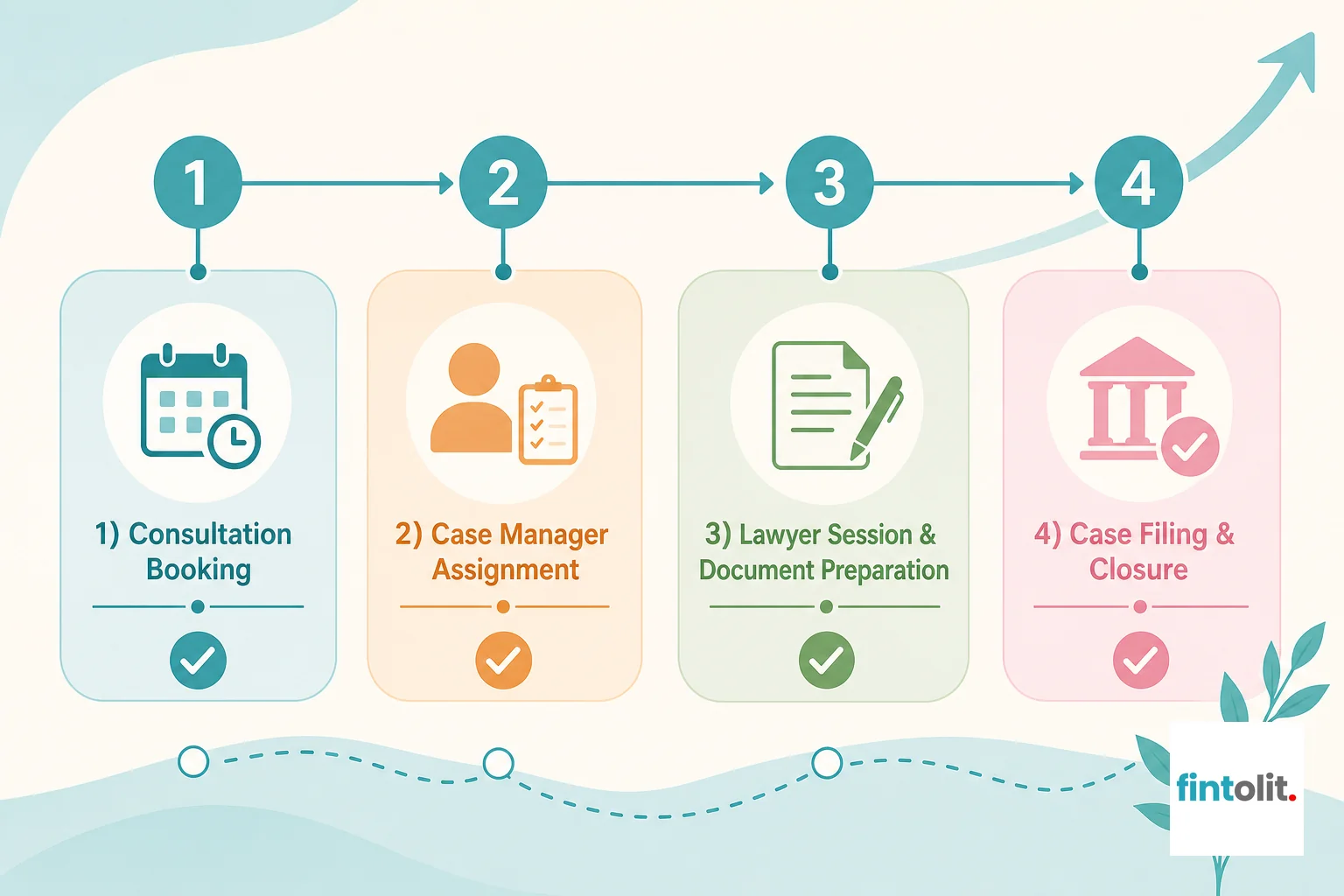
A case manager's job here is simple: make sure your suit doesn't get delayed on a technicality that had nothing to do with your actual dispute. Before filing, they help you assemble:
- Your ID and address proof, matched against how you're named in the notice.
- The loan agreement, IOU, or transaction proof, checked for consistency in dates and amounts.
- Proof that the legal notice was served, such as postal tracking or courier acknowledgment.
- A jurisdiction check, confirming which court in Delhi, Gurugram, or Noida has authority over your case.
- Court fee calculation, based on the exact amount you're claiming.
- A drafted plaint or complaint, reviewed by the same lawyer handling your case from start to finish.
[[ ]]
]]
This is the checklist stage where most self-filed cases fall apart. One missing signature or an unclear jurisdiction claim can send your case back for correction, adding weeks or months. Fintolit assigns one case manager to your file the moment you consult, so nothing gets lost between a call center and a courtroom.
Common Delays That Stall Recovery Cases (and How to Dodge Them)
Most recovery cases don't fail on merit. They stall on process. Here are the delays we see most often in Delhi NCR courts, and how to avoid each one.
- Wrong jurisdiction filed: Filing in a court that doesn't have authority over the defaulter's residence or the place the loan was made forces a transfer, costing months.
- Missing signatures or witnesses: An IOU without a witness signature is weaker proof and invites objections from the defense.
- Incomplete notice service proof: If you can't prove the notice actually reached the defaulter, courts may ask you to resend it and restart the clock.
- Ignoring the settlement window: Some defaulters respond to a notice with a partial payment offer. Ignoring this instead of documenting it properly can complicate your case later.
[[ ]]
]]
None of these are complicated fixes. They just need someone checking the file before it goes to court, not after.
How Long Does It Actually Take in Delhi NCR Courts?
A summary suit under Order 37 CPC can reach a decision in six to twelve months if the defaulter doesn't contest it seriously, while a cheque bounce complaint under Section 138 typically takes twelve to eighteen months given how court calendars run in Delhi, Gurugram, and Noida.
Need a Lawyer for clarity on your case?
Contested cases, where the defaulter fights every hearing, can stretch well beyond these ranges. That's exactly why gathering strong proof and filing correctly the first time matters so much. It's often the difference between a six-month resolution and a two-year ordeal.
Frequently Asked Questions
Can I recover money from a friend without a written agreement?
Yes, you can still recover money without a written agreement, but you'll rely more heavily on bank transfer records, chat acknowledgments, and witness statements to prove the loan existed and the amount owed.
What if the defaulter has moved to another city?
You can still file, but you'll need to confirm their current address for the legal notice and determine the correct jurisdiction, which may now be a different court than where the loan was originally made.
Should I file a police complaint instead of a civil suit?
A police complaint fits fraud or cheating cases, not a straightforward unpaid loan between friends. For most money recovery situations, a civil suit or a cheque bounce complaint is the appropriate legal route, not a criminal one.
Do I need a lawyer to send a legal notice?
You can technically draft one yourself, but a notice sent on a lawyer's letterhead carries more weight with the recipient and is harder to dismiss, which often speeds up a response or settlement.
If a friend still hasn't returned your money after promises and excuses, waiting longer only makes the recovery harder. Fintolit connects you with a verified senior lawyer and a dedicated case manager who handles your notice, your documents, and your filing from the same desk, no handoffs, no guesswork on cost. Learn more about how a legal consultant compares to a lawyer for a case like yours, or see how legal fees in India actually break down before you commit. When you're ready to act, book your consultation and get a clear resolution plan, or chat with us on WhatsApp if you'd rather talk it through first.
You're just getting to the good part.