

A criminal breach of trust case is decided by paper, not panic. The strongest criminal breach of trust case defence india lawyers can build rests on proving there was never real "entrustment," or that whatever happened after was a business dispute, not a dishonest act. Courts want a fund trail, a written agreement, and a witness who saw the handover. Without those, even a genuine allegation collapses.
Key Takeaways
- Entrustment must be documented: Prosecutors have to show the accused actually held property or funds in trust, not just received a payment under a contract.
- Dishonest intent decides the case: A failed business deal is not automatically a crime; the court looks for a deliberate act of misappropriation.
- Civil disputes get dressed up as criminal complaints often: The Supreme Court has repeatedly quashed such cases when the facts show only a broken contract.
- Documents beat statements: Bank records, ledgers, and written agreements carry more weight in court than oral claims from either side.
- Section 316 BNS replaced Section 406 IPC: The offence still carries imprisonment up to five years, or fine, or both, under the current BNS framework.
At a Glance: Evidence That Decides a Breach of Trust Case
| Evidence Type | What It Proves | How Strong in Court |
|---|---|---|
| Entrustment agreement / GPA / MOU | Whether property was actually handed over in trust | High — often decisive |
| Bank statements and fund trail | Where the money went after entrustment | High |
| WhatsApp / email correspondence | Intent and timeline of the dispute | Medium to high |
| Accounting ledgers | Whether misappropriation actually occurred | High, if certified |
| Eyewitness testimony | Confirms entrustment took place | Medium — needs corroboration |
| Forensic accountant's report | Traces complex fund movement | High in financial cases |
| Prior civil suit or notice | Shows the dispute is civil, not criminal | Can lead to quashing |
What Counts as Criminal Breach of Trust Under Indian Law?
Criminal breach of trust needs three things together: someone was entrusted with property, they had control over it, and they dishonestly used it for themselves or someone else. Miss any one of those three, and the charge does not hold, whatever the complaint alleges.
The offence used to sit under Section 406 of the Indian Penal Code. It now lives under Section 316 of the Bharatiya Nyaya Sanhita, and the punishment stays the same: imprisonment that can extend to five years, a fine, or both. The number changed. The test a prosecutor has to meet did not.
Entrustment is the word that does all the work here. It means a relationship of trust existed, not just a transaction. Handing your partner ₹10 lakh to run a joint business is entrustment. Paying a seller for goods that were never delivered usually is not, that's a civil dispute about a broken promise, and courts have said so plainly.
Cheating under Section 318 BNS and theft under Section 303 BNS sit next to breach of trust, and lawyers often see all three thrown into one FIR by a complainant who is angry rather than legally precise.
Is Section 316 BNS (406 IPC) Bailable, and What Does the Bail Process Look Like?
This is usually the second question people ask, right after "am I in trouble." Simple criminal breach of trust under Section 316(1) BNS is generally treated as a cognizable, non-bailable offence, which means the police can arrest without a warrant and bail is not automatic. It has to be applied for before a magistrate, or a sessions court if the magistrate refuses.
Aggravated forms, involving a public servant, banker, or someone acting in their professional capacity, attract longer sentences and are dealt with even more strictly at the bail stage. Because the exact classification and the local bench's practice can shift the strategy, confirm the current bailable status for your specific FIR section with your lawyer before you assume either outcome.
Need a Lawyer for clarity on your case?
In practice, the bail process usually runs in this order:
- FIR is registered under Section 316 BNS (or 406 IPC, if the case predates the BNS switch), and the accused is either summoned or arrested.
- If arrested, an application for regular bail is filed before the magistrate handling the case, or anticipatory bail is filed before arrest if the accused has advance notice of the FIR.
- The court weighs the entrustment evidence, flight risk, and whether the dispute looks civil in nature, the same documentary record described below matters here too.
- If the magistrate refuses, the application moves to the sessions court, and from there, if needed, to the High Court.
Why So Many Breach of Trust Cases Are Actually Civil Disputes in Disguise
A failed business deal gets called a crime more often than the law allows. The Supreme Court quashed exactly this kind of case in a real estate matter, holding that a refundable security deposit paid toward a joint development agreement was not "entrustment" of property at all.

In that case, landowners in Chennai had signed a Joint Development Agreement and executed a General Power of Attorney in favour of a builder, who paid a refundable deposit as consideration for that GPA. When the project collapsed, the landowners filed a criminal complaint.
The Supreme Court held the money was paid as consideration for executing the GPA, not as property entrusted to the builder, so criminal breach of trust simply did not apply. The remedy was civil.
The same principle showed up in the Supreme Court's ruling involving Delhi Race Club (1940) Limited, a party in a case examining when a sale transaction stops being an entrustment once goods change hands and ownership passes.
Once property is genuinely sold or delivered, the relationship generally stops being one of trust unless a special arrangement says otherwise, a distinction the Bombay High Court applied when it quashed an FIR built on that same confusion.
This pattern repeats in family businesses and partnerships too. In one Supreme Court matter involving a partnership dispute over land contribution, criminal proceedings were allowed to continue past the quashing stage because the facts, unlike the JDA case, still showed a plausible dishonest intent, a reminder that outcomes turn on the specific facts pleaded, not on the label the complainant chooses.
What Makes a Case Genuinely Criminal Instead of Civil?
A case stays criminal when the facts show a fiduciary relationship existed and the accused deliberately converted the property for personal use after that trust was created. If the money changed hands as ordinary consideration for a contract, without a separate trust arrangement, it usually stays civil.
The Documentary Evidence That Wins These Cases
Paper wins these cases more often than people expect. A defence lawyer's first job is collecting everything that shows how the money or property actually moved, and why.
- The entrustment document itself: a partnership deed, GPA, MOU, or trust letter that spells out what was handed over and on what terms.
- Bank statements and transfer records: these show whether funds went where the accused says they went, or whether they were used for the stated purpose.
- Written correspondence: emails, letters, and WhatsApp threads that establish the timeline and both parties' understanding of the arrangement.
- Company or personal accounting ledgers: especially in business disputes, ledgers can show the money was accounted for, even if the venture failed.
- Any prior civil notice or suit: if the complainant already sued for recovery of money, that itself supports the argument that this is a civil dispute, not a crime.
Getting this evidence organised early matters more than most people realise. Our dedicated case manager keeps every document, deadline, and hearing update in one place so nothing goes missing between the FIR and the trial.
Need a Lawyer for clarity on your case?
The Testimonial Evidence Courts Actually Weigh
Witness statements matter, but courts treat them as secondary to documents in breach of trust matters. A witness who saw money handed over strengthens the entrustment claim; one who saw it spent strengthens the misappropriation claim. Neither carries weight without something in writing behind it.

Forensic accountants play a growing role in white-collar breach of trust cases, tracing complex fund movement across accounts and shell arrangements. On the defence side, cross-examination usually targets one thing: whether the complainant can actually prove dishonest intent, or only a failed outcome.
As the Bombay High Court noted, mens rea, the dishonest state of mind, has to be shown through clear intent to cause wrongful gain or wrongful loss, not inferred from the fact that a deal simply went sour.
A Hypothetical Case Walkthrough: The Partnership Deposit Dispute
Consider a hypothetical: two friends in Gurugram start an event-management partnership. One partner deposits ₹15 lakh into a joint account for equipment purchases. The venture fails within a year, and the depositing partner files an FIR alleging the other partner misappropriated the funds.
A strong defence here would pull three things fast: the partnership deed defining how funds could be used, bank statements showing the ₹15 lakh actually went toward equipment and vendor payments, and WhatsApp messages where both partners discussed and approved those purchases at the time. Together, that evidence shows the money was spent as agreed, even if the business failed, which is the opposite of dishonest misappropriation.
Without that paper trail, the same facts could look very different to a magistrate hearing only one side's version first. This is exactly why waiting to gather evidence until after an FIR is filed puts the accused at a real disadvantage. Our guide on building a defence early in a cheating or fraud allegation covers the same urgency.
How to Find a Good Lawyer for a Breach of Trust Case in Delhi?
Look for a criminal lawyer with a track record in economic offences, not a generalist who mostly handles matrimonial or property matters. Ask to see their profile and past case types before you pay for a consultation, and confirm they will personally handle your matter from FIR stage to trial.
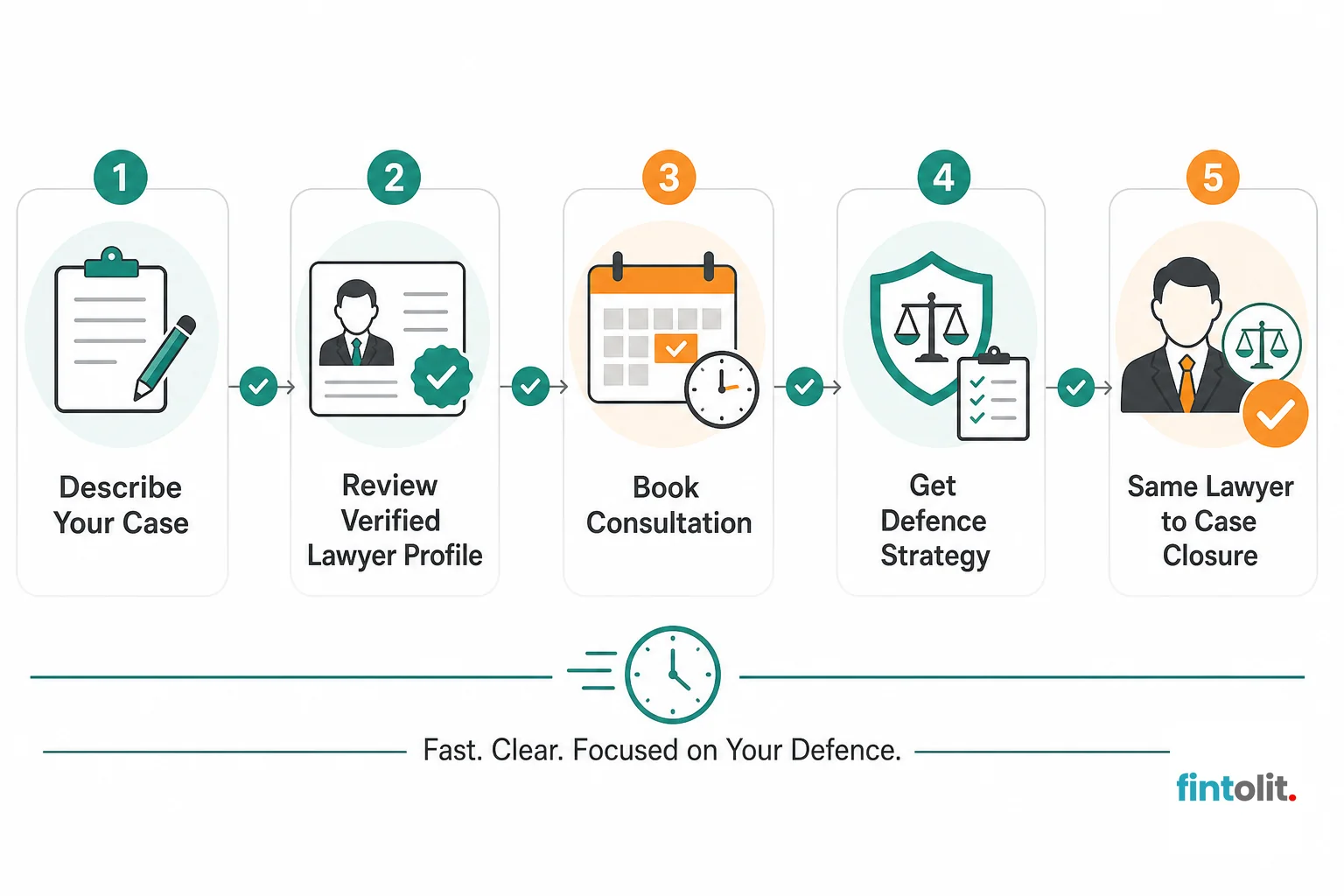
Delhi, Gurugram, and Noida each have their own court timelines and local police practices, so a lawyer familiar with the specific district matters. Fintolit shares a verified lawyer's name and background before you commit to a fee, so you know exactly who is defending you.
You can review how this works in more depth through our guide to choosing the right lawyer for your case in India, or compare formats through online vs offline consultations for six real case types.
What a Strong Defence Strategy Looks Like
Move fast, and move in order. A defence built in the first two weeks after an FIR is filed almost always looks stronger than one assembled after the chargesheet lands.
- Collect every document connected to the entrustment: agreements, receipts, ledgers.
- Pull complete bank statements covering the entire disputed period, not just the flagged transactions.
- Preserve all written correspondence, including deleted chats if recoverable through proper channels.
- Identify witnesses who saw the entrustment or the disputed transaction happen.
- Check whether a parallel civil suit or notice already exists, since that supports a quashing argument.
- Get a specialist criminal lawyer involved before your first police interview, not after.
A case manager who tracks each of these steps against actual court dates removes a lot of the fear that comes with facing an FIR alone.
Frequently Asked Questions
Is criminal breach of trust a serious charge in India?
Yes, it carries real consequences: imprisonment that can extend up to five years, a fine, or both, under Section 316 of the BNS. Aggravated versions involving public servants or bankers carry longer terms.
Need a Lawyer for clarity on your case?
Can a civil dispute be turned into a criminal breach of trust case?
It can be filed as one, but courts routinely quash such FIRs once the record shows only a broken contract or a failed business deal, with no genuine entrustment or dishonest intent proved at the outset.
How long does a breach of trust trial take in Delhi or Gurugram courts?
These cases typically move through several stages: FIR and investigation, chargesheet filing, framing of charges, trial with witness examination, and judgment. Straightforward matters, where the entrustment or the fund trail is clear, can wrap up in under two years once charges are framed.
Contested ones, especially where forensic accounting or multiple witnesses are involved, commonly stretch past that, sometimes running several years given typical Delhi and Gurugram court backlogs. Ask your lawyer where your matter currently sits in that sequence, since the stage you are at tells you more than any average.
What should I do first if I'm named in a breach of trust FIR?
Gather every document connected to the transaction and consult a specialist criminal lawyer before you speak to the police again. Do not destroy or alter any records, that can independently damage your defence.
An FIR alleging breach of trust moves fast, and the paperwork stacks up quickly: entrustment documents, bank statements, correspondence, and now, potentially, a bail application. Fintolit connects you with a verified senior criminal lawyer, backed by a dedicated case manager who tracks every document and deadline for your case.
Book a consultation to get a clear defence strategy built around the actual evidence in your matter, or chat with us on WhatsApp if you need to talk through your situation right now.
Recommended Resources
You're just getting to the good part.