

You get a legal letter with scary sections and a 30-day deadline and just do not know what to do. We've all been there. The urge to call everyone you know or frantically Google things is totally natural, but it's usually where things go wrong.
A legal notice reply is not just a formality. It is your first legal move in what could become a formal dispute. How you respond or whether you respond at all can shape the entire trajectory of the case. Done right, a well-crafted reply can de-escalate the situation, protect your rights, and even shift the balance of power in your favour. Done wrong, it can hand the other party exactly the ammunition they need.
This guide walks you through the strategy behind replying to a legal notice in India, step by step, in plain language, without the jargon.
What a Legal Notice Actually Means (And Why Panic Is the Wrong Response)
A legal notice is basically a formal heads-up sent to someone before taking them to court. Under Section 80 of the Code of Civil Procedure (CPC), it's actually required before suing the government. In private disputes, it's simply a common first step before things escalate legally.
Here is what a legal notice is not: it is not a court summons, not a judgment, and not proof that you have done anything wrong. It is, in essence, an invitation, sometimes a demand, sometimes a warning, to respond before things escalate. The sender is legally required to give you a chance to reply.
Legal notices are extremely common across India. They are sent in property disputes, landlord-tenant conflicts, employment terminations, consumer complaints, business disagreements, and family matters. Receiving one does not mean you are guilty. It means someone has a grievance and has chosen to formalise it.
The right response is not panic. It is a calm, methodical, and strategic reply, drafted with care and, ideally, with professional legal guidance.
1. Read the Notice Carefully Before You Do Anything Else
Before you write a single word in response, read the notice thoroughly, more than once. This sounds obvious, but many people skim it, fixate on the threatening tone, and miss the actual legal substance.
As you read, look for the following:
- Who sent it? Is it from a lawyer on behalf of a client, or directly from an individual or company? A lawyer-drafted notice carries more formal weight.
- What is the legal basis? Which law, section, or agreement does the notice rely on? This tells you what kind of dispute you are dealing with.
- What are the specific allegations? List them out. Some may be accurate, some exaggerated, and some entirely false.
- What is being demanded? Payment, an apology, return of property, cessation of an activity? The demand tells you what the other party actually wants.
- What is the deadline? Most notices give 15 to 30 days for a reply. Missing this window can hurt your position.
One critical point: do not ignore the notice. In Indian courts, silence in response to a legal notice can sometimes be interpreted as an admission of the claims made. Even if you believe the notice is frivolous or baseless, a formal reply is almost always the right move.
2. Understand What You Can Safely Admit vs. What You Must Dispute
This is where many people go wrong, either admitting too much or disputing everything, including facts that are clearly true. Both extremes can damage your position.
What You Can Admit
Admitting undisputed facts is not only acceptable, it is often strategically wise. It shows good faith, keeps the reply focused, and prevents you from looking evasive. For example, if a notice says you entered into a contract with the sender on a specific date, and you did, there is no harm in acknowledging that fact.
Need a Lawyer for clarity on your case?
What You Must Never Admit
The line you must never cross is admitting liability or wrongdoing. There is a significant legal difference between:
- "I acknowledge that a payment of ₹50,000 was due on 15 March." (factual acknowledgment)
- "I accept that I failed to pay and caused you loss." (admission of liability)
The first is a statement of fact. The second is a legal concession that can be used against you in court. Your reply should stick to facts and avoid any language that implies you accept responsibility for the harm alleged.
The 'Without Prejudice' Principle
If you are open to settling the matter, consider marking any settlement-related communication as "Without Prejudice." This legal phrase signals that the communication is made in an attempt to resolve the dispute and cannot be used as evidence of admission in court proceedings. However, use this correctly, a formal reply to a legal notice is typically an open communication, not a without-prejudice one.
If you are unsure where the line falls in your specific situation, this is exactly the kind of question a legal consultation can resolve quickly and clearly.
3. Know the Language That Can Hurt You in a Legal Notice Reply
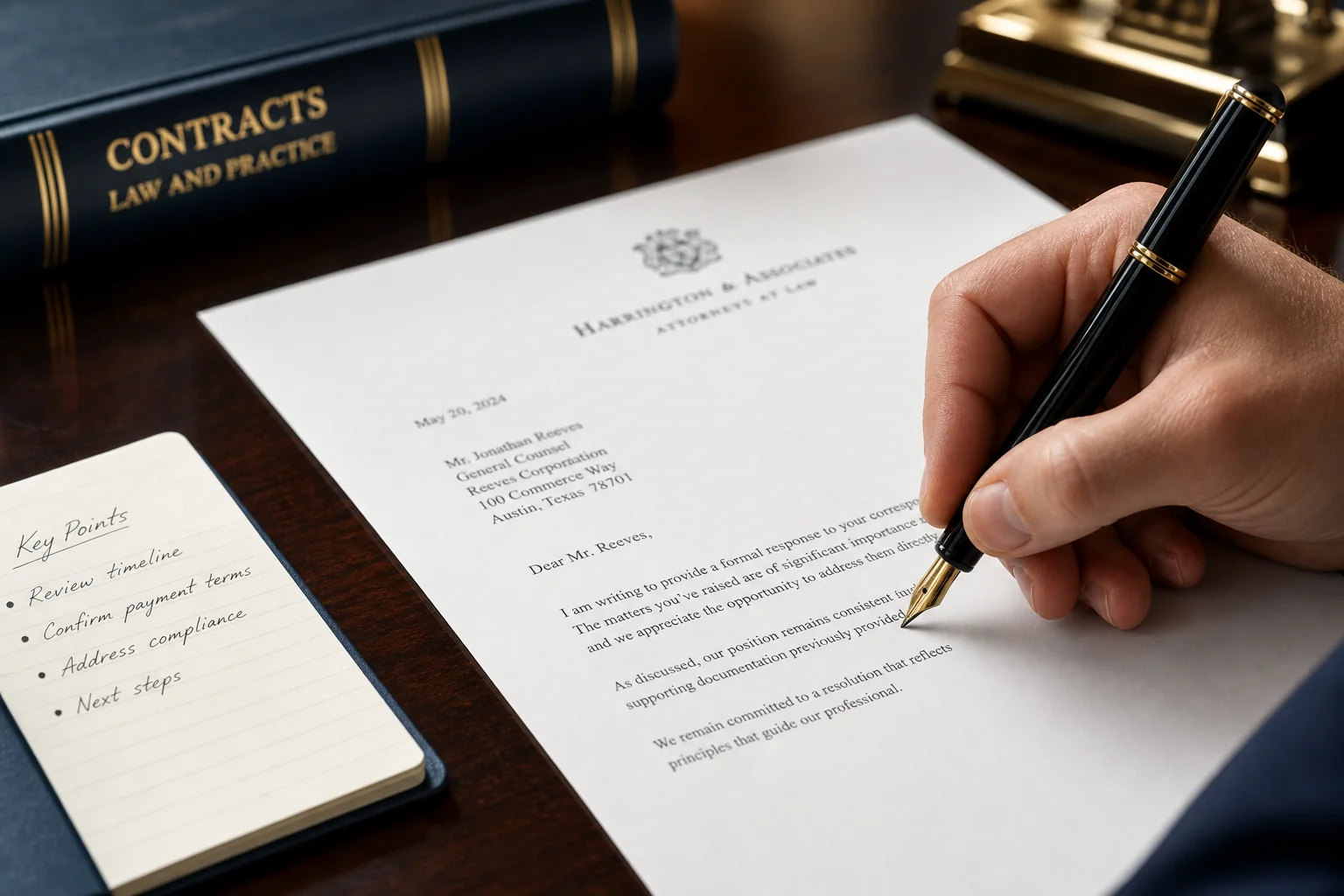
The words you choose in your reply matter enormously. Courts and opposing lawyers read legal notice replies carefully, looking for admissions, inconsistencies, and weaknesses. Certain phrases, even when used casually or politely, can seriously undermine your position.
Phrases to Avoid Completely
- "I'm sorry for the inconvenience caused." This sounds polite, but it implies you accept that you caused inconvenience, which is an implicit admission of fault.
- "I agree that the situation could have been handled better." Again, this concedes that something went wrong on your end.
- "I will try my best to resolve this." Vague promises create expectations and can be cited as commitments you failed to keep.
- "I accept your version of events." Never accept the other party's narrative unless you have verified every detail and it is entirely accurate.
- "I had no choice but to..." This kind of defensive framing can imply guilt even when you were acting within your rights.
Tone Matters as Much as Content
Emotional language, anger, frustration, threats, weakens your reply. Even if the notice is completely baseless and you are furious, your reply must remain factual, formal, and measured. A reply that reads as defensive or aggressive signals to the other party (and potentially to a court) that you are rattled. A calm, point-by-point rebuttal signals confidence and legal preparedness.
Equally, do not make threats you cannot legally back up. Saying "I will sue you for defamation" when you have no clear grounds for a defamation claim can backfire badly.
4. Structure Your Reply Strategically: What to Include Section by Section
A well-structured legal notice reply follows a clear format. Here is how to build it:
Opening: Acknowledge Receipt Without Admitting Claims
Begin by formally acknowledging that you have received the notice. State the date of receipt and the name of the sender's advocate. Do not, in this opening, agree with or validate any of the claims made. A standard opening might read: "I write in response to the legal notice dated [date], received by me on [date], sent on behalf of [sender's name] by [advocate's name]."
Factual Rebuttal: Address Each Allegation Point by Point
Go through the notice's allegations one by one. For each claim, state clearly whether it is:
- Admitted (if it is a neutral, undisputed fact)
- Denied (if it is false or inaccurate)
- Disputed (if it is partially true but misrepresented)
Be specific. Vague denials ("all allegations are denied") are weaker than targeted rebuttals that explain why a claim is wrong.
Legal Position: State Your Rights
Where relevant, cite the legal provisions that support your position. For example, if a landlord is claiming you violated the tenancy agreement, reference the specific clause and explain why your actions were within its terms. If an employer is claiming misconduct, reference the applicable HR policy or the Industrial Disputes Act.
Need a Lawyer for clarity on your case?
Evidence References: Mention What You Have
You do not need to attach all your evidence to the reply, and in many cases, it is strategically better not to. However, referencing the existence of supporting documents (contracts, receipts, emails, photographs) signals that you are prepared and have a strong factual basis for your position.
Closing: Reserve All Rights
End with a standard reservation of rights clause. This signals that your reply does not waive any legal rights you may have, and that you reserve the right to take appropriate legal action if needed. A typical closing reads: "All rights and remedies available to me under law are expressly reserved."
For guidance on how legal documentation is typically structured and priced, see our overview of legal documentation costs in India.
5. When to Counter-Claim or Issue a Notice in Return
Sometimes, the best response to a legal notice is not just a rebuttal, it is a counter-notice. This is appropriate when the party who sent you a notice has also committed a legal wrong against you.
Common Scenarios Where a Counter-Notice Makes Sense
- A landlord sends you a notice for alleged damage to the property, but has been illegally withholding your security deposit for months.
- An employer sends a notice alleging misconduct, but owes you unpaid salary, overtime, or statutory dues.
- A business partner claims you breached a contract, but they were the first to violate its terms.
- A buyer or seller in a property transaction alleges default, but the delay was caused by their own failure to complete documentation.
A counter-notice serves two purposes. First, it puts the other party on notice that you have your own legal claims. Second, it shifts the negotiating dynamic, suddenly, both parties have something to lose, which often creates space for a fair settlement.
Timing matters here. Ideally, a counter-notice is sent alongside or shortly after your reply, not weeks later. Delayed counter-claims can look like afterthoughts.
One important caution: only issue a counter-notice if you have genuine legal grounds. A baseless counter-claim can damage your credibility and, in some cases, expose you to additional liability. This is a decision best made with a lawyer's input. If you are dealing with a workplace-related notice, our guide on workplace legal rights in Delhi covers the relevant protections in detail.
6. Common Mistakes That Weaken Your Legal Notice Reply
Even people who take the notice seriously often make avoidable errors. Here are the most common ones:
Replying Too Quickly
The urgency of a legal notice can push people to respond within hours. Resist this. Take the time to gather your documents, review the facts, and ideally consult a lawyer. A hasty reply full of errors or admissions is worse than a carefully considered reply sent on day 25 of a 30-day window.
Replying Too Late
The flip side: missing the deadline entirely. If the notice gives you 30 days and you respond on day 45, the other party may have already filed a case. Always note the deadline and work backwards from it.
Replying Informally
A WhatsApp message, a casual email, or a phone call is not a legal notice reply. Your response must be a formal written document, sent via registered post or courier with acknowledgment, so there is a documented record of your reply and its delivery.
Over-Disclosing Evidence
Attaching every document you have to your reply is a common mistake. It shows the other party exactly what evidence you hold, giving them time to prepare counter-arguments before any formal proceedings begin. Reference your evidence; do not hand it over.
Drafting It Yourself Without Review
Writing your own reply is not impossible, but it carries real risk. Legal language has precise meanings, and a phrase that seems harmless in everyday speech can carry significant legal weight. At minimum, have a lawyer review your draft before sending it. Platforms like Fintolit's online legal consultation make this fast, affordable, and accessible, you can get a senior lawyer's review without visiting a law firm.
Need a Lawyer for clarity on your case?
Ignoring the Notice Entirely
This is the worst option. Courts have, in various judgments, noted that silence in response to a legal notice can be treated as an implied admission. Beyond the legal risk, ignoring a notice almost guarantees that the matter escalates to formal litigation, which is far more expensive and time-consuming than a well-handled reply.
7. Special Scenarios: Tailoring Your Reply by Notice Type
The core strategy for a legal notice reply stays the same across dispute types, but the specific content and evidence you reference will vary. Here is a quick guide by notice category:
Property Disputes
Reference your title documents, sale deed, possession records, and mutation entries. If the notice involves a boundary dispute or encroachment, mention any survey records or municipal approvals you hold. Property disputes in India often hinge on documentary evidence, so your reply should signal that you have it. For a deeper understanding of property-related legal rights, see our guide to property disputes in Delhi.
Employment and Workplace Notices
Reference your appointment letter, employment contract, HR policies, and any written communications relevant to the allegation. If the notice relates to termination, check whether proper procedure under the Industrial Disputes Act or your contract was followed. Workplace notices often involve procedural violations by the employer, your reply should highlight these.
Consumer and Business Disputes
Gather invoices, delivery records, payment receipts, and the full communication trail. If you are a business owner who has received a notice from a customer, your reply should demonstrate that you fulfilled your contractual obligations or explain any genuine reasons for delay or non-performance.
Family Matters
Family-related legal notices, divorce, maintenance, property partition, require particular sensitivity. Avoid inflammatory language. Stick to facts. Do not make personal attacks on the other party in your reply, even if the notice itself is emotionally charged. Courts look unfavourably on replies that escalate conflict unnecessarily. For guidance on family legal matters, our family lawyer consultation guide is a useful starting point.
Landlord-Tenant Disputes
Reference your rent agreement, rent receipts, and any written communication with the landlord. If the notice alleges non-payment, provide proof of payment. If it alleges damage to the property, document the property's condition with photographs. The terms of your rent agreement are central to your legal position.
Frequently Asked Questions About Legal Notice Replies in India

Do I legally have to reply to a legal notice?
There is no absolute legal obligation to reply to every legal notice. However, in practice, not replying is almost always a mistake. Courts can draw adverse inferences from silence, and failing to reply removes your opportunity to put your version of events on record before any litigation begins.
What happens if I ignore a legal notice?
If you ignore a legal notice, the sender is likely to proceed with filing a case in the appropriate court or forum. You will then have to respond in court, a far more formal, expensive, and time-consuming process than simply replying to the notice. Ignoring a notice does not make the problem go away; it typically makes it worse.
Can I reply to a legal notice myself without a lawyer?
Yes, you can. There is no law that requires a lawyer to draft your reply. However, the risks of self-drafting are significant, inadvertent admissions, incorrect legal references, and poor structure can all weaken your position. For straightforward matters, a lawyer's review of your draft may be sufficient. For complex disputes, having a lawyer draft the reply from scratch is strongly advisable.
How long do I have to reply to a legal notice?
The notice itself will usually specify a deadline, commonly 15, 30, or 60 days. If no deadline is mentioned, a reply within 30 days is generally considered reasonable. Always aim to reply before the deadline. If you need more time to gather documents or consult a lawyer, it is sometimes possible to send a brief acknowledgment stating that a detailed reply will follow.
Need a Lawyer for clarity on your case?
Can a legal notice reply be used against me in court?
Yes. Your reply is a formal document and can be submitted as evidence in court proceedings. This is precisely why the language and content of your reply must be carefully considered. Admissions made in a legal notice reply have been cited in Indian court judgments. Treat your reply with the same seriousness you would treat a court submission.
What if the notice contains false claims?
Deny them clearly and specifically. State that the allegations are false, incorrect, or misleading, and explain why. If you have documentary evidence that directly contradicts the claims, reference it in your reply. In some cases, a notice containing knowingly false claims may itself give you grounds for a counter-claim, for example, under defamation law or for malicious prosecution. Discuss this possibility with a lawyer.
Does the cost of getting legal help for a notice reply vary a lot?
It can. Traditional law firms may charge significantly for drafting a reply, especially for complex matters. Online legal consultation platforms offer more transparent, fixed-fee options. For a clear picture of what legal help typically costs in India, our complete breakdown of legal fees in India is worth reading before you decide how to proceed.
Your Next Step: Don't Face a Legal Notice Alone
A legal notice reply is one of those situations where the difference between a good outcome and a costly one often comes down to the quality of your first response. The strategic choices you make in the next 15 to 30 days, what to admit, what to dispute, what language to use, and whether to counter-claim, can determine whether this matter resolves quietly or escalates into prolonged litigation.
You do not need to navigate this alone, and you do not need to spend a fortune to get expert guidance. Fintolit connects you with verified, senior lawyers across India for affordable, confidential consultations, online or in person at your home. Whether you need a lawyer to review your draft reply, draft it from scratch, or advise you on whether a counter-notice makes sense, you can get that guidance quickly and without the intimidation of a traditional law firm.
Take the first step today. Book your legal consultation with Fintolit and get a clear, strategic plan for your legal notice reply, before the deadline passes.
Prefer to talk it through first? Chat with us on WhatsApp and describe your situation. A dedicated case manager will guide you to the right legal expert for your specific notice type, whether it involves property, employment, consumer rights, or a family matter.
The notice arrived. Now it's your move, make it count.
You're just getting to the good part.