
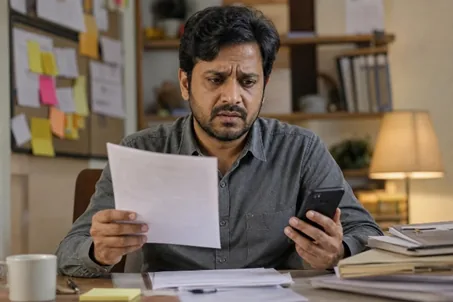
A legal notice lands in your inbox or at your doorstep, and the instinct for many people is to set it aside. It feels like a formality, something to "deal with later," or, worse, something that will simply go away if ignored. It won't.
Ignoring a legal notice is one of the most expensive mistakes a person or business can make in India today. It doesn't make the dispute disappear; it actively works against you, strengthens the other side's case, and often converts a manageable situation into a courtroom battle you didn't need to fight. Here's exactly what happens when a legal notice goes unanswered, and why responding, even with a simple, well-drafted reply, is almost always the smarter move.
First, What a Legal Notice Actually Is
A legal notice is a formal written communication, usually sent through an advocate , informing you of a grievance and giving you a fixed window , typically 15 to 30 days , to resolve it before the sender takes legal action. It could relate to unpaid dues, a contractual breach, a bounced cheque, a property dispute, a consumer complaint, or a workplace grievance.
It is, in effect, a final warning issued through a formal legal channel. What you do in response to it shapes everything that follows.
What Actually Happens When You Ignore It
1. It Becomes Evidence against You
This is the part most people don't realise until it's too late. Courts in India have consistently treated silence in response to a legal notice as an adverse circumstance, not necessarily an outright admission of guilt, but a factor that weighs against you. The Madras High Court has observed in multiple rulings that while non-issuance of a reply to a legal notice doesn't automatically amount to an admission under the Bharatiya Sakshya Adhiniyam (which has replaced the old Evidence Act), it is "certainly an adverse circumstance" that courts can , and do , hold against the recipient when weighing the overall facts of a case.
In plain terms: if you had a genuine defence, courts expect you to have said so when you had the chance. Staying silent looks, to a judge, like you had nothing to say.
2. The Other Side Proceeds Straight to Litigation
A legal notice exists, in part, to demonstrate that the sender attempted resolution before approaching the court. Once the notice period lapses without a response, the sender's lawyer is free to file a suit, initiate a criminal complaint, or take whatever next step the situation demands, and they walk into court with documentary proof that you were given a fair opportunity to resolve the matter and chose not to engage.
3. You Risk an Ex-Parte Decree
If the matter proceeds to a civil suit and you continue to stay unresponsive, failing to appear or file a defence even after being served court summons, the court can pass an ex-parte decree: a judgment delivered in your absence, based entirely on the other side's case. Reversing an ex-parte decree afterward is far harder and costlier than responding the first time around.
The Supreme Court, in Bhanu Kumar Jain v. Archana Kumar, clarified that a person against whom an ex-parte decree is passed does have remedies, they can apply to have the decree set aside, or file an appeal, but both routes require proving valid grounds (such as the summons never reaching them) and involve fresh rounds of litigation, delay, and legal cost that could have been avoided entirely by responding on time.
4. In Cheque Bounce Cases, Silence Is Especially Damaging
Nowhere is the cost of ignoring a notice clearer than in cheque dishonour cases under Section 138 of the Negotiable Instruments Act, 1881. Once a cheque bounces, the holder must send a legal notice demanding payment within 30 days. If the drawer doesn't pay within 15 days of receiving that notice, a criminal complaint can be filed.
Need a Lawyer for clarity on your case?
In the landmark case Rangappa v. Sri Mohan (2010) 11 SCC 441, the Supreme Court held that once the issuance of a cheque and the signature on it are admitted, a strong presumption arises under Section 139 that the cheque was issued for a legally enforceable debt , and the burden shifts entirely to the accused to prove otherwise. Several courts examining cheque bounce disputes have specifically pointed to the accused's failure to respond to the statutory notice as a factor reinforcing this presumption against them. In other words: by staying silent at the notice stage, you don't just lose an opportunity, you actively make the criminal case against you stronger.
A Section 138 conviction can mean imprisonment of up to two years, a fine of up to twice the cheque amount, or both, consequences that often dwarf the original sum in dispute.
5. You Lose Negotiating Leverage
A legal notice usually arrives before positions have fully hardened. Responding, even to dispute the claim, propose a settlement, or request more information, keeps the door open for resolution on your terms. Ignoring it removes you from the conversation entirely. By the time you're forced to respond (often through a court summons), the other side has already invested in litigation, is less inclined to settle, and the costs on both sides have multiplied.

6. Courts Read "No Real Defence" Into Frivolous Silence
In faster-track recovery proceedings such as summary suits under Order XXXVII of the Code of Civil Procedure, the consequences of inaction are particularly severe. The Supreme Court in M/s Mechelec Engineers & Manufacturers v. Basic Equipment Corporation (1976) held that a defendant whose defence is "sham or illusory" , including one who never raised a defence in the first place , is not entitled to delay the plaintiff's decree. The Court reaffirmed this approach decades later in IDBI Trusteeship Services Ltd. v. Hubtown Ltd. (2017), where it laid down that unconditional leave to defend is granted only where a substantial, genuine defence exists. A person who never even responded to the legal notice that preceded the suit starts from a significantly weaker position when trying to convince the court they have one.
How This Plays Out Internationally
For NRI readers, the consequences of ignoring formal legal demands are comparably serious elsewhere. In the United Kingdom, ignoring a "statutory demand" for an unpaid debt over £5,000 for 21 days can allow the creditor to file a bankruptcy petition against you, without further warning. In the United States, failing to respond to a demand letter followed by a lawsuit summons typically results in a default judgment, where the court rules entirely in the claimant's favour simply because the defendant never showed up to contest it. The pattern is universal: legal systems are built to move forward with or without your participation, and silence is read as forfeiting your side of the story.
What You Should Do Instead
- Read the notice carefully and note the exact deadline for response
- Don't respond emotionally or informally , a reply drafted without legal guidance can sometimes concede more than intended
- Get a lawyer to review it immediately, even if you believe the claim is baseless
- Respond within the stipulated time, whether that's a denial, a counter-proposal, or a request for more details
- Keep proof of your response , delivery receipts, acknowledgment, or postal tracking
The cost of a proper legal consultation at this stage is almost always smaller than the cost of the litigation that follows silence.
How Fintolit Helps You Respond the Right Way, the First Time
Receiving a legal notice is stressful enough without having to figure out the right response alone. Fintolit exists precisely for this moment, to make sure you act correctly within the window that actually matters.
Need a Lawyer for clarity on your case?
Fintolit is a DPIIT-certified legal services platform, and every advocate in our network is rigorously vetted, specialists, not generalists, each with 10+ years of active courtroom experience. When you bring us a legal notice, you're connected with someone who has handled this exact situation before, not someone learning on the job with your case.
Here's what you get when you work with Fintolit:
- A dedicated case manager who handles your case personally from start to finish
- A 60-minute consultation with a senior specialist lawyer , flat fee, no per-minute meter
- 15 days of direct lawyer access , reach out anytime within this window and we'll connect you with your advocate for follow-up
- A written consultation summary and legal roadmap , a documented plan for your next steps, not just a verbal opinion
- 24x7 case manager support , so a looming deadline never catches you without help
- Fixed, transparent pricing , no meter, no surprises, complete clarity from the first conversation
- End-to-end support as a one-stop solution, beyond the consultation, Fintolit handles everything your advocate recommends: drafting your reply, filing a counter-notice, representation in court if it comes to that, and follow-through until the matter is resolved
You don't have to become a legal expert overnight. You just need to respond in time, and respond well. We make sure of both.
Visit Fintolit to get your legal notice reviewed before the deadline passes.
Frequently Asked Questions
1. Is it ever safe to ignore a legal notice? No. Even if you believe the claim against you is entirely baseless, ignoring the notice removes your opportunity to put your position on record early. A reply, even a firm denial, protects you far better than silence.
2. What's the deadline to respond to a legal notice in India? There's no single fixed period; it depends on what the notice specifies, commonly 15 to 30 days. For cheque bounce notices under the Negotiable Instruments Act, the law specifies that payment must be made within 15 days of receiving the notice, or a criminal complaint can follow.
3. Can silence on a legal notice be used as an admission in court? Not automatically as a formal admission, but courts have repeatedly treated non-response as an adverse circumstance that weakens the recipient's position, particularly when weighed alongside other evidence.
4. What happens if I ignore a legal notice and a court case is filed against me? If you continue to stay unresponsive after being served court summons, the court can pass an ex-parte decree, a judgment against you, in your absence. Reversing it afterward requires a separate legal process with no guarantee of success.
5. I received a legal notice for a cheque that bounced. What should I do? Respond immediately, ideally with legal help. Under Section 139 of the Negotiable Instruments Act, courts presume the cheque was issued for a real debt once your signature is established, and that presumption only gets stronger if you don't respond to the notice or offer a credible defence.
6. Does responding to a legal notice mean I'm admitting fault? No. A response can deny the claim entirely, dispute the facts, propose a settlement, or simply ask for clarification. What matters is that your position is on record, not that you agree with the sender.
7. Can I draft my own reply to a legal notice without a advocate? You can, but it's risky. A poorly worded reply can unintentionally concede facts, weaken your legal position, or miss procedural requirements that matter later in court. An advocate -drafted reply protects you on both fronts, legally and strategically.
You're just getting to the good part.