
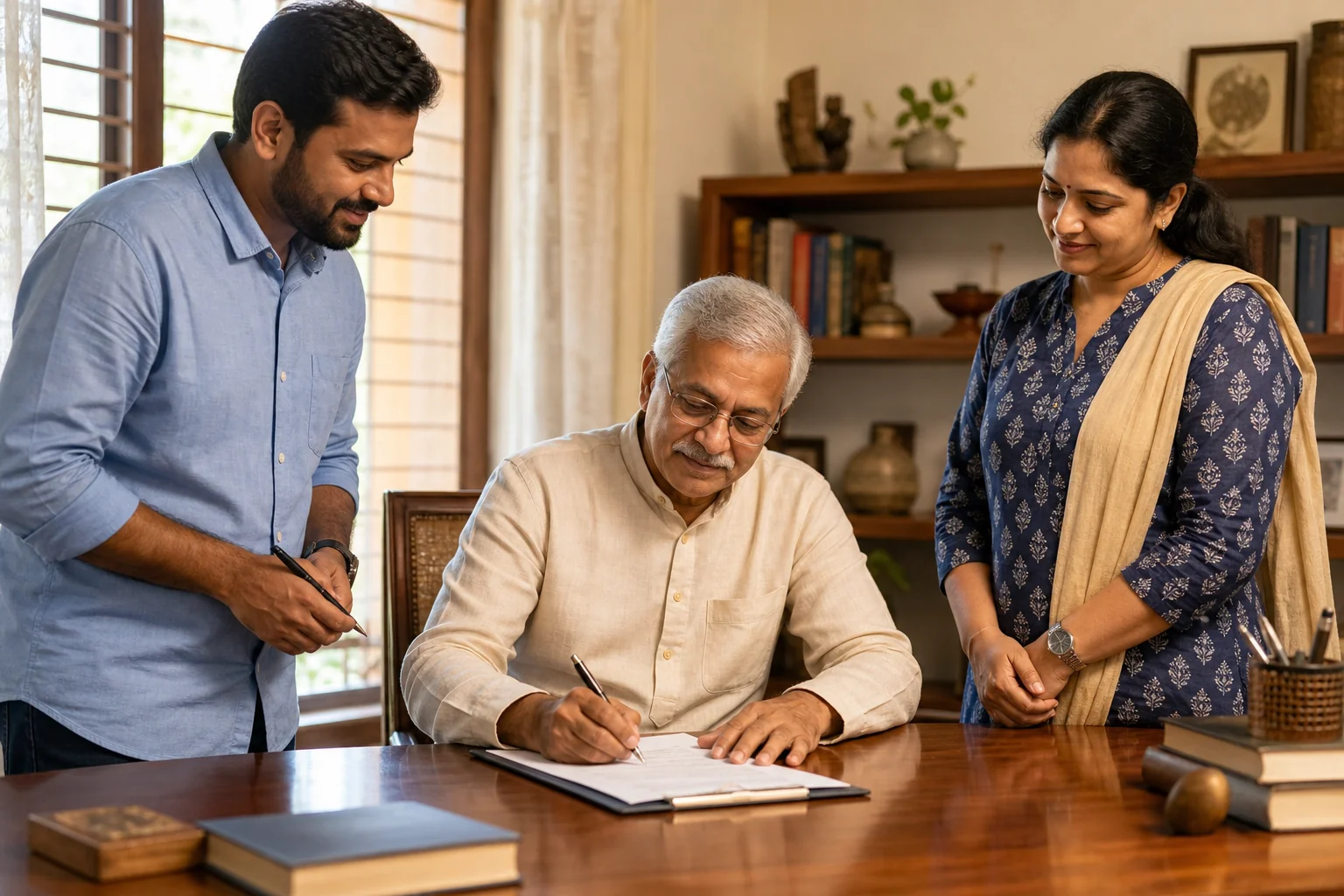
A will is not just a formality for the wealthy or the elderly. It is the one document that decides, in plain terms, who gets what when you are no longer around to explain your wishes. Get it wrong, and your family could spend years and lakhs of rupees fighting in court over something you could have settled in an afternoon.
This guide walks through the exact legal steps to draft a valid will in India, the mistakes that get wills thrown out or challenged, and why having a verified lawyer involved, even for something that seems simple, protects the people you care about most.
Why Most Indians Delay Writing a Will (And Why That's Risky)
Ask around and you will hear the same excuses. "I'm too young." "My family will figure it out." "Writing a will feels like inviting bad luck." These beliefs are common across Indian households, but they leave millions of families exposed to exactly the kind of dispute that destroys relationships and drains savings.
Here is the legal reality: if you die without a valid will, known as dying intestate, your assets get divided according to the succession law that applies to your religion. For Hindus, Sikhs, Jains, and Buddhists, the Hindu Succession Act, 1956 decides who inherits what, and the split rarely matches what the deceased actually wanted. Muslims follow their personal law of inheritance, while Christians, Parsis, and interfaith couples fall under the Indian Succession Act, 1925. In every case, the outcome is decided by a formula, not by your wishes.
In Delhi NCR specifically, where property values have climbed sharply and joint family homes are common across areas like Dwarka, Rohini, and Gurugram's older sectors, intestate succession often triggers exactly the kind of multi-year litigation described above. Siblings disagree over who gets the ancestral house. A widow finds she has to prove her share in court. A second marriage complicates a distribution that could have been crystal clear with one signed document.
Drafting a will is not about assuming the worst. It is about giving your family certainty when they will need it most.
1. Understand the Legal Requirements for a Valid Will in India
Wills in India are governed primarily by the Indian Succession Act, 1925. The good news is that the law does not demand a complicated format. It demands clarity and correct execution. Here is what makes a will legally valid:
- The testator must be an adult of sound mind. Anyone above 18 years old, mentally competent, and acting without pressure or fraud can make a will.
- It must be in writing. India does not recognize oral wills as valid, except in very limited cases for certain religious communities and privileged wills made by soldiers or airmen in active duty.
- The testator must sign or affix a mark. The signature should appear at the end of the document, confirming the testator's intent to give effect to it.
- Two witnesses must attest the will. Both witnesses need to see the testator sign, and they must sign the document themselves. Crucially, a witness should never be a beneficiary named in the will.
- Registration is optional, but strongly recommended. A will does not need to be registered to be valid, but registering it at the Sub-Registrar's office adds a strong layer of legal protection and makes it much harder to challenge later.
One detail people often miss: the requirements shift slightly depending on your religion. Hindus, Sikhs, Buddhists, and Jains largely follow the Indian Succession Act for will-making, but succession without a will follows the Hindu Succession Act. Muslims in India can generally will away only up to one-third of their property under Islamic personal law, unless all heirs consent to more. Christians and Parsis follow the Indian Succession Act in full.
Need a Lawyer for clarity on your case?
2. List and Value Your Assets Before You Start Drafting
Before you write a single clause, sit down and make a complete list of everything you own. This step alone prevents the single biggest reason wills get disputed: assets left out, forgotten, or described so vaguely that nobody can identify them later.
Your list should cover:
Immovable property: flats, plots, ancestral homes, and commercial property, whether in Delhi, Gurugram, Noida, or elsewhere. Note the exact address, registration details, and whether the property is self-acquired or ancestral, since ancestral property follows different succession rules.
Movable assets: bank accounts, fixed deposits, mutual funds, stocks, provident fund balances, gold, and jewelry.
Insurance policies: note existing nominees, since a will can clarify beneficial ownership even where a nominee is already listed.
Digital assets: cryptocurrency holdings, domain names, or monetized online accounts, an increasingly overlooked category.
Business interests: shares in a private company, partnership stakes, or sole proprietorship assets.
Debts and liabilities: outstanding loans or dues, since your estate typically settles these before distribution to heirs.
Being specific here saves everyone pain later. Instead of writing "my flat in Delhi," specify the full address, property registration number, and any co-owners. Courts have overturned or delayed the execution of otherwise well-intentioned wills purely because the property described did not match any real record.
3. Choose Your Beneficiaries and Executor Carefully
Once your asset list is ready, decide who gets what. This is where family dynamics often complicate a straightforward legal task, but clarity here is what prevents future arguments.
A few practical guidelines:
- Name beneficiaries precisely, full legal names, relationship to you, and if possible, identification details like PAN or Aadhaar reference to avoid confusion between people with similar names.
- Appoint an executor you trust completely. This person carries out your wishes, applies for probate if needed, and manages the estate distribution. Many people choose a spouse, adult child, or a professional such as a lawyer or chartered accountant for larger estates.
- Nominate a guardian for minor children, if applicable. Without this clause, courts decide guardianship, which can drag on for months during an already difficult time.
- Include a residuary clause. This single sentence, stating who inherits any asset not specifically mentioned, closes a loophole that causes a surprising number of disputes. People acquire new assets after writing a will and forget to update it. A residuary clause covers exactly that gap.
If your family situation includes step-children, a second marriage, an estranged relative, or a business partner with a stake in shared property, this is precisely where generic online templates fall short. A family lawyer in Delhi who understands succession nuances can help you word these clauses so they hold up if challenged.
4. Draft the Will: Structure and Essential Clauses
With your assets listed and beneficiaries decided, you are ready to draft the actual document. A legally sound will in India typically follows this structure:
- Opening declaration: States your full name, age, address, and a clear statement that this is your last will, made voluntarily and while of sound mind.
- Revocation clause: Declares that this will cancels any previous wills you may have made. Without this, courts may struggle to determine which version of multiple wills applies.
- Asset distribution clause: Lists each asset and names the beneficiary, using the specific details gathered in Step 2.
- Executor appointment clause: Names your chosen executor and, ideally, an alternate in case the first is unable to serve.
- Guardian clause (if applicable): Names a guardian for minor children.
- Residuary clause: Covers any asset not explicitly mentioned elsewhere.
- Signature and attestation block: Space for your signature, the date, and signatures of both witnesses along with their names, addresses, and identification details.
A well-drafted will typically runs two to four pages for a moderately complex estate. It should read in plain, direct language. Avoid vague phrases like "my belongings should be shared fairly" since courts interpret ambiguity strictly, and "fairly" rarely means the same thing to every family member. If you are unsure how to phrase a specific clause, particularly around jointly-owned Delhi NCR property or a family business, a quick legal contract review mindset applies here too: check every clause for ambiguity before you sign.
Need a Lawyer for clarity on your case?
5. Sign, Witness, and Register Your Will
Once your draft is ready, execution matters as much as content. Here is the correct process:
- Sign in front of two witnesses simultaneously. Both must be present at the same time and watch you sign. They then sign themselves, confirming they witnessed your signature.
- Choose witnesses who are not beneficiaries. A witness who also stands to inherit under the will creates a conflict of interest that courts view with suspicion, and in some cases, it can invalidate that person's share.
- Register the will (recommended, not mandatory). Visit the Sub-Registrar's office in your jurisdiction, for instance in Delhi, Gurugram, or Noida, along with your witnesses and identification documents. Registration involves a modest fee and typically takes under an hour. A registered will is far harder to dispute since it is time-stamped and held in government custody.
- Store it safely. Keep the original in a secure location, such as a bank locker or with your executor, and tell your immediate family where to find it. A will nobody can locate is as good as no will at all.
If you own property across multiple cities within the service area, say a flat in Noida and a plot in Gurugram, mention the specific jurisdiction of each asset clearly, since this affects which court would eventually process probate if a dispute arises.
Common Mistakes That Get Wills Challenged in Court
Even well-intentioned wills get contested. Understanding the most common grounds for challenge helps you avoid them entirely.

- Vague property descriptions. "My house" is not enough when a family owns two houses. Always include full addresses and registration numbers.
- Missing assets. A will that lists only some properties invites the argument that the rest should pass under intestate succession rules instead, contradicting your actual wishes.
- Interested witnesses. As mentioned, a witness who benefits under the will creates grounds for challenge.
- No mention of debts or liabilities. This can leave beneficiaries confused about what they are actually inheriting, net of dues.
- Failing to update the will. Marriage, divorce, the birth of a child, a new property purchase, or the death of a named beneficiary should all trigger a review. An outdated will can create as much confusion as no will at all.
- Ignoring religious succession nuances. A Muslim testator bequeathing more than one-third of their estate without heir consent risks that portion being challenged. Similarly, ancestral Hindu property has its own rules that a generic template will not capture.
- Signs of undue influence or unsound mind. Wills made under suspicious circumstances, especially those changed shortly before death or drafted with only one family member present, are frequently challenged under Section 61 of the Indian Succession Act.
If you are worried that an existing will in your family might already carry one of these red flags, or if a dispute has already started, understanding your options early matters. A property lawyer in Delhi can review a contested will and outline realistic next steps before positions harden further.
Why a Verified Lawyer Makes Your Will Court-Proof
Free online will templates are everywhere, and it is tempting to fill one out in twenty minutes and consider the job done. The problem is that a generic template cannot account for your specific property structure, your state's registration process, your religion's succession nuances, or the particular family tensions that might later challenge the document.
A verified lawyer brings three things a template cannot: correct legal language that survives scrutiny, awareness of how courts in Delhi, Gurugram, and Noida have actually ruled on similar disputes, and an outside perspective on clauses that might look fine to you but read as ambiguous to a judge years later.
Need a Lawyer for clarity on your case?
This is exactly the gap Fintolit was built to close. Instead of guessing whether an online template is good enough, or paying unpredictable fees at a traditional law firm, you get matched with a verified, senior lawyer with 10+ years of experience in family and property law. You see their name and background before you pay a rupee, so you always know exactly who is drafting your will. Sessions run as a focused 60-minute consultation, available online from anywhere or through the Lawyer at Home service if you would rather have the conversation in your own living room, which many families prefer for something as personal as estate planning.
You also get a dedicated case manager who keeps you updated at every stage, from the first draft to registration, and the same lawyer handles your case start to finish, so you are never re-explaining your family situation to a new person halfway through. Pricing is fixed and shared upfront, with no hidden charges added after you have already committed. If you want to understand how legal costs typically break down before you commit to any service, this complete cost breakdown of legal fees in India is worth reading first. And if you are still deciding whether professional help is worth it compared to a free template or informal advice from a relative, our comparison of paid lawyer versus free legal advice in India lays out exactly where each approach falls short.
Fintolit currently serves clients across Delhi NCR, including Gurugram, Haryana, and Noida, Uttar Pradesh, covering the exact regions where joint family property and cross-city asset ownership make careful will drafting especially important.
Frequently Asked Questions About Drafting a Will in India
Is it mandatory to register a will in India?
No. Registration is optional under Indian law, but a registered will is significantly harder to dispute since it carries an official time stamp and is held securely by the Sub-Registrar's office. Most lawyers recommend registration for any estate involving property.
Can I change my will after it is drafted?
Yes, and you should whenever your circumstances change significantly. You can revise a will through a codicil, which is a formal amendment, or by drafting an entirely new will that explicitly revokes all previous versions. Keep only one valid, updated copy in circulation to avoid confusion.
What happens if I die without a will in Delhi?
Your estate is distributed according to the succession law that applies to your religion, the Hindu Succession Act for Hindus, Sikhs, Buddhists, and Jains, or the Indian Succession Act for Christians and Parsis, and Muslim personal law for Muslims. This often does not match what the deceased would have actually wanted, and it frequently leads to prolonged disputes among heirs.
Do I really need a lawyer to draft a will, or can I do it myself?
You are legally permitted to draft your own will. The risk is that self-drafted wills, especially those based on generic templates, are more frequently challenged over ambiguous language, missing clauses, or incorrect execution. For estates involving property, business interests, or complex family situations, professional drafting significantly reduces the chance of a future dispute.
How much does drafting a will typically cost in India?
Costs vary widely depending on whether you use a template, a local lawyer, or a legal services platform, and depending on the complexity of your estate. Rather than guessing, it helps to understand the typical range and what drives cost differences before you commit to any option.
Can NRIs draft a will for property held in India?
Yes. NRIs can draft a will for Indian assets, though the process may require additional steps such as notarization abroad or specific attestation depending on the country of residence. It is worth discussing this directly with a lawyer familiar with cross-border succession.
Need a Lawyer for clarity on your case?
A will is not a document you write once and forget. It is a living record of your wishes that should evolve as your life does, updated after marriage, children, new property, or any major change in your family.
Writing a will can feel like an uncomfortable task to start, but it is one of the most caring things you can do for the people who depend on you. It replaces confusion with certainty, and it replaces months of potential court battles with a clear, signed instruction that everyone can trust. Whether you are drafting your first will, updating an old one, or trying to understand a family member's existing document, getting it right the first time matters far more than getting it done quickly.
If you want the peace of mind that comes from working with a verified, experienced lawyer who explains every clause in plain language and stays with your case from start to finish, book your consultation with Fintolit today. You can also chat with us on WhatsApp if you have a quick question before you commit, or simply book now to get a fixed-fee session with a specialist family and property lawyer, online or at your home, anywhere across Delhi, Gurugram, or Noida.
You're just getting to the good part.